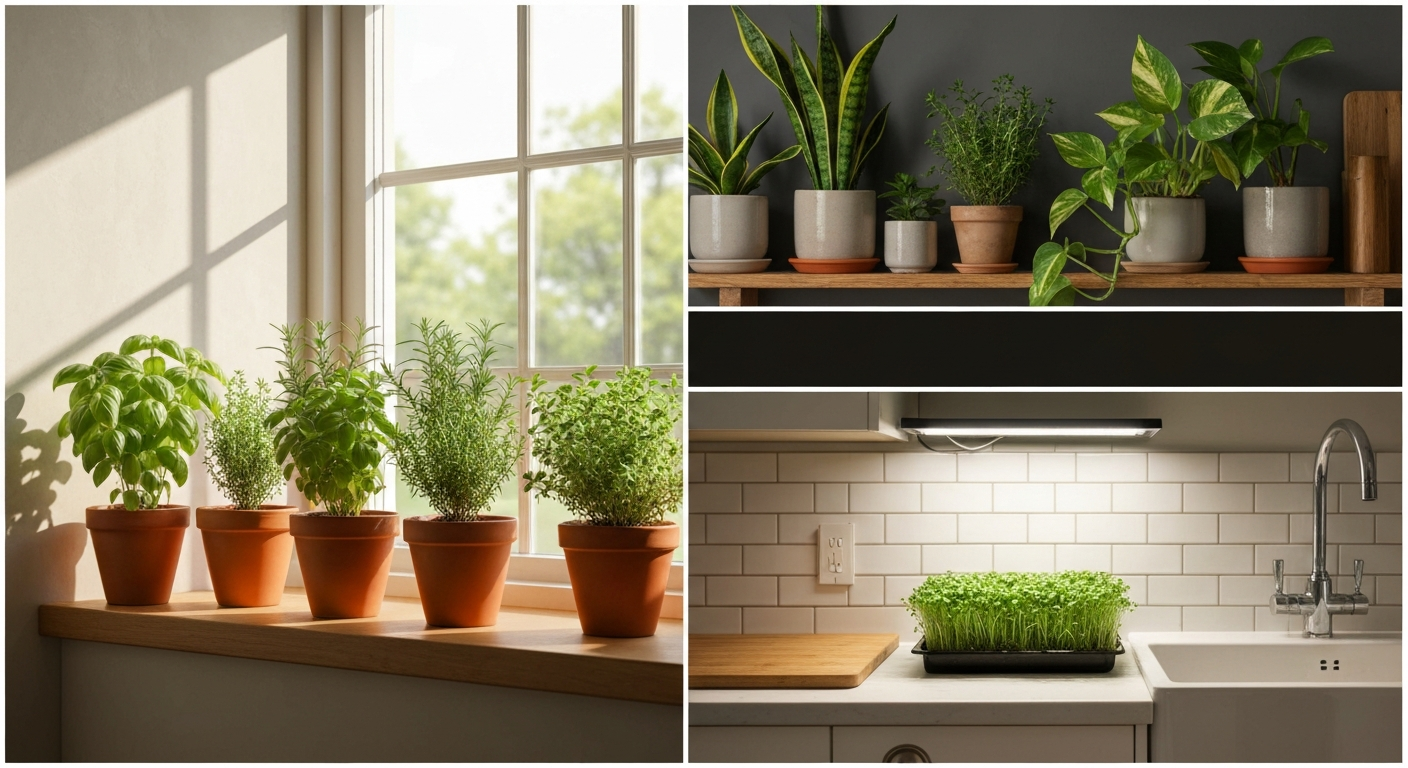
Most kitchens can support a surprisingly wide range of plants, from basil and chives on a sunny south-facing windowsill to pothos and snake plants tucked in a low-light corner. The best picks depend on four things you already know about your kitchen: how much direct light the windows get, how humid it tends to be (especially near the sink or stove), how much counter or shelf space you have, and whether you want something edible or just something green. If you have a bright, sunny windowsill, start with basil, mint, parsley, or a tray of microgreens. If your kitchen is darker, go with pothos, peace lily, or Chinese evergreen. Near the sink or oven where steam and heat build up, mint, lemon balm, and moisture-tolerant tropicals like peace lily thrive. That is the short version. Everything below will help you choose the right plant for your exact situation.
Plants That Can Grow in Kitchen: Best Picks by Light & Goal
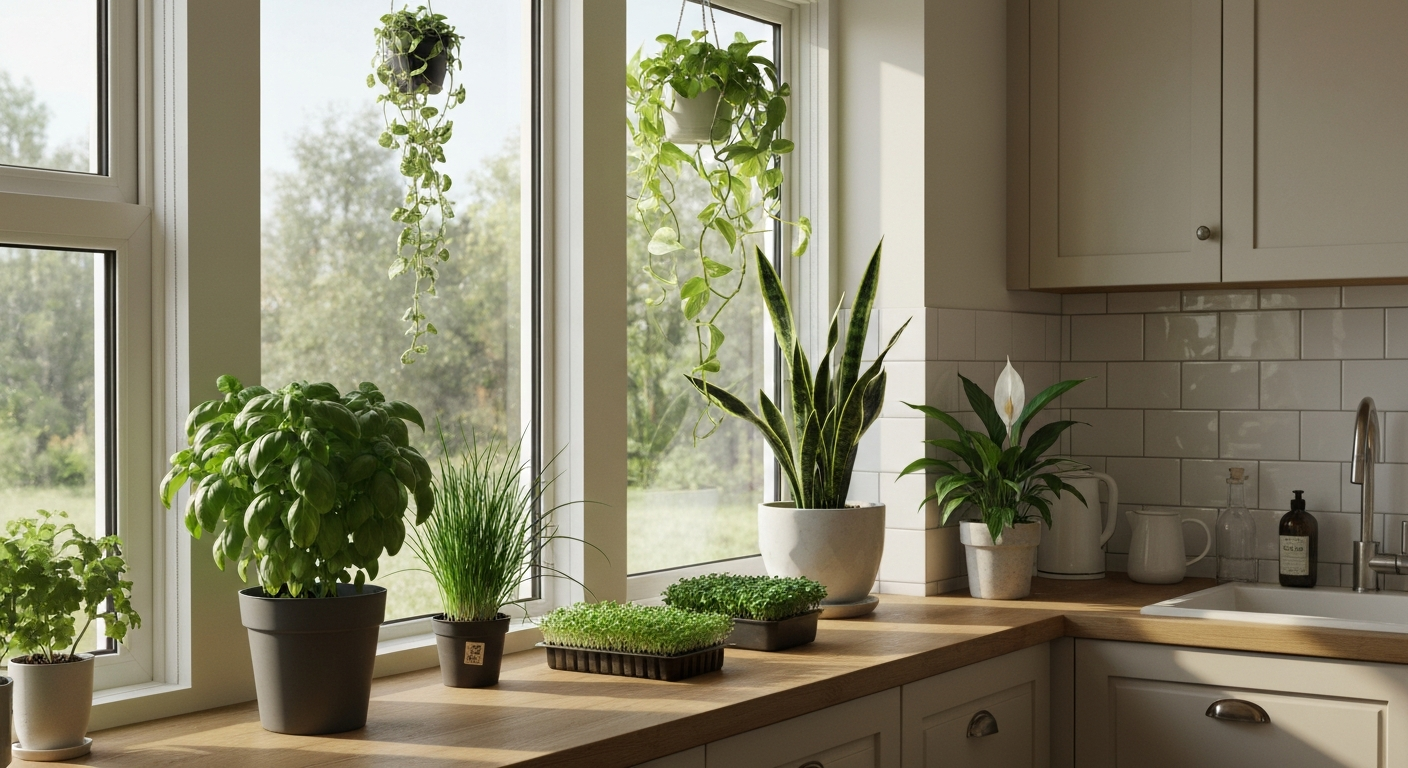
Top plants by kitchen condition at a glance
Before diving into details, here is a fast-reference map of which plants belong where in a typical kitchen. These are the picks I come back to again and again because they actually work in real kitchens, not just ideal growing conditions. For an organized list of the best plants to grow in kitchen with specific recommendations for different spots, see best plants to grow in kitchen.
| Kitchen condition | Best plant picks | Why they work |
|---|---|---|
| Sunny south or west windowsill | Basil, chives, parsley, cilantro, mint, leaf lettuce, microgreens | High-light herbs and greens hit their DLI targets naturally |
| Low-light counter or shelf | Pothos, Chinese evergreen, peace lily, snake plant, ZZ plant | Tolerate 3–6 mol·m⁻²·d⁻¹ DLI; survive at very low PPFD |
| Humid sink or steam zone | Mint, lemon balm, peace lily, spider plant, Boston fern | Prefer 50–70%+ RH; extra moisture prevents drying out |
| Heat near oven or appliances | Basil, rosemary, thyme, aloe vera, snake plant | Warm-season plants and succulents handle ambient heat well |
| Tiny counter or apartment | Microgreens in trays, chives in 4-inch pots, compact lettuce | Shallow trays, small containers, fast harvests under 21 days |
How to pick the right plant for your kitchen
Choosing a kitchen plant is really just a quick decision tree. Work through these five questions and you will land on the right category every time.
- Check your light first. Stand at your window at noon on a clear day. Direct sun patches on the counter mean you have enough light for edible herbs and microgreens. Bright indirect light (no direct sun patch) suits low-light edibles like lettuce and most foliage houseplants. No natural light at all means you need a grow light or you stick with the hardiest ornamentals.
- Estimate your humidity zone. Kitchens near a sink or with a gas stove tend to run 50–60% RH. Most herbs and houseplants are comfortable there. If your kitchen is very dry (below 40% RH, common in winter with central heating), tropical species will struggle without a pebble tray or small humidifier.
- Know your temperature range. Most kitchen herbs like 65–75°F (18–24°C). If your kitchen runs hotter near the oven or a sunny window in July, lean toward heat-tolerant picks like basil, rosemary, and thyme. Cilantro bolts in persistent heat above 75°F, so save it for cooler months or a shaded spot.
- Measure your available space honestly. A standard windowsill holds two to four 4-inch pots side by side. A half-gallon pot is enough for leaf lettuce; basil wants a 1–2 gallon container; a cherry tomato needs at least 5 gallons. If you only have a strip of counter, microgreens in 10x20 inch trays are your most productive option per square foot.
- Decide what you want out of the plant. Edible herbs and greens reward you with harvests but need more light and attention. Ornamental foliage plants are lower maintenance and tolerate neglect better. If you want both — something useful and attractive — mint, chives, and pothos all deliver without demanding a lot.
One more thing worth considering: the season and your region. If it is late July and you live somewhere warm (Texas, California, the Southeast), starting cilantro indoors right now will likely end in bolting within a few weeks because ambient temperatures stay high even inside. Basil, by contrast, loves this moment. In cooler months or northern climates, basil needs a heat mat or a warm windowsill to germinate well. Timing matters even indoors.
Searchable plant lists by condition
Sunny windowsill (4+ hours direct sun daily)
- Basil: fastest-growing culinary herb, ready to harvest in 4–8 weeks from seed
- Chives: nearly unkillable, regrow after cutting, perfect in a 4-inch pot
- Parsley: slower but steady, needs 10–15 mol·m⁻²·d⁻¹ DLI — south window delivers that
- Cilantro: great in cooler months, bolts in heat above 75°F — plant in fall or late winter
- Leaf lettuce: harvestable in 30–40 days, works in a half-gallon pot or tray
- Microgreens (sunflower, radish, peas, kale): harvest in 7–21 days, highest return per inch of space
Low-light kitchen (north window or no direct sun)
- Pothos: thrives at very low PPFD, trails nicely from a shelf or hanging pot
- Snake plant (Sansevieria): tolerates 3–6 mol·m⁻²·d⁻¹ DLI, almost impossible to overwater if drainage is good
- Chinese evergreen (Aglaonema): handles low light and inconsistent watering with ease
- Peace lily: low-light tolerant and humidity-loving, doubles as an air plant near the sink
- ZZ plant: survives serious neglect, no direct sun required
High-humidity zone (near sink, dishwasher, or steam)
- Mint: loves moisture, spreads aggressively — keep it contained in its own pot
- Lemon balm: similar to mint, lemony fragrance, handles steam well
- Peace lily: tropical, prefers 50–70%+ RH, thrives near the sink
- Spider plant: produces offshoots, handles humidity and low light
- Boston fern: needs consistent moisture and humidity, works near a window above the sink
Heat-tolerant (near oven, toaster oven, or warm appliances)
- Basil: a warm-season annual that actually performs better when ambient temperatures stay above 65°F
- Rosemary: Mediterranean herb, heat and drought tolerant, wants full sun
- Thyme: handles heat and dry air, low water needs, compact enough for small pots
- Aloe vera: succulent, loves warmth and neglect, bonus use for minor kitchen burns
- Snake plant: handles temperature swings near appliances without complaint
Small-space and apartment-friendly picks
- Microgreens in 1020 trays: 1–2 inches of substrate depth, reused trays, harvest in under three weeks
- Chives in a 4-inch pot: perpetual harvest, takes up almost no space
- Compact lettuce varieties (e.g., Tom Thumb, Little Gem): fit in a half-gallon container
- Pothos in a hanging planter: takes zero counter space, tolerates low light
- Herb tower or pocket planter: grows 4–6 herb varieties in one vertical column
Growing on a sunny windowsill: edible herbs, greens, and microgreens
A south-facing or west-facing window in summer is genuinely productive growing space. On a clear summer day in most of the continental US, a south windowsill can deliver 15–20 mol·m⁻²·d⁻¹ DLI, which is exactly what basil (target: 15–25 mol·m⁻²·d⁻¹) and cilantro (15–20 mol·m⁻²·d⁻¹) need. Parsley is more forgiving at 10–15 mol·m⁻²·d⁻¹, making it a solid choice even for east-facing windows that only catch morning sun.
Microgreens are the single highest-return option for windowsill space. You plant densely in a shallow tray (1–2 inches of a peat-coir mix works well), and you harvest in 7–21 days depending on the species. Radish and sunflower microgreens are among the fastest. Pea shoots take around 12–16 days and are very forgiving for beginners. You do not need deep containers or lots of soil, a standard 10x20 inch seedling tray with drainage holes and 1.5 inches of a 50/50 peat-perlite mix is all you need.
For edible herbs, container size matters more than most beginners realize. Basil in a 4-inch pot will stall out fast, give it at least a 1-gallon container so the roots have room and the soil holds moisture between waterings. Mint is the one exception: it is so vigorous that it actually does fine in small pots, but keep it separate from everything else because it will colonize any shared container. Leaf lettuce needs about half a gallon per plant, and it appreciates being kept slightly cooler than herbs, so position it a few inches back from the glass if the window gets very hot in the afternoon.
Windowsill placement tips
- Rotate pots a quarter turn every 3–4 days to prevent lopsided growth toward the light
- Keep basil away from cold glass in winter — leaves touching the glass on a freezing night will blacken
- Use a saucer with pebbles and water under pots to raise humidity and catch drainage
- In summer, an afternoon-facing west window can overheat small pots — move them back or use a sheer curtain to diffuse intense direct sun after 3pm
Low-light kitchens and rooms with no windows
A north-facing kitchen, an interior wall counter, or a kitchen with only a small high window is not a lost cause, but it does change what you can grow. Research has shown that some ornamental plants can survive at PPFD levels as low as 6–7 µmol·m⁻²·s⁻¹, roughly equivalent to a dim 500 lux LED overhead. Adaptation of indoor ornamental plants to various lighting levels in growth chambers simulating workplace environments, peer‑review (PMC) reports survival at canopy PPFD ≈6.8 µmol·m⁻²·s⁻¹ (~500 lx white LED) though plants do not thrive blank" rel="noopener noreferrer">Adaptation of indoor ornamental plants to various lighting levels in growth chambers simulating workplace environments — peer‑review (PMC) reports survival at canopy PPFD ≈6.8 µmol·m⁻²·s⁻¹ (~500 lx white LED) though plants do not thrive.. Surviving is different from thriving, though. At those levels, expect slow growth and no meaningful production from edible plants. For truly low-light spaces, the honest best choices are foliage houseplants: pothos, ZZ plant, snake plant, Chinese evergreen, and peace lily. See an expanded list of plants that can grow in bedroom for options particularly suited to sleeping spaces. For cooler, drier indoor spaces, check plants that can grow in air conditioned room for specific varieties tolerant of lower humidity and steady AC temperatures.
If you want edible plants in a low-light kitchen, you need a grow light. This is not a complicated upgrade. A simple LED panel or a clip-on grow lamp positioned 6–12 inches above your plants running for 14–16 hours per day can deliver 150–250 µmol·m⁻²·s⁻¹ PPFD. Iowa State Extension recommends practical photoperiod starting points: 12–16 hours for seedlings and high‑light herbs and 14–16 hours for microgreens, and advises combining photoperiod with PPFD to reach desired DLI targets Iowa State Extension recommends practical photoperiod starting points: 12–16 hours for seedlings and high‑light herbs and 14–16 hours for microgreens; combine photoperiod with PPFD to meet DLI targets.. At 16 hours, that gives you a DLI of roughly 9–14 mol·m⁻²·d⁻¹, which is enough for microgreens (target 9–12 mol·m⁻²·d⁻¹), leaf lettuce (target 12–17 mol·m⁻²·d⁻¹), parsley, and chives. A full-spectrum LED panel in the 45–65 watt range covers a typical counter herb setup without a high electricity cost.
The same principles apply to other low-light rooms in your home. Offices without windows, basement corners, and even bedrooms with only ambient light all follow the same rule: foliage plants survive on very little, but anything productive needs supplemental light. If you are thinking about growing in a basement, the good news is that temperature down there is usually stable and cool, which actually favors lettuce, spinach, and microgreens over heat-loving herbs. A 2x4 foot grow rack with LED strips is a practical basement setup for year-round greens.
Best low-light foliage plants for dark kitchens
- Pothos (Epipremnum aureum): trails from shelves, tolerates irregular watering, nearly indestructible
- ZZ plant (Zamioculcas zamiifolia): slow-growing but handles the darkest corners; drought-tolerant
- Snake plant (Dracaena trifasciata): upright, sculptural, tolerates 3–6 mol·m⁻²·d⁻¹ DLI
- Chinese evergreen (Aglaonema): colorful foliage, handles low PPFD and low humidity
- Peace lily (Spathiphyllum): blooms in low light, prefers higher humidity near the sink
Humidity- and heat-loving plants for the sink and oven zones
The area directly above or beside the kitchen sink is one of the most underrated growing spots in the house. Steam from washing dishes, the dishwasher venting, and the natural splash zone push humidity up to 55–70% RH in a typical kitchen, well within the preferred range for most houseplants (40–60%) and especially good for moisture-loving tropicals that want 70–80%.
Mint is my go-to recommendation above the kitchen sink. It loves the extra humidity, grows fast, and you use it constantly in cooking. Put it in a 4-inch pot, give it whatever light comes through that window, and cut it back by a third every couple of weeks to keep it bushy. Lemon balm behaves the same way and smells incredible. For ornamental options, peace lily handles the combination of lower light and higher humidity better than almost any other plant.
Near the oven or on a counter adjacent to high-heat appliances, the dynamic shifts. Temperatures can regularly exceed 80–85°F (27–29°C) in those zones. Basil, rosemary, and thyme are all Mediterranean or warm-climate plants that genuinely prefer warm conditions. Aloe vera is also an excellent choice here, it is extremely heat and drought tolerant, and having it in the kitchen has the practical bonus of the gel being immediately accessible for minor burns. What you want to avoid near appliances is anything cold-sensitive or that needs consistent moisture: cilantro, ferns, and baby seedlings will suffer.
Placement and ventilation tips for humid and hot zones
- Do not place any plant directly above the oven or in a position where steam hits the foliage constantly — this invites fungal disease
- Leave 6–8 inches of clearance between plants and the stovetop; heat and cooking fumes can scorch leaves
- If your sink window is north-facing, supplement with a small LED clip light — moisture-loving foliage plants will still thrive without it, but mint and herbs need more light to stay productive
- Check soil moisture more frequently near heat sources — pots near the oven dry out 30–50% faster than pots in cooler spots
- Use a terracotta pot near high-heat zones rather than plastic — terracotta breathes and prevents root rot from heat-driven overwatering
Small-space and apartment kitchen solutions
If your kitchen counter space is measured in inches rather than feet, you need a different approach to growing. The key insight is that dense, fast-turnover crops give you far more return per square inch than traditional potted herbs. Microgreens grown in a 10x20 inch tray give you a full harvest in under three weeks and then the tray is free for the next batch. A chives plant in a single 4-inch pot will produce cuttings indefinitely and never needs repotting for a year or more.
Container and tray options
For container sizing, Virginia Tech's container vegetable guidelines give useful minimums: leaf lettuce works in a half-gallon pot, radishes need as little as a 1-pint container, and cherry tomatoes (if you are ambitious) need at least a 5-gallon container, though dwarf varieties like Tumbling Tom can manage in 1 gallon. Sticking to herbs and greens keeps your container sizes manageable and your footprint small. A windowsill bar (a narrow shelf mounted inside the window frame) can double your windowsill growing space without taking up counter space at all.
Hanging baskets and vertical planters
Hanging baskets are underused in kitchens. A single 8-inch basket filled with trailing herbs like thyme, oregano, or a trailing variety of mint uses zero counter space and looks attractive. Vertical pocket planters (fabric or plastic wall-mount panels with individual pockets) let you grow 6–12 herb varieties on a single wall panel. The limitation is watering, you need to check soil moisture more frequently in vertical setups because individual pockets dry out faster than larger containers.
Compact hydroponics for apartment kitchens
Small hydroponic systems have become genuinely practical for apartment kitchens. The simplest approach is the Kratky method: a lidded opaque container (a 5-gallon food-safe bucket or even a mason jar works), nutrient solution mixed to an EC of 1.2–2.0 mS/cm at a pH of 5.5–6.5 (Penn State Extension recommends keeping hydroponic pH in the 5.0–7.0 range), and net pots with seedlings suspended in the lid. No pump, no electricity, no moving parts. This works well for lettuce and herbs in a single harvest cycle. For lettuce, a Kratky setup can go from transplant to harvest without any reservoir changes, University of Minnesota Extension notes that this 'set-and-forget' approach suits short-lived crops. For longer crops like basil, plan to top up the reservoir with fresh nutrient solution as roots absorb it. Use opaque containers to prevent algae, and clean the system between cycles.
Growing in bathrooms and windowless bathrooms
Bathrooms are a different challenge than kitchens, but many of the same principles apply. The key difference is that bathroom humidity swings dramatically, from very high (70–90%+ RH during showers) to moderate when the room sits unused, and light is often limited to a single frosted window or none at all. For specific recommendations on the best plant to grow in bathroom, see our guide to the best plant to grow in bathroom. This makes moisture-tolerant, low-light plants the obvious starting point.
Best species for bathrooms with natural light
- Peace lily: thrives in the high post-shower humidity, tolerates low indirect light well
- Spider plant: handles humidity swings and indirect light, produces baby offshoots reliably
- Boston fern: loves bathroom humidity, but needs bright indirect light — not for windowless rooms
- Pothos: one of the only plants that genuinely does well in both low light and variable humidity
- Orchids (Phalaenopsis): enjoy the humid bathroom environment and indirect light from a frosted window
Windowless bathrooms: substituting for natural light
A bathroom with no window is a real constraint. Without any natural light, your options narrow to the most shade-tolerant houseplants, and even those will eventually decline without some supplement. A small full-spectrum LED bulb in the overhead fixture (or a plug-in LED panel) running on a timer for 12–14 hours per day can keep peace lily, pothos, and Chinese evergreen healthy indefinitely. For a quick checklist of species suited to windowless baths, see what plants can grow in a bathroom without windows. ZZ plants and cast iron plants (Aspidistra) are probably the two most genuinely tolerant of very low PPFD, they can persist with minimal decline at light levels that would kill most other plants.
Managing mold in high-humidity rooms
Mold on potting mix surfaces is the most common problem in humid rooms, and it is almost always a watering issue rather than a humidity issue. In a bathroom, pots stay moist much longer because evaporation is slower. Water less frequently than you think necessary, check 2 inches below the soil surface before watering. Use a potting mix with good drainage (a 50/50 peat-coir and perlite blend dries more evenly than dense all-purpose mixes). Terra cotta pots breathe better than plastic in high-humidity rooms. If you do see white or gray surface mold, scrape the top layer of mix, let the surface dry, and improve airflow. A small fan running intermittently is one of the most effective mold-prevention tools in any humid growing space.
Soil, watering, and fertilizing basics
Most kitchen plant failures come down to one of three things: wrong potting mix, overwatering, or no fertilizer after the first few weeks. Get these right and most plants sort themselves out.
For potting mix, use a peat-lite style blend: roughly 50% peat moss or coir plus 50% perlite or vermiculite. This is the standard recommended by university extension programs and it works because it drains well, holds enough moisture, and has a low pathogen load compared to garden soil or dense commercial mixes. Avoid using soil dug from outdoors in containers, it compacts, drains poorly, and often carries pests. For microgreens specifically, straight coir or a 70/30 coir-perlite mix works well in shallow trays.
Watering frequency depends entirely on pot size, plant type, and room temperature. A small pot in a warm spot near an oven may need water every day in summer. A large pot with a snake plant in a cool low-light corner may only need water every 10–14 days. The only reliable method is the finger test: push your finger 1–2 inches into the mix. If it is still moist, wait. Most herbs want to dry out slightly between waterings. Most tropical foliage plants (pothos, peace lily) prefer to stay consistently moist but never waterlogged.
Fertilizing is where most kitchen growers underperform. Potting mix comes with nutrients that run out in 4–6 weeks. After that, your herbs and greens are living on what you give them. A balanced liquid fertilizer (something like a 5-1-1 or 3-1-2 NPK ratio) diluted to half strength and applied every two to three weeks during active growing keeps herbs productive. Foliage houseplants need much less, a slow-release granule added every few months is plenty. In winter, when light levels drop and most plants slow down, cut fertilizing roughly in half or stop entirely until growth picks back up in spring.
Troubleshooting common kitchen plant problems
| Problem | Most likely cause | Quick fix |
|---|---|---|
| Yellowing leaves on basil | Overwatering or poor drainage | Check that drainage holes are clear; let soil dry slightly before next watering |
| Leggy, stretched herbs | Not enough light | Move closer to window or add a grow light at 150–250 µmol·m⁻²·s⁻¹ for 14–16 hours |
| White mold on soil surface | Overwatering in low-airflow conditions | Scrape surface, reduce watering, improve airflow with a small fan |
| Brown leaf tips on foliage plants | Low humidity or fluoride in tap water | Use filtered or rain water; place pot on a pebble tray with water |
| Cilantro bolting quickly | Too warm or too much light | Move to a cooler spot (below 70°F); grow in fall/winter or use a shaded position |
| Fungus gnats in potting mix | Staying too wet; decaying organic matter near surface | Let soil dry thoroughly between waterings; use a sticky yellow trap; top-dress with a layer of sand |
| Mint taking over other plants | Aggressive root spread | Grow mint in its own isolated pot; do not plant it in shared containers |
| Microgreens not sprouting evenly | Uneven moisture or old seed | Pre-moisten substrate before seeding; use a humidity dome for the first 2–3 days |
Harvesting, propagating, and keeping the cycle going
Harvesting correctly extends the productive life of kitchen herbs significantly. For basil, always cut just above a leaf node (the point where leaves branch off the stem). Never take more than a third of the plant at once. This forces the plant to branch out rather than bolt toward seeds. Basil harvested this way from a single 2-gallon pot can keep producing for 3–5 months in good light conditions. Mint and chives can be cut back more aggressively, they regrow from the base and actually benefit from a hard cut every few weeks.
Propagating from cuttings is one of the most practical skills for a kitchen grower. Basil, mint, lemon balm, and rosemary all root easily in a glass of water on the windowsill. Cut a 4–6 inch stem, remove the lower leaves, place it in water, and roots usually appear in 1–2 weeks. Pothos and spider plant produce offshoots you can pot up directly. This means you can keep a continuous supply of plants without buying new ones every season.
For microgreens, the cycle is naturally self-renewing as long as you keep fresh seed on hand. After harvesting one tray, rinse it out, refill with fresh mix, reseed, and you have the next batch underway within minutes. Staggering two or three trays by a week each means continuous harvests rather than a feast-or-famine cycle. Radish, sunflower, and pea are the easiest to keep cycling. Basil microgreens are more demanding, Virginia Tech's microgreen production guidance suggests starting basil microgreens at around 231 µmol·m⁻²·s⁻¹ for the first phase and increasing to around 300 µmol·m⁻²·s⁻¹ for the final three days for best flavor development. That level of precision is for enthusiasts, but even a basic grow light setup will give you decent basil microgreens.
A simple starting schedule for new kitchen growers
If you are starting today (late July), here is a practical first-month plan based on what actually works in real kitchens right now. Late summer is a great time to start basil, mint, and microgreens indoors. It is too warm for cilantro unless you have a cool spot or air conditioning running strongly, save cilantro for September or October.
- Week 1: Buy or start one basil plant in a 1-gallon pot on your sunniest windowsill. Start one tray of radish or sunflower microgreens in a 1020 tray on the counter.
- Week 2: Harvest your first microgreens (radish should be ready). Start a second tray to keep the cycle going. Check your basil daily and water only when the top inch of soil feels dry.
- Week 3: Take your first basil cutting just above a node to encourage branching. If your kitchen is low-light, this is the week to evaluate whether you need a grow light — if your basil is stretching toward the window and looking pale, you do.
- Week 4: Add one low-maintenance foliage plant (pothos or snake plant) for any darker corner or shelf. Start a pot of chives — they take about 3 weeks to produce cuttings and will last indefinitely.
- Month 2 and beyond: Expand to parsley or leaf lettuce if your windowsill light is working well. Try a Kratky hydroponics setup for lettuce if you want more production without more counter space.
FAQ
Which plants reliably grow in a typical kitchen windowsill with bright, indirect light?
Bright, indirect windowsills (DLI ≈10–20 mol·m⁻²·d⁻¹) support: edible herbs — basil, parsley, chives, cilantro (with cool conditions), oregano, thyme; compact vegetables — leaf lettuce, baby kale, dwarf chard, small radishes; microgreens — arugula, broccoli, sunflower; humidity‑loving foliage — pothos varieties, philodendron; pet‑safe options — basil, parsley (verify species). Use 1–4 L (½–1 gal) pots for small herbs, 1–5 gal for larger herbs or dwarf tomato/pepper.
What can I grow in a low‑light/no‑window kitchen, office, or basement?
In low light (DLI <4–6 mol·m⁻²·d⁻¹) prioritize ornamental tolerant species and non‑productive edible options unless you add lights. Good choices without supplemental light: snake plant, ZZ plant, pothos, cast‑iron plant, Chinese evergreen. For edible production in these spaces, use LED grow lights (see lighting Q&A). Microgreens or seedlings under lights are much more feasible than fruiting crops.
How should I choose what to grow given my light, humidity, temperature, space, season and goal?
Decision rules: 1) Measure light: bright window (south/east/west) vs. low light. If unsure, assume medium if you see clear shadows midday. 2) Match DLI: low‑light plants need ≤6 mol·m⁻²·d⁻¹; leafy herbs/greens: ~10–15; fruiting crops: ≥20. 3) Check humidity: near sinks/ovens is often 50–70% — good for tropical herbs (mint, basil) and humidity‑loving foliage. 4) Temperature: most culinary herbs prefer 18–24 °C (65–75 °F); basil is heat‑loving, cilantro prefers cooler. 5) Space: use microgreens/trays, windowsill pots, hanging baskets, or small hydroponic buckets as space dictates. 6) Season: start cool‑season greens in fall/winter with lights; start heat‑loving herbs in spring/summer or provide supplemental heat/lights. 7) Goal: choose food (herbs, microgreens), medicine (aloe, peppermint), or aesthetics (flowering/foliage) and match to above constraints.
Which edible herbs and microgreens are best by light level and goal?
Grouped recommendations: - Bright windowsill (medium‑high): basil, parsley, cilantro (cool), chives, oregano, thyme; microgreens: basil, radish, broccoli. - Moderate light (filtered/ east/west): parsley, chives, mint, leaf lettuce, arugula microgreens. - Low light (with lights recommended for food): grow microgreens or use LED arrays; otherwise choose ornamental low‑light plants. For fast food yield: microgreens (7–21 days) and leaf lettuce (30–40 days) give quickest return. For medicine: aloe (bright, low water) and peppermint (moist, medium light).
What compact vegetables can I grow in containers on a kitchen counter or windowsill?
Compact options: leaf lettuce and baby greens (½–1 gal per head or shallow trays), radishes (small pots or 1‑pint containers), butterhead or loose‑leaf lettuce, dwarf cherry tomatoes in 1–5 gal (choose patio/dwarf cultivars), small peppers in 2–5 gal, and microgreens in shallow trays (1–2 in substrate). Expect 30–60 days for most leafy crops; microgreens in 1–3 weeks.
Which plants like high humidity near sinks or steam (bathroom/kitchen) and how to use that?
Humidity‑loving edible and ornamental plants: mint, basil (likes warmth plus humidity), lemon balm, some fern and philodendron species for foliage. Place humidity‑sensitive herbs near the sink or on a humidity tray; avoid prolonged wet foliage for herbs to limit disease. For bathrooms without windows, combine with LED lighting if you want production; otherwise choose tropical houseplants that tolerate low light but high RH.
Best Plants to Grow in Kitchen: Light, Space & Purpose Guide
Best plants to grow in kitchen: easy herbs, low-light greens, air-purifiers, and placement, care & lighting tips.