The best plants to grow in a kitchen depend almost entirely on how much light your kitchen actually gets. In a south-facing kitchen with a sunny windowsill, you can grow basil, rosemary, and chamomile with almost no extra effort. In a north-facing or windowless kitchen, your best bets shift to mint, chives, pothos, and snake plant, or you add a small LED grow light and open the door to almost everything. This guide walks through every common kitchen scenario, matches plants to your real conditions, and gives you honest timelines so you know what to expect.
Best Plants to Grow in Kitchen: Light, Space & Purpose Guide
Rachel Hartley
23 Jul 2026
What this guide covers, and how to choose
Kitchen gardens fail for one reason more than any other: the wrong plant for the light level. Beyond light, you're juggling humidity from cooking steam, limited counter or windowsill space, and what you actually want from your plants, fresh herbs for cooking, a tea garden, something that looks good, or a combination. I've structured this guide around those real variables: light first, then humidity, then space, then purpose. Read the self-assessment section below, figure out your kitchen's category, and jump to the section that matches you. You don't need to read every section, just the ones that fit your situation.
Quick self-assessment: figure out your kitchen before you buy a single plant
Before spending money on plants, spend five minutes measuring what you actually have. Most kitchen disappointments come from guessing wrong about light. Here's how to assess the three things that matter most.
Measuring light
Stand at your windowsill at noon on a clear day. If you can see a defined shadow from your hand, you have usable bright light. A vague, blurry shadow means bright indirect. No shadow at all means low light. For a more precise read, a cheap lux meter (under $15 on most platforms) gives you a number: above 10,000 lux is bright/direct; 2,000–10,000 lux is bright indirect; below 2,000 lux is low light. Gardeners who want to get technical can convert to Daily Light Integral (DLI), which is the number plant scientists actually use. Herbs and leafy crops do well at a DLI of roughly 12–20 mol per square meter per day, while microgreens work with as little as 9–16. If your kitchen doesn't hit those numbers naturally in winter (and most north-facing kitchens won't), a grow light is the practical fix, more on that in the low-light section.
Measuring humidity and temperature
Kitchens near the stove or dishwasher often run 50–70% relative humidity during cooking hours, which is actually great for moisture-loving tropical plants. A small digital hygrometer (also under $15) tells you your baseline. For temperature, most kitchen herbs and houseplants are happy between 60–75°F (15–24°C), but basil will sulk below 60°F and rosemary dislikes hot, dry air from a heating vent directly overhead.
Measuring space
Measure your windowsill width and depth, most are 4–6 inches deep, which limits you to 4-inch pots unless you add a shelf or tray. Counter space is more generous but gets claimed fast. Note where your outlets are if you're considering grow lights or a hydroponic kit. A single magnetic knife-rack-style planter or a two-tier hanging planter can triple your usable growing surface without stealing counter space.
Your decision checklist
- Which direction does my kitchen window face? (South/west = bright sun; north/east = indirect or low)
- How many hours of direct sun does the sill get in summer vs. winter?
- Do I have counter space, or am I working with just a windowsill or a shelf?
- Is there excess humidity from cooking, or is my kitchen dry (common with forced-air heating)?
- Do I want to eat what I grow, use it medicinally, or mostly just want greenery?
- Am I willing to add a grow light, or do I need a zero-electricity solution?
- What's my watering reliability — daily, or closer to twice a week on a good week?
Bright, sunny kitchens, the full menu of what you can grow
A south-facing kitchen window that gets 6 or more hours of direct sun is one of the best growing setups in a home. You can grow almost any culinary herb, push into tea and medicinal territory, and still have space for something purely decorative. Here's how I'd break it down by purpose.
Fresh food and culinary herbs
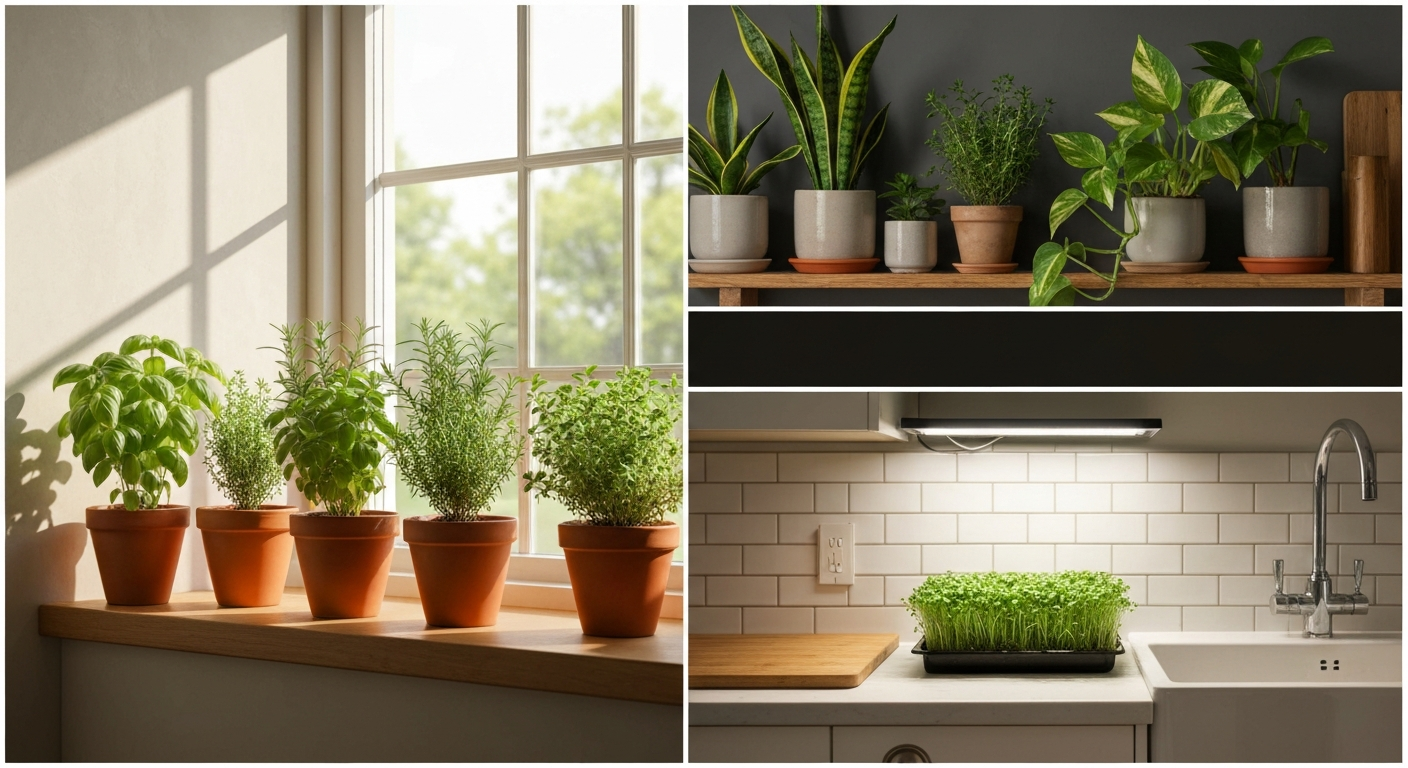
Basil is the star in a sunny kitchen. It needs 6–8 hours of direct light to produce abundant, flavorful leaves, and in a bright window it rebounds quickly after cutting, harvest above a leaf node, and you'll have new growth within days. Start from a 4-inch nursery transplant rather than seed if you want to eat within 3–6 weeks. Rosemary thrives in the same conditions and is nearly impossible to overwater if you keep it in well-draining gritty mix. Oregano, thyme, and sage round out the sunny-windowsill herb kit and require minimal fussing once established. For something fresh and different, try lemon verbena, it's frost-sensitive, so keeping it in a pot makes it easy to move outdoors in summer and back in before your first fall frost. Microgreens also work beautifully here: radish and arugula microgreens are ready in as little as 5–7 days, and a DLI of 9–16 mol per square meter per day (easily met by a sunny window) is all they need.
Medicinal and tea plants
Chamomile (German chamomile, Matricaria chamomilla) needs full sun for reliable flower production, that's your limiting factor for a kitchen tea garden. Give it a deep pot (at least 8 inches) and bright light, and it will flower within 8–12 weeks from transplant. Lemon balm is easier: it tolerates more shade than chamomile, grows fast, and makes an excellent calming tea. For best volatile oil content in any medicinal herb, harvest leaves in the morning after any moisture has evaporated. If your kitchen gets less bright in winter, supplementing with 12–16 hours of LED grow light keeps tea herbs productive year-round. For tea and medicinal herbs indoors, maximize usable leaf and flower yield by providing 12–16 hours of bright light (supplemental LEDs in winter), using a well-drained potting mix, and harvesting in the morning after dew or evaporation for highest volatile oil content For tea and medicinal herbs indoors, maximize usable leaf and flower yield by providing 12–16 hours of bright light (supplemental LEDs in winter), using a well-drained potting mix, and harvesting in the morning after dew or evaporation for highest volatile oil content..
Decorative plants that love sun
Succulents and small cacti are the obvious choice for a bright kitchen, they tolerate the dry air near vents, need infrequent watering, and look good in small pots. Aloe vera is especially practical: it has decorative appeal and the gel from a broken leaf is genuinely useful for minor kitchen burns. Geraniums (Pelargonium) bring color and tolerate dry conditions well. For something trailing and architectural, string of pearls (Senecio rowleyanus) drapes nicely from an upper shelf in a sunny corner.
Bright but indirect, or north-facing kitchens, what actually works here
North-facing or east-facing kitchens are the most common situation I hear about, and they're totally workable, you just have to be honest about which plants will thrive versus which ones will limp along. Bright indirect light (roughly 2,000–10,000 lux, or 150–300 µmol·m⁻²·s⁻¹) is plenty for several great kitchen plants.
Culinary herbs for indirect light
Chives, parsley, mint, and oregano are the four I'd reach for first in a north-facing kitchen. Chives and mint are the most tolerant of lower light levels and respond well to cut-and-come-again harvesting. Parsley is slow to germinate from seed (give it 2–6 weeks if you're starting from scratch) but once established as a transplant, it produces steadily in bright indirect light. One warning on mint: it spreads aggressively in garden beds but in a container it's polite, and indoors, the container is the only way to grow it anyway, so that problem takes care of itself. Oregano and thyme sit right at the edge of indirect light tolerance; they'll grow but may be slightly less potent in flavor than they'd be in a sunny window.
Houseplants and decorative picks
Pothos, heartleaf philodendron, and peperomia are all well-suited to bright indirect light in a kitchen. They handle the occasional temperature swing and humidity spikes from cooking steam without drama. Peace lily (Spathiphyllum) adds a flowering accent and tolerates the same conditions. You'll see these plants marketed heavily with air-purifying claims, I'll address that honestly in the next section.
A note on air-purifying plants (honest version)
The NASA clean air study from the 1980s launched decades of marketing around houseplants 'purifying' indoor air. The scientific reality, based on more recent quantitative reviews, is more sobering: potted houseplants remove VOCs at negligible rates in a normally ventilated home. To meaningfully impact air quality in a real kitchen, you'd need an impractically large number of plants, far more than any windowsill can hold. If indoor air quality is a genuine concern, a mechanical air purifier with a HEPA/activated carbon filter or simply improving ventilation (range hood, open windows) will do far more than any plant. Grow plants because they're beautiful, edible, or calming, not as an air cleaner.
Low-light and windowless kitchens, reliable plants and realistic expectations
If your kitchen has no window or is a studio or basement setup, you're in low-light territory (under 2,000 lux or below about 100–150 µmol·m⁻²·s⁻¹). This is where plant choices get narrow, but it's absolutely not hopeless. The key is honesty: no culinary herb will thrive in true low light without a grow light. But several houseplants genuinely don't mind, and if you're open to adding a small LED panel, the edible options open right back up. This overlaps with situations covered for office spaces with no windows, which face the same light constraints.
Houseplants that genuinely tolerate low light
- ZZ plant (Zamioculcas zamiifolia) — tolerates low light and irregular watering; one of the most forgiving plants indoors
- Snake plant (Dracaena trifasciata) — survives a wide light range from bright to light shade; prefers to dry out between waterings
- Pothos (Epipremnum aureum) — handles low light but will grow slowly and may lose variegation; a good choice if you don't want something demanding
- Spider plant (Chlorophytum comosum) — adaptable and fast-spreading; produces offshoots you can pot up and give away
- Cast iron plant (Aspidistra elatior) — nearly indestructible in low light; slow-growing but very long-lived
- Peace lily (Spathiphyllum) — tolerates low light and will even flower, though less frequently
Adding a grow light: what to buy and how to use it
A basic full-spectrum LED grow light in the 20–40W range, positioned 6–12 inches above your plants on a 12–16 hour timer, transforms a windowless kitchen into a functional herb garden. Look for LEDs that specify PPFD output (target 150–400 µmol·m⁻²·s⁻¹ at plant level) rather than just wattage claims. Bar-style grow lights that mount under a cabinet are particularly useful in kitchens because they don't take up counter space and light the plants naturally from above. With supplemental LED lighting, herbs like basil, chives, parsley, and mint are all viable even in a completely windowless setup.
Microgreens: the fastest food in a low-light or windowless kitchen
Microgreens are genuinely the most practical edible crop for low-light or windowless kitchens when paired with a grow light. They need a DLI of only 9–16 mol per square meter per day, which an entry-level LED easily provides. Radish, arugula, mustard, pea, and sunflower microgreens are among the fastest and most reliable, most are ready to harvest in 5–14 days from seeding. One important safety note: microgreens (grown in a growing medium and harvested above the soil line) are not the same as sprouts (germinated in water or jars). Sprouts carry a documented higher food-safety risk from pathogens like Salmonella and E. coli; the FDA has specific safety guidance for sprout production for this reason. Stick to microgreens in a home kitchen setup, keep your trays and scissors clean, and use clean water.
High-humidity kitchens, plants that love steam and placement tips
Kitchens near active stovetops, dishwashers, or that share a wall with a bathroom often run humidity levels of 50–70% during cooking hours. Most houseplants handle this fine, many actually prefer it. But a few plants don't, and placement matters.
Plants that thrive in steamy conditions
- Pothos and philodendron — genuinely enjoy humidity spikes and won't develop the brown leaf tips that dry air causes
- Spider plant — benefits from the moisture and produces more offshoots in humid conditions
- Peace lily — native to humid tropical environments; a naturally good fit
- Ferns (especially Boston fern) — require high humidity and will reward a steamy kitchen with full, lush fronds
- Mint — thrives in moisture-rich air; keep the soil consistently moist but not waterlogged
- Basil — likes humidity above 40% and wilts fast in dry heat, so a steamy kitchen is a positive
Plants to keep away from the stove
Rosemary and succulents prefer dry conditions and will rot or develop fungal issues if they're sitting in persistent steam near a dishwasher vent. Keep drought-tolerant plants on a windowsill away from the cooking zone. Also avoid placing any plant directly above a gas burner or electric element, radiant heat and sudden temperature spikes (not just humidity) will damage foliage regardless of species.
Placement strategies for high-humidity kitchens
- Position humidity-loving plants (ferns, peace lily, pothos) closest to the cooking and dishwasher zone
- Keep drought-tolerant plants (rosemary, succulents, snake plant) on a far windowsill or upper shelf away from steam sources
- Use terra cotta pots for herbs near the stove — terra cotta breathes and dries faster, reducing root rot risk from humidity buildup in the soil
- Hang trailing plants (pothos, spider plant) from ceiling hooks or a rail above the sink — they benefit from sink splash and ambient humidity without sitting in wet soil
Basements, windowless bathrooms, and air-conditioned or bedroom setups
Sometimes a kitchen isn't really a kitchen in the traditional sense, you're working with a studio apartment where the cooking area shares space with a bedroom, a basement kitchenette, or a layout where the best light is actually in an adjacent bathroom. The light and humidity conditions in these spaces each have their own logic, and the plant choices shift accordingly.
Basements
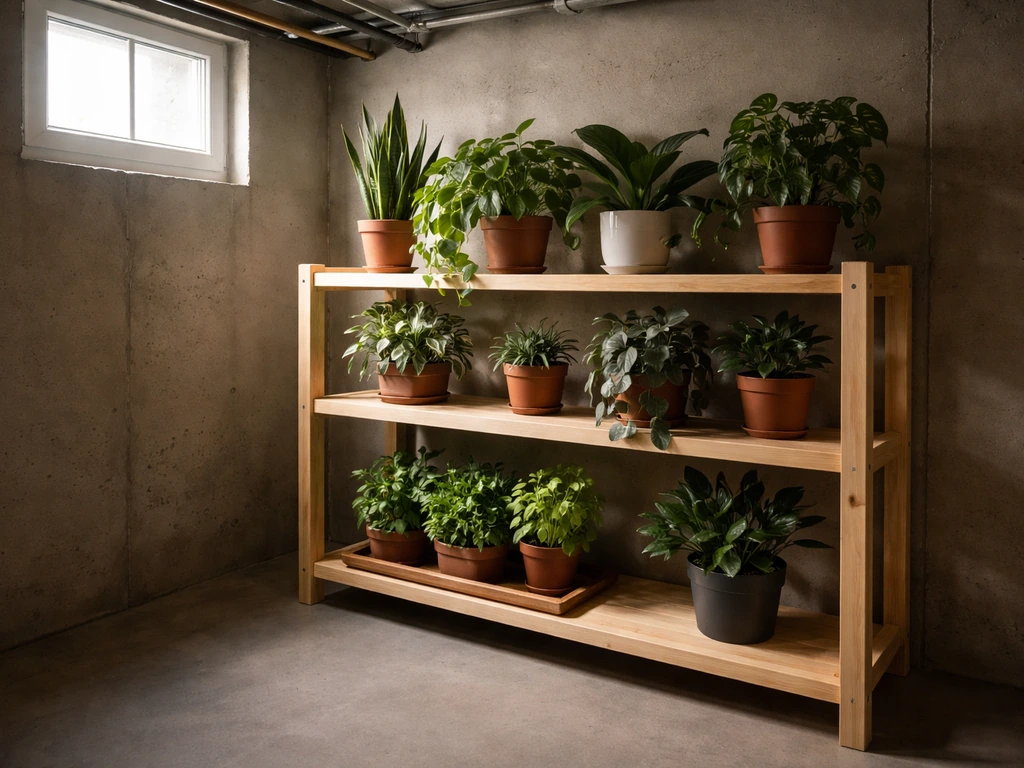
Basement kitchens or cooking spaces typically have very little or no natural light, cooler temperatures, and potentially higher ambient humidity. The houseplants that handle this best are ZZ plant, snake plant, and pothos, all can adapt to low light and cooler temps (though none like it consistently below 55°F). For edibles in a basement, a grow light is essentially mandatory. A simple Kratky-method hydroponic setup (a passive reservoir system with no pump) works extremely well for herbs and lettuce in a basement because it's low-maintenance and doesn't require a floor drain. Plants that can grow in a basement environment are worth exploring more deeply if your setup falls in this category.
Windowless bathrooms and bathroom-adjacent kitchens
High humidity and low light is the defining combination here. Peace lily, pothos, ZZ plant, and spider plant all do well. Ferns (Boston fern, maidenhair fern) are a particularly good fit if there's even moderate indirect light from a frosted window. If you're working with a bathroom that has no windows at all, the same grow-light logic applies as in the basement section. What plants can grow in a bathroom without windows is a closely related question worth addressing separately for those setups. For a quick recommendation and placement tips, see our guide to the best plant to grow in a bathroom best plant to grow in bathroom.
Air-conditioned rooms and bedrooms
Air conditioning creates dry air and can push temperatures down to 65–68°F consistently, which slows down warm-season herbs like basil but suits cooler-season plants like mint, parsley, and chives well. Snake plant, ZZ plant, and pothos all handle the dry, cool air of an air-conditioned studio or bedroom kitchen without complaint. If you're growing in a bedroom that doubles as a living and cooking space, trailing plants on a shelf above head height are a practical solution that keeps foliage away from cooking surfaces. For more suggestions and care tips, see our roundup of plants that can grow in bedroom settings. Plants that can grow in an air-conditioned room and plants that can grow in a bedroom are both relevant reads if your setup straddles these spaces.
Small-space solutions: windowsills, countertops, hanging setups, and apartments
Most kitchen gardens are small by necessity. The good news is that the plants best suited to kitchens, herbs, microgreens, compact houseplants, are also the plants best suited to small containers and limited surfaces. See our guide on plants that can grow in kitchen for a quick list of suitable species and setup tips. Here's how to maximize what you have.
Container size and plant matching
Pot size is the constraint that kills more kitchen gardens than light. Basil needs at least a 6-inch pot to have enough root volume for consistent harvests; cramped roots mean small leaves and early bolting. Mint, chives, and parsley work fine in 4–6 inch pots. Rosemary and lemon verbena eventually want 8–10 inch pots if you're keeping them long-term. For windowsills that are only 4–5 inches deep, a rail or bracket shelf positioned 6–8 inches in front of the window glass (not blocking light) adds usable depth.
Recommended plants by space type and purpose
| Space type | Best plants | Purpose | Minimum container size |
|---|---|---|---|
| Sunny windowsill | Basil, thyme, oregano, chives | Culinary | 4–6 inch pots |
| Sunny windowsill | Aloe vera, small succulents | Decorative/practical | 4 inch pots |
| North-facing windowsill | Mint, parsley, chives | Culinary | 4–6 inch pots |
| North-facing windowsill | Pothos, peperomia | Decorative | 4 inch pots |
| Countertop (bright) | Microgreen trays, basil, lemon verbena | Culinary/tea | Shallow trays or 6 inch pots |
| Countertop (low light) | ZZ plant, snake plant | Decorative | 6 inch pots |
| Hanging (any light) | Pothos, spider plant, string of pearls (bright) | Decorative | 5–6 inch hanging pots |
| Shelf under cabinet (grow light) | Chives, mint, parsley, microgreens | Culinary | 4–6 inch pots or shallow trays |
| Small apartment / studio | Mint, chives, microgreens, ZZ plant | Culinary + decorative | 4 inch pots or trays |
Hydroponic options for small kitchens
If you don't want to deal with soil on a kitchen counter, a small hydroponic kit is worth considering. The Kratky method (a passive reservoir with no pump or electricity beyond a light) is the lowest-maintenance option and works reliably for herbs and lettuce. Wick systems are even simpler but limit you to less thirsty plants. Countertop NFT (nutrient film technique) kits are more expensive but can grow a full rotation of herbs year-round on a relatively small footprint. With any hydroponic setup, use the nutrient solution ratios recommended by the manufacturer and change the reservoir every 1–2 weeks to prevent algae and bacterial buildup.
Seasonal and regional timing notes
If you're reading this in July in a region with long summer days (say, the Pacific Northwest or the upper Midwest), your kitchen windowsill is close to its peak light output right now, the ideal moment to get basil and fast-growing herbs established. By October, day length drops significantly, and without supplemental light, warm-season herbs like basil start to slow and eventually fail. That's the moment to either invest in a grow light, transition to cool-tolerant plants (mint, chives, parsley), or pivot to microgreens on a timer. In warmer climates like the Deep South or Southern California, the summer heat (especially in kitchens near a west window in August) can actually stress plants, afternoon shade or a sheer curtain helps more than you'd think during peak summer heat. For another relevant comparison, see what plants can grow in a bathroom without windows.
Common problems and how to fix them
- Basil going leggy and yellow: almost always not enough light — move to brighter spot or add a grow light; also check if it's rootbound
- Mint wilting despite watering: usually too small a pot or too much heat near a vent; repot to a larger container and move away from heat sources
- Herbs with pale, thin leaves: light deficiency — increase light duration or intensity before assuming a nutrition problem
- Rosemary dropping leaves and developing gray fuzz: overwatering plus high humidity; use terra cotta, let it dry out fully between waterings, and move away from the stove
- ZZ or snake plant with yellowing leaves: almost always overwatering; these plants want to dry out almost completely between drinks
- Microgreens developing mold on substrate surface: reduce humidity, improve airflow with a small fan, and make sure you're not overwatering the tray
FAQ
Which plants reliably do well in bright, sunny kitchen windows (south or west-facing) for fresh food or tea herbs?
Basil, rosemary, lemon verbena and chamomile perform best in bright, sunny windows (≈6–8 hours direct sun or equivalent DLI). Use 4–6" pots or larger with well-draining potting mix, feed lightly with balanced fertilizer, pinch regularly for bushiness, and expect first harvests 3–6 weeks after transplant for basil and 6–10 weeks for woody herbs like rosemary/verbena. If flowers (chamomile) are the goal, provide the brightest light possible or 12–16 hours of supplemental LED light in winter.
Which herbs and edible plants tolerate bright indirect light (east-facing or north-but-bright) and small spaces?
Parsley, oregano, thyme, chives and many culinary microgreens tolerate bright indirect light (150–300 µmol·m⁻²·s⁻¹). They fit windowsills, shallow troughs, or small countertop containers; parsley may take 2–6 weeks to germinate. Microgreens (basil, arugula, mustard, radish, pea) are excellent for countertops or micro-trays and are harvestable in 5–21 days depending on species.
What are the best options for low-light kitchens or rooms with no windows?
For no-window or low-light kitchens, choose hardy houseplants for decoration and humidity resilience (pothos, snake plant/Dracaena trifasciata, ZZ plant, spider plant, peace lily, peperomia). For edible production in low-light, rely on supplemental LED grow lights sized by DLI; otherwise, expect slow, leggy growth. Microgreens under LEDs are still a practical edible option in windowless kitchens.
Can I rely on plants to clean kitchen air (VOCs, cooking odors)?
No — realistic numbers of potted plants do not measurably improve indoor air quality in normal homes. Scientific reviews show plants remove VOCs effectively only in sealed, engineered chambers; ventilation and mechanical filtration are far more effective for reducing cooking odors and pollutants.
Which plants tolerate high-humidity kitchen conditions (steam from cooking, bathroom-adjacent)?
Humidity-loving herbs and ornamentals do well: mint, lemon balm, chives, and tea herbs like lemon verbena tolerate humidity; houseplants such as peace lily, spider plant, and pothos thrive in humid kitchens. Keep potted soil well-draining to avoid root rot, and provide airflow to limit fungal problems.
What container types and placements work best for different kitchen spaces (windowsill, countertop, hanging, small apartment)?
Windowsill: shallow saucers or 4–6" pots for herbs, deeper pots for rosemary/verbena. Countertop: trays for microgreens, 6–8" pots for mixed herbs. Hanging/vertical: trailing herbs or pothos in 6–8" hanging baskets; vertical shelves with LEDs for small lettuce/herb setups. Small apartments: compact hydroponic kits or microgreen trays maximize yield per footprint. Use saucers to protect surfaces and choose light-colored pots to limit heat buildup on sunny sills.
Next Article
Plants That Can Grow in a Basement: Best Options
Basement-friendly plants for low light: assess conditions, choose easy houseplants and herbs, plus mold and root-rot tro