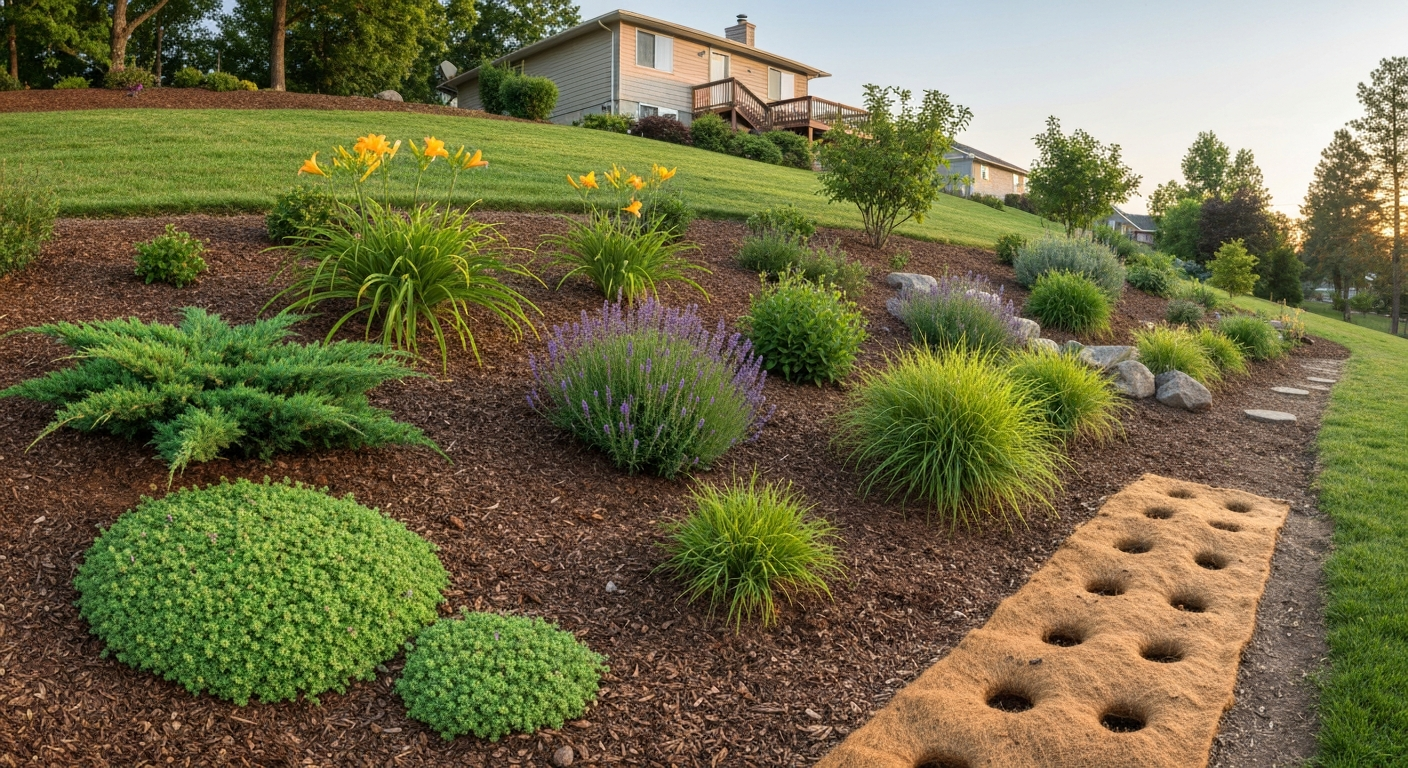
The plants that consistently perform best on slopes are deep-rooted groundcovers, ornamental grasses, native shrubs, and fibrous-rooted perennials. Creeping juniper, crown vetch, native switchgrass, daylilies, and drought-tolerant salvias hold soil well, require little fuss once established, and tolerate the fast drainage and wind exposure that slopes produce. Which exact species you should reach for depends on your slope's sun exposure, steepness, soil type, and your climate zone, but those categories cover the majority of home gardeners in most regions. For a concise list of the best plants to grow on hillside, see our quick guide to species and planting tips.
What Plants Grow Best on a Slope: Top Picks & Planting Guide

Rachel Hartley
21 Jul 2026
Quick picks: best plants for slopes by situation
If you just need a fast answer before diving into the details, here are the most reliable performers organized by common slope scenario. Each one earns its place because it either anchors soil through dense fibrous roots, spreads quickly to cover bare ground, or survives the boom-and-bust moisture cycles that slopes create.
| Situation | Top pick | Why it works |
|---|---|---|
| Hot, dry, south-facing slope | Creeping juniper (Juniperus horizontalis) | Drought-tolerant, spreads to 8 ft, deep roots grip dry soil |
| Hot, dry, south-facing slope | Lantana (in zones 8–11) | Fast cover, minimal water, deer-resistant |
| West-facing slope, afternoon heat | Native switchgrass (Panicum virgatum) | Deep roots, tolerates heat + drought, holds dry slopes |
| West-facing slope, afternoon heat | Russian sage (Perovskia atriplicifolia) | Survives baking afternoon sun, almost no irrigation needed once established |
| East-facing, part-shade slope | Hostas + astilbe combo | Reliable in morning sun/afternoon shade, thrives in moisture |
| Shaded/north-facing slope | Pachysandra terminalis | Reliable evergreen groundcover in full shade |
| Shaded/north-facing slope | Native ferns (Dryopteris or Osmunda spp.) | Deep rhizomes hold moist shaded slopes without irrigation |
| Moist or seasonally wet slope | Native sedges (Carex spp.) | Fibrous mat of roots, tolerates saturation and partial shade |
| Erosion control, any slope | Native grasses + wildflower seed mix | Fast germination, root mass builds within one season |
| Edible/medicinal on gentle slope | Comfrey (Symphytum officinale) | Deep taproot stabilizes soil; leaves used medicinally |
| Low-maintenance ornamental | Daylilies (Hemerocallis hybrids) | Spreads steadily, crowds out weeds, almost indestructible |
How to read your slope before you plant anything
A slope is not just a flat bed tipped sideways. It changes how water moves, how soil dries, how much wind hits your plants, and how root systems behave under load. Spend 20 minutes with this checklist before ordering a single plant, it will save you from replanting the same spot twice.
Slope assessment checklist
- Steepness: Measure the rise-to-run ratio. A slope steeper than 3:1 (roughly 18 degrees or more) is hard to mow and risky to work on; plan for low-maintenance groundcovers or erosion-control mats rather than annuals that need regular attention. Slopes steeper than 2:1 may need engineering input before planting.
- Sun exposure: Track where sun falls at 9 a.m., noon, and 3 p.m. A south-facing slope in July gets more daily radiation than a flat bed in the same location. A north-facing slope may get almost none. This single factor narrows your plant list dramatically.
- Soil texture: Take a handful of moist soil and roll it between your fingers. Sandy soil falls apart, clay soil forms a ribbon. Sandy slopes drain fast (drought stress is common); clay slopes can waterlog and slip under heavy rain. The University of Minnesota Extension recommends a full lab soil test before any slope planting project — pH, organic matter, and phosphorus levels all affect establishment.
- Drainage and wet spots: Watch the slope during and after rain. Note where water sheets off (erodible zones), where it pools (saturated spots), and where it exits. These observations directly control plant choice.
- Aspect and microclimate: A south- or west-facing slope in Phoenix, Arizona behaves like a different climate entirely compared to the same aspect in Portland, Oregon. Cross-reference your USDA 2023 Plant Hardiness Zone and the AHS Heat Zone Map to understand both cold limits and summer heat load before finalizing species.
- Proximity to the house: Roots from large shrubs or small trees can reach foundations. Aggressive spreaders like kudzu or trumpet vine can damage mortar and cladding. Plan a buffer of at least 3–5 feet from foundation walls — more for woody plants.
- Wind exposure: Hilltop and exposed slopes dry out faster than valley slopes. Windward sides of a slope may need wind-tolerant species or a temporary windbreak during establishment.
- Existing vegetation: Note what is already growing and surviving. Native volunteer plants tell you what the site naturally supports. Existing weeds tell you what you are competing against.
Safety and foundation concerns when slopes meet your house
This is the section most gardening articles skip, and it is the one that matters most if your slope runs up to or alongside the house. Slopes adjacent to structures carry real risks: soil saturation increases hydrostatic pressure on foundation walls, and poorly planned plantings can accelerate erosion or redirect water toward footings.
USACE technical guidance (UFC 3-220-20) is clear that unmitigated water buildup behind retaining walls is one of the leading causes of retaining wall failure. See UFC 3‑220‑20 Foundations and Earth Structures Manual (USACE/DoD), drainage & retaining wall design for specific requirements on drainage layers, filter media, and safe discharge paths to prevent hydrostatic-induced retaining wall failures UFC 3‑220‑20 Foundations and Earth Structures Manual (USACE/DoD) — drainage & retaining wall design. If your slope is held by an existing wall, make sure there is a drainage layer, a functioning drain outlet, and that your planting plan does not block that outlet. Dense groundcovers are fine; they actually reduce surface runoff. But avoid planting directly against a weep pipe or drain outlet.
For the slope itself, vegetation is genuinely protective. Research published in 2024 (MDPI) confirms that plant roots stabilize slopes through two mechanisms: mechanical root reinforcement (roots physically resist shear forces in the soil) and hydrological effects (transpiration draws water from the soil, increasing matric suction and resistance to slippage). Plants with dense fibrous root systems, grasses, sedges, groundcovers, outperform deep-rooted woody plants for immediate slope stabilization. Woody plants catch up over time as roots mature.
- Keep plants 3–5 feet from foundation walls minimum; 8–10 feet for large shrubs or small trees.
- Route water away from the house, not toward it — check your grading before planting.
- Do not remove all existing vegetation at once on a steep slope; bare soil erodes rapidly, especially on slopes over 3:1.
- If installing a new retaining wall, include a gravel drainage layer and perforated drain pipe behind it before backfilling.
- On slopes near the front or side of the house, low-growing groundcovers (under 2 feet) maintain sight lines and reduce wind resistance during storms.
Start with your goal, then pick plants
The single biggest mistake I see on slope projects is buying plants before deciding what the slope needs to do. Erosion control, ornamental beauty, low labor, and food production all lead to completely different plant choices. Get honest about your primary goal first.
Erosion control
If your slope is actively eroding or is bare after construction, stabilization is the priority. NRCS Critical Area Planting standard (Code 342) recommends pairing a fast-germinating temporary cover (annual ryegrass or oats) with permanent perennial species to protect soil during the establishment window. The temporary cover closes within 4–6 weeks; the perennials take over within one to two seasons. On slopes steeper than 3:1, pair the seed mix with an erosion control blanket or coir mat to hold seed in place until roots establish, blankets alone can reduce surface erosion by 80–95% during the vulnerable first season.
Low maintenance
Low-maintenance slopes need plants that spread on their own, suppress weeds through canopy cover, and require no annual replanting. Native shrubs and groundcovers are the clear winners here. Once established (typically two to three seasons), species like creeping juniper, native sedges, and native grasses need almost no intervention. Avoid annuals, vegetable crops, and anything that requires regular deadheading or division on a steep slope, those tasks become genuinely dangerous on an incline.
Edible and medicinal
Gentle slopes (under 15 degrees) can support edible plantings if you work with the terrain. Comfrey is the standout choice: its deep taproot (up to 6 feet) actively improves soil structure and reduces erosion, and its leaves are widely used as a compost activator and topical medicinal herb. Thyme, oregano, and rosemary all perform well on dry sunny slopes and double as culinary crops. Berry-producing shrubs like native gooseberries (Ribes spp.) or elderberries (Sambucus nigra) work on moderate slopes and provide both food and wildlife habitat. Steep slopes are difficult to safely harvest on, so keep edible plantings to the gentler sections.
Ornamental beauty
Ornamental slopes reward layered planting: low groundcovers at the front, mid-height perennials and grasses in the middle, and shrubs or small accent trees at the top. This mirrors natural vegetation structure and looks intentional rather than planted. Daylilies, ornamental grasses, lavender, and Russian sage all flower over long seasons with minimal irrigation. If your slope is next to the front of the house where curb appeal matters, these same plants work beautifully in that context too. See the guide to the best plants to grow next to house for plant selections optimized for foundations and curb appeal.
Plant types that work on slopes: strengths and honest trade-offs
| Plant type | Best use on slopes | Key strengths | Trade-offs |
|---|---|---|---|
| Groundcovers | Full slope cover, erosion control | Fast spread, dense canopy suppresses weeds, fibrous roots hold topsoil | Takes 1–2 seasons to fully establish; some (like English ivy) become invasive |
| Ornamental grasses | Erosion control, ornamental, low-water sites | Deep fibrous roots, drought-tolerant once established, minimal care | Some species reseed aggressively; clumps may need division every 4–5 years |
| Native shrubs | Long-term stabilization, wildlife habitat | Deep roots, adapted to local climate, very low maintenance once established | Slower to establish (2–3 seasons); woody roots may interfere with walls if too close |
| Perennials | Ornamental, moderate slopes, edible/medicinal | Seasonal color, many spread to fill gaps, easy to divide and propagate | Not always competitive with weeds on bare slopes; may need irrigation in year one |
| Small trees | Top-of-slope anchors, shade creation | Deepest root systems, long-term structural stabilization | Slow benefit; planting near house requires careful species selection and spacing |
| Native species | Any slope type, any goal | Pre-adapted to local soils, rainfall, and climate; minimal inputs after establishment | May be harder to source locally; can look 'unfinished' in year one compared to ornamentals |
A note on native plants
Across nearly every slope scenario, native plants outperform introduced cultivars on a long enough timeline. They are locally adapted to the precipitation patterns, soil chemistry, and temperature extremes of your region in ways that no amount of irrigation or fertilizer can fully compensate for in a non-native plant. NRCS Plant Materials Centers publish regionally tested seed mixes and planting rates by state, these are worth checking before you finalize your species list, especially if you are in the Mountain West, Great Plains, or Pacific Northwest where native grass and forb mixes are exceptionally well-documented.
Best plants for south-facing hot and dry slopes
South-facing slopes in summer are as close to a desert microclimate as most gardens get. The sun angle is direct, the soil surface dries out between rainfalls faster than a flat bed, and reflected heat from nearby walls or paved surfaces can push temperatures 10–20 degrees above ambient air temperature. You need plants that evolved in dry, high-radiation environments, not plants you are trying to water into submission.
- Creeping juniper (Juniperus horizontalis): Spreads 6–8 feet wide, roots deeply, handles full sun and reflected heat. One of the most reliable slope plants in zones 3–9. The 'Bar Harbor' and 'Blue Chip' cultivars stay low enough to avoid blocking views from the house.
- Lavender (Lavandula angustifolia): Thrives on hot, dry, alkaline slopes in zones 5–8. Needs excellent drainage — clay slopes are a problem without amendment. Bloom time (June–August) provides ornamental interest and pollinator habitat.
- Lantana (Lantana camara, zones 8–11): Extremely heat and drought-tolerant, spreads aggressively in warm climates, and produces continuous color through summer and fall. Note: invasive in Florida and some Gulf Coast states — check your region before planting.
- Rosemary (Salvia rosmarinus, zones 7–11): Low-sprawling forms like 'Prostrate Rosemary' cover dry slopes beautifully, stabilize soil, and give you a culinary crop. Excellent on south-facing slopes in Mediterranean-climate zones (California, Pacific Northwest coast).
- Buffalo grass (Bouteloua dactyloides): Native to the Great Plains, drought-dormant in summer, extremely low water use. Ideal for south-facing slopes in zones 4–8 where turf-like coverage with zero irrigation is the goal.
- Yarrow (Achillea millefolium): Native across North America, spreads by rhizome to fill bare ground, tolerates poor dry soil. White or yellow flowers from June through September. Also has a traditional medicinal history as a wound herb.
- Coneflower (Echinacea purpurea): Deep taproot survives dry slopes, blooms July–September, and provides seed for birds through winter. Medicinal use (immune support) is widely documented. Works in zones 3–9.
- Sedum / stonecrop (Sedum spp.): Drought-tolerant succulents that handle reflected heat, poor soil, and fast drainage. 'Autumn Joy' and 'Dragon's Blood' are proven performers on rocky or sandy south slopes.
Planting timing matters on hot slopes: in zones 7 and south, plant in fall rather than spring so roots establish during cool weather before the first brutal summer. In zones 4–6, plant in early spring (after last frost) or early fall (6 weeks before first frost). Bare-root establishment through July or August in Texas, Oklahoma, or Arizona is a near-certain failure for anything but the most xeric species.
Best plants for west-facing slopes and afternoon heat exposure
West-facing slopes get a specific kind of stress: they are shaded in the morning (when soil moisture is at its highest) and then hammered with intense afternoon sun through the hottest part of the day. This combination stresses plants that are not genuinely heat-tolerant and causes a lot of die-off in year one. The west side of the house is a related challenge, and many of the same plant choices apply in both contexts.
- Native switchgrass (Panicum virgatum): Thrives in zones 5–9, tolerates heat and periodic drought, and its deep fibrous root system is excellent for slope stabilization. Cultivars like 'Shenandoah' and 'Heavy Metal' stay upright through summer and turn red in fall.
- Russian sage (Perovskia atriplicifolia): One of the best plants for hot, dry, windy slopes in zones 4–9. Silver foliage and blue flowers from July through frost. Almost impossible to kill with too little water once established.
- Blue oat grass (Helictotrichon sempervirens): Cool-season grass that tolerates afternoon heat better than most; steel-blue foliage is attractive year-round in zones 4–8. Excellent on dry west-facing slopes.
- Coreopsis (Coreopsis lanceolata or C. verticillata): Native to eastern and central North America, blooms spring through fall, handles heat and drought reliably. Spreads gradually by seed and rhizome to fill slope coverage.
- Purple coneflower (Echinacea purpurea): As listed for south slopes — equally effective on hot west-facing sites.
- Agastache (Agastache spp.): Native to the American Southwest, extremely heat-tolerant, long bloom season (July–September), pollinator magnet. 'Blue Fortune' and 'Black Adder' handle zones 5–9 including hot afternoon exposure.
- Dwarf mugo pine (Pinus mugo var. pumilio): Slow-growing evergreen that stabilizes slopes in zones 2–8, handles wind and drought, and stays low enough for slopes near the front or side of the house.
On west-facing slopes, mulch is especially important. A 2–3 inch layer of shredded wood mulch applied at planting reduces soil temperature, retains moisture through afternoon heat, and significantly improves first-year survival. Avoid black rubber mulch on hot slopes, it amplifies heat stress.
Best plants for east-facing and shaded or north-facing slopes
East-facing slopes get cool morning sun and afternoon shade, a gentler environment than south or west, and one that supports a wider range of plants. North-facing slopes are the most challenging: they may get little to no direct sun, soil stays moist or even waterlogged, and plant choices narrow considerably. But these conditions suit some beautiful and underused plants.
East-facing slopes (morning sun, part shade)
- Astilbe (Astilbe spp.): Loves morning sun and afternoon shade, moisture-retentive soil, and produces feathery plumes in pink, white, and red from June through August. Excellent for ornamental east-facing slopes in zones 4–8.
- Hostas (Hosta spp.): Dense clumping habit suppresses weeds, thrives in morning light, tolerates heavy clay. Spreads reliably over time to fill a slope without replanting.
- Native coral bells (Heuchera spp.): Evergreen to semi-evergreen in zones 4–9, handles morning sun and afternoon shade, and the fibrous root mass holds slope soil effectively.
- Solomon's seal (Polygonatum biflorum): Native woodland perennial that naturalizes easily on shaded east-facing slopes, spreads by rhizome, and needs almost no care once established.
- Wild ginger (Asarum canadense): Native groundcover for shady, moist slopes in zones 3–8. Dense, low mat of heart-shaped leaves suppresses weeds completely within two to three seasons.
North-facing and deeply shaded slopes
- Pachysandra terminalis: The workhorse of shaded slopes in zones 4–8. Evergreen, spreads steadily, 8–10 inches tall, and outcompetes most weeds once established. It does not perform in deep drought, so mulch it well.
- Native ferns (Dryopteris marginalis, Osmunda cinnamomea, Polystichum acrostichoides): Deep rhizomes hold moist, shaded slopes. Christmas fern (Polystichum) is especially tough: evergreen, tolerates dry shade once established, and is native across eastern North America.
- Creeping phlox (Phlox stolonifera, not P. subulata): The stolonifera species handles shade better than the more commonly sold subulata; it creeps across the soil surface and produces lavender flowers in spring.
- Foam flower (Tiarella cordifolia): Native woodland groundcover, spreads by runners, thrives in moist shade in zones 3–8. Low enough for slopes next to house foundations without blocking light.
- Native bleeding heart (Dicentra eximia): Fern-like foliage, blooms spring through fall in cool shaded slopes, dies back in summer heat but regrows reliably in zones 3–9.
Best plants for moist, wet, or poorly drained slopes
Wet slopes are a different challenge than dry ones. Waterlogged soil loses structural strength, and heavy rains on a wet slope can trigger slippage. The goal is to move water through the soil using deep-rooted plants that tolerate saturation while simultaneously drawing down the soil moisture through transpiration. Riparian and wetland natives are your best tools here.
- Native sedges (Carex stricta, C. pensylvanica, C. lupulina): The single best group of plants for wet or seasonally saturated slopes. Dense, fibrous root mats, tolerant of both flooding and temporary dry periods, and available in species suited to zones 3–9. Carex stricta is especially effective in consistently wet zones.
- Buttonbush (Cephalanthus occidentalis): Native shrub that tolerates standing water, zones 4–10. Roots stabilize streambanks and wet slopes; white spherical flowers attract pollinators in July–August.
- Native willows (Salix discolor, S. humilis, or shrub willow hybrids): Fast-growing, extremely fibrous root systems, ideal for wet slope bioengineering. These are used in NRCS live fascine and live stake installations specifically for wet slope stabilization. Keep them away from drain pipes and house foundations.
- Joe Pye weed (Eutrochium purpureum): Tall (4–7 feet) native perennial for moist slopes in part shade to full sun. Blooms August–September, excellent wildlife habitat value, spreads steadily by seed and rhizome.
- Cardinal flower (Lobelia cardinalis): Native to streambanks and wet meadows, blazing red blooms in July–August, hummingbird magnet. Zones 3–9. Works on consistently moist slopes in partial shade.
- Swamp milkweed (Asclepias incarnata): Native to wet meadows and margins, zones 3–6 primarily. Deep roots stabilize moist slopes and it is a critical monarch butterfly host plant.
- Soft rush (Juncus effusus): For truly wet or ponding spots at the base of a slope. Clumping habit, tolerates standing water, and the dense root mass is effective at the toe of a slope where water exits.
On wet slopes, avoid planting right before the rainy season in your region, newly planted rootballs in saturated soil have no grip and can literally slide out of the ground. Plant in late summer or early fall in humid climates, or in spring as soils begin to dry, so roots have time to anchor before the next wet cycle.
How to actually plant and stabilize a slope
Choosing the right plants is half the job. How you install them on a slope determines whether they live through year one. I have killed enough slope plantings to know that skipping stabilization steps during installation is almost always the cause of early failures.
Step-by-step slope planting process
- Test your soil before you plant: Use a university extension soil test (the University of Minnesota Extension protocol is a good template regardless of region) to check pH, organic matter, and drainage. Sandy slopes typically need organic matter worked in; clay slopes may need grit or compost to improve drainage and structure.
- Install erosion control before or during planting: On slopes steeper than 3:1, lay coir (coconut fiber) erosion control blankets or jute netting before planting. Cut X-shaped holes through the mat, plant through them, and pin the mat flat with 6-inch landscape staples at 2-foot spacing. On gentler slopes, apply 3 inches of shredded wood mulch immediately after planting.
- Plant on contour: Dig individual planting holes slightly below grade (create a small shelf) so water collects around the rootball rather than sheeting past it. This small step dramatically improves establishment on dry slopes.
- Choose transplants over seed for steep slopes: Plugs and container plants survive better on steep terrain than direct-seeded plants. For large areas where transplants are cost-prohibitive, hydroseeding (seed + mulch + tackifier slurry applied by a hydromulch rig) is the most effective alternative — UC Davis restoration guidance notes that hydroseeding outperforms broadcast seeding on slopes by improving seed-to-soil contact and reducing displacement.
- Water deeply at planting, then taper off: Give transplants a thorough initial watering and then irrigate weekly for the first 4–6 weeks. After that, reduce frequency and let plants adapt to ambient moisture. Drip irrigation on slopes should use pressure-compensating emitters to maintain uniform output across elevation changes and prevent drainage erosion at the low end of the run.
- Pair temporary cover with long-term species: On bare slopes, sow annual ryegrass or oats immediately at NRCS Code 342 seeding rates as a nurse crop. This germinates in 7–14 days and holds the soil while your permanent perennial plugs or slower-germinating native grass seed establishes.
- Mulch, then monitor: Check your slope after the first significant rain event. Look for rills (small erosion channels), displaced mulch, or areas where the erosion mat has lifted. Address any failures within a week — a small bare spot becomes a major erosion problem in one season if ignored.
Terracing for very steep or small slopes near the house
If your slope is steep, short, and adjacent to the house (think a 6-foot rise along the side yard), terracing with simple retaining walls may be more practical than trying to maintain groundcovers on bare soil at extreme angles. Timber, dry-stacked stone, or concrete block walls in the 12–18 inch range create level planting beds that hold soil, allow water to be directed deliberately, and make maintenance actually possible. The key rule: every retaining wall needs a drainage solution behind it. Pack clean gravel behind the wall, add a perforated drain pipe at the base, and route the outlet away from the house. Skipping drainage is how walls fail.
Irrigation on slopes: avoiding the mistakes
Standard irrigation heads are poorly suited to slopes, water runs off before it can penetrate, and sprinklers create erosion patterns. Drip irrigation is far better, but it has its own slope-specific quirk: without pressure-compensating emitters, lower emitters receive more flow than upper ones due to gravity, meaning your upslope plants get starved while the low points get soaked and possibly eroded. Manufacturers like Netafim explicitly design pressure-compensating (PC) emitters for slope use, and ASCE engineering guidance confirms that pressure compensation is the correct technical solution for sloped drip systems. See Designing trickle irrigation systems in sloping fields without pressure‑compensating emitters, ASCE (2022) for peer‑reviewed guidance recommending pressure‑compensating emitters, staged pressure regulation, or paired lateral designs to preserve emitter uniformity and prevent low‑point drainage/erosion on slopes Designing trickle irrigation systems in sloping fields without pressure‑compensating emitters — ASCE (2022). Use non-drain check-valve emitters at low points to prevent post-shutdown drainage rills. Set irrigation timers for multiple short cycles (10–15 minutes with an hour between) rather than one long soak, this reduces runoff and lets water infiltrate between bursts.
Ongoing maintenance: what slopes actually need
Once established (usually after the second growing season), a well-planted slope is genuinely low-maintenance. The key tasks that remain are simple and seasonal.
- Refresh mulch annually: Slopes lose mulch to wind and water faster than flat beds. Add 1–2 inches of shredded wood mulch each spring before the growing season.
- Spot-weed in years one and two: Weed pressure is highest during establishment. Once your groundcovers close the canopy, weed suppression largely takes care of itself. Pull or hoe weeds before they set seed.
- Cut back ornamental grasses in late winter: Cut clump-forming grasses to 4–6 inches from the ground in late February or early March (before new growth emerges) to allow for clean regrowth. Do this before the soil is wet to avoid compacting the slope.
- Divide aggressive spreaders every 3–4 years: Daylilies, hostas, and some native grasses will crowd themselves out over time. Divide and replant bare centers in fall or early spring.
- Inspect erosion control mats each spring: Check that coir or jute blankets are still anchored. Replace any sections that have degraded before warm-season rains arrive.
- Fertilize sparingly on slopes: Nutrient runoff from over-fertilized slopes contributes to waterway pollution (this is an EPA nonpoint-source concern). Use slow-release organic fertilizer at establishment, then rely on decomposing mulch and the soil biology to feed your plants.
Design tips for slopes next to the house
A slope next to or in front of the house is part of the property's visual identity, and how you plant it either adds or subtracts from curb appeal. For specific plant recommendations for areas directly alongside structures, consult the guide to the best plants to grow on the side of a house. A few practical design principles that actually work:
- Layer heights from low at the front to taller at the back or top: Groundcovers at the toe of the slope, mid-height perennials and grasses in the middle, shrubs or small trees at the crest. This matches the natural structure of hillside plant communities and looks intentional.
- Use repeating masses instead of one-of-everything: Three to five plants of the same species in a clump look far better than single specimens scattered across a slope. Repeating the same three or four plants at intervals creates rhythm and cohesion.
- Match color to the house: For slopes directly in front of or beside the house, choose plant colors that complement (not clash with) the exterior. Silver-foliage plants (artemisia, Russian sage, lavender) are nearly universal harmonizers.
- Account for seasonal gaps: Choose plants whose seasons overlap. A slope that is spectacular in June and bare in September looks unfinished. Combine spring bloomers (phlox, coreopsis), summer stalwarts (daylilies, switchgrass), and fall interest (asters, sedum, ornamental grass seed heads).
- Edge the planting at the base: A clean edge where the slope planting meets a lawn, path, or driveway makes even an informal native planting look cared for. A simple steel or stone edging installed at planting saves hours of trimming later.
If your slope connects to the front of the house or wraps around the side, the same plant principles apply but the visual weight of the choices matters more. For specific plant suggestions and planting layouts, see our guide to the best plants to grow in front of house. Low, spreading plants that stay under 2 feet maintain sight lines to the entrance and do not overwhelm a small house facade. For specific planting suggestions for the south side of a house, see what plants grow on the south side of a house. The relationship between slope plantings and the house foundation is a recurring design question, it is worth thinking through carefully before planting anything that will be difficult to remove once it establishes.
FAQ
How do I quickly assess a slope before choosing plants?
Use a simple checklist: record sunlight (hours and direction), soil type (sand/loam/clay) with a ribbon or field test, moisture (seasonal wetness or drainage), slope steepness (gentle <15°, moderate 15–35°, steep >35°), exposure (north/south/east/west side of house), local hardiness/heat zone (USDA Plant Hardiness Map and AHS Heat‑Zone), and access/maintenance constraints. Soil test labs give pH, nutrients and organic matter — essential for plant and amendment choices.
Which plant types work best by goal: erosion control, low maintenance, ornamental, edible/medicinal?
Erosion control: deep‑ and fibrous‑rooted grasses (fescue, native bunchgrasses), groundcovers (vinca, creeping phlox, native sedges), and shrubs with dense roots (willow for wet sites, bayberry). Low‑maintenance: drought‑tolerant native shrubs and bunchgrasses, mulched groundcovers, and succulents in dry climates. Ornamental: mixed perennials, flowering shrubs and groundcovers selected for bloom season and exposure. Edible/medicinal: terrace or terrace‑bed plantings with herbs (thyme, oregano), berry shrubs (currants, raspberries on gentle slopes), and fruit trees on terraces with proper anchoring. Always match species to sun, soil and moisture.
What groundcovers are reliable on sunny, well‑drained slopes?
Low‑maintenance sun groundcovers: native sedum species (in dry climates), creeping thyme (dry, Mediterranean), woolly yarrow (dry, well‑drained), creeping phlox (temperate), and prairie dropseed or blue grama used as low mounds. Choose drought‑tolerant species for steep, drained slopes; mix with mulch and erosion blankets for establishment.
What groundcovers and moisture‑loving species are best for shady or wet slopes?
Shady/wet slope options: native sedges and carex species, woodland phlox, foamflower (Tiarella), wild ginger, ivy‑type groundcovers only where noninvasive (avoid invasive English ivy in many regions). For persistently wet toes consider willow shrubs or wetland‑tolerant switchgrass and native rushes. Verify regional invasiveness and prefer natives where possible.
Which shrubs and grasses give the best root reinforcement on slopes?
Shrubs with fibrous or deep roots: native willows and dogwoods (for moist sites), bayberry or cotoneaster (for drier sites). Grasses: turf‑forming fine fescues, tall fescues, switchgrass (Panicum virgatum), little bluestem, and native bunchgrasses. Root area ratio and root tensile strength vary by species — mix shallow fibrous (grasses/groundcovers) with deeper‑rooting shrubs for layered reinforcement.
How should I sequence plants and temporary covers when stabilizing a newly disturbed slope?
Establish temporary fast covers first (annual rye, oats or quick‑establishing native annuals) to reduce immediate erosion. Simultaneously outplant or hydroseed a mix including longer‑term perennials, grasses and shrubs (plugs or container stock) timed for regional planting windows. Use erosion control blankets or hydromulch on steep/open soils until perennials and shrubs develop.
Next Article
What Plants Grow in South Side of House: Climate-Smart Picks
What plants grow on the south side of a house? Sun-smart, region & season advice, plant lists, containers, care.