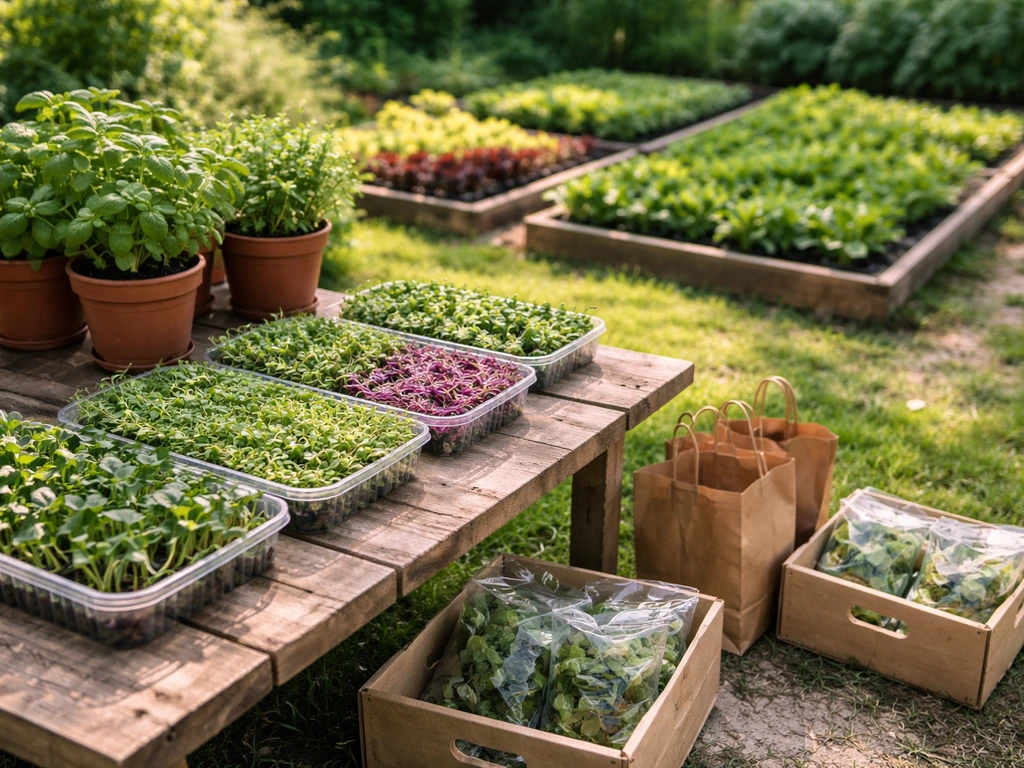
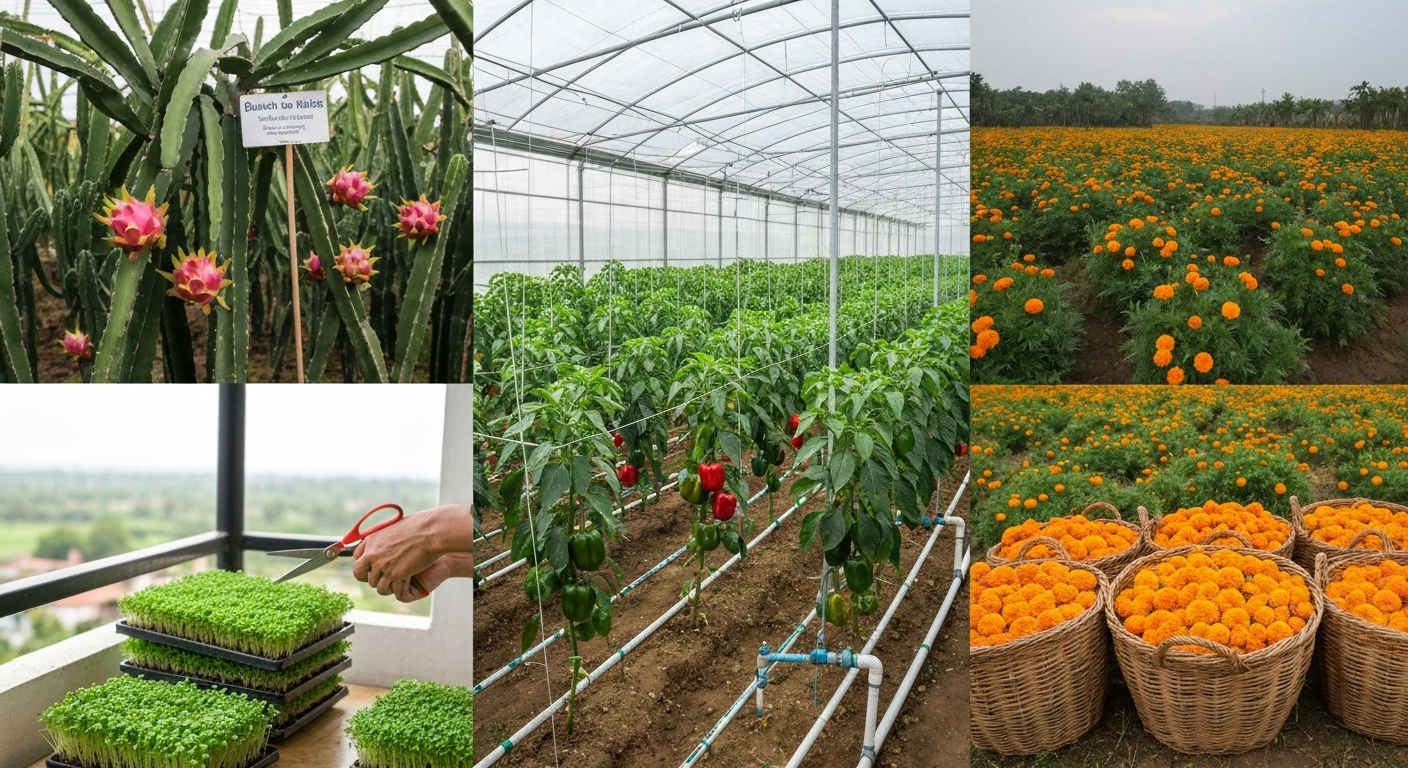
If you want to grow plants for real income or meaningful household savings in India, your best starting bets right now are capsicum (bell pepper) in a polyhouse or net house, microgreens on a balcony or rooftop, oyster mushrooms indoors, and marigold or rose for cut flowers in open fields. For longer-term orchard-scale returns, dragon fruit in Karnataka, Maharashtra, or Andhra Pradesh is delivering benefit-to-cost ratios close to 2:1. This guide walks you through all of these, and more, matched to India's regions, seasons, and whatever space you actually have. For a quick shortlist of the best plants to grow to make money in India, see the high-return overview at the start of this guide.
Best Profitable Plants to Grow in India: Guide by Season

Rachel Hartley
8 Aug 2026
Who this guide is for and how to use it
Whether you have a 10 sq ft kitchen windowsill, a 300 sq ft rooftop terrace, a backyard plot, or a full acre of farmland, this guide is written for you. I've organised it so you can jump straight to the section that fits your situation: apartment dwellers should head to the microgreens and houseplant sections first, backyard gardeners can dig into the vegetable and herb profiles, and anyone with land should read the full crop profiles and polyhouse sections before spending a rupee. The quick checklist below helps you zero in on the right starting point within five minutes.
Quick decision checklist: pick the right plant for your goals
Run through these questions before picking a crop. Your answers will point you to the right section and save you from growing the wrong thing for your situation.
- Space: Do you have under 50 sq ft (windowsill/balcony), 50–300 sq ft (rooftop/terrace), or 300 sq ft+ of ground/open land?
- Water access: Is your water supply reliable year-round, seasonal, or limited (terrace/apartment)?
- Time horizon: Do you want returns within 30 days, 3–6 months, or are you comfortable waiting 1–3 years for an orchard to mature?
- Capital: Can you spend under ₹5,000, ₹5,000–₹50,000, ₹50,000–₹2 lakh, or more on setup?
- Goal: Income (selling produce), household savings (consuming what you grow), or both?
- Region: Are you in a North Indian plains state, Central India, the Northeast/East, the Western coast/Konkan, or Tamil Nadu/coastal South?
- Skill level: Are you a first-time grower, a home gardener with 2–3 seasons of experience, or a practising farmer looking to diversify?
If you answered 'under 50 sq ft, under ₹5,000, income within 30 days,' go straight to microgreens. If you answered 'backyard land, ₹50,000–₹2 lakh, 6–12 months,' capsicum or floriculture is your lane. If you have an acre and a 2–3 year patience, dragon fruit in a suitable climate is the highest-margin orchard crop in this guide.
India's climate and seasons at a glance, matching crops to region
India spans six broad agro-climatic zones that matter for plant choices: the Indo-Gangetic plains (hot summers, cold winters, monsoon July–September), the Deccan plateau (semi-arid, moderate winters), the Western coast/Konkan (hot and humid, heavy southwest monsoon), the Eastern coast (cyclone-prone, northeast monsoon October–December), the Northeast (high rainfall, mild winters), and the arid/semi-arid Northwest (Rajasthan/Gujarat). The ICAR and IMD jointly run Agromet Advisory Services across 127 agro-climatic zones, and their district-level crop calendars are your best free resource for precise sowing windows in your specific district.
The most important seasonal rule in India is this: the main kharif season (June–October) suits vegetables like bitter gourd, cowpea, and chilli; the rabi season (October–March) suits tomato, capsicum, coriander, and most cole crops; and the zaid season (March–June) is for short-duration, heat-tolerant crops like gourds and quick-cycle leafy greens. Get this wrong and no amount of good inputs will save your crop.
Seasonal planting calendar by region
| Region | Best Rabi Crops (Oct–Mar) | Best Kharif Crops (Jun–Sep) | Best Zaid/Summer Crops (Mar–Jun) |
|---|---|---|---|
| North India (UP, Punjab, Haryana, Delhi) | Capsicum, tomato, coriander, marigold, rose | Bitter gourd, cowpea, chilli, turmeric | Pointed gourd, ridge gourd, mint |
| Central India (MP, Chhattisgarh) | Garlic, onion, tomato, turmeric | Guar, soybean, chilli, sesame | Moong, bottle gourd, watermelon |
| East India (WB, Odisha, Bihar) | Potato, coriander, mustard greens, marigold | Jute, bitter gourd, pointed gourd | Okra, cucumber, watermelon |
| West India (Maharashtra, Konkan, Goa) | Capsicum, tomato, strawberry (high altitude), tuberose | Rice, banana, coconut, ginger | Cashew (harvest), mango (harvest), okra |
| South India / Tamil Nadu / Chennai (coastal) | Banana, jasmine, tuberose, coriander, capsicum | Rice, brinjal, cowpea, curry leaf | Drumstick (moringa), pointed gourd, watermelon |
| Northeast (Assam, Meghalaya, Sikkim) | Ginger, turmeric, large cardamom (Sikkim) | Rice, banana, ginger planting | Bamboo shoots, pineapple, passion fruit |
In Chennai and coastal Tamil Nadu specifically, the northeast monsoon (October–December) is the major rainfall event, which flips the productive season compared to the rest of India. TNAU extension guidance consistently recommends raised beds and good drainage for coastal plots to manage waterlogging and salt build-up from shallow saline water tables, more on this in the Chennai-specific section below.
How to choose by climate, space and time horizon
Time horizon is the most underrated decision factor. Short-term growers (returns needed within 60 days) should stick with microgreens, oyster mushrooms, coriander, or quick-cycle leafy greens, these pay back fast and have low sunk cost if something goes wrong. Medium-term growers (3–12 months) can target capsicum, chilli, marigold, gerbera, or rose. Long-term investors (1–3 years) should seriously look at dragon fruit, large cardamom in the Northeast, or a well-established nursery operation.
| Time Horizon | Best Crop Choices | Typical Startup Cost | Growing Space Needed |
|---|---|---|---|
| Under 60 days | Microgreens, oyster mushrooms, coriander, methi | ₹500–₹15,000 | 10–300 sq ft indoors |
| 3–6 months | Capsicum, chilli, tomato, marigold, tuberose | ₹5,000–₹1.5 lakh | 100 sq ft–1 acre |
| 6–12 months | Rose, gerbera, curry leaf nursery, banana | ₹20,000–₹3 lakh | 500 sq ft–1 acre |
| 1–3 years | Dragon fruit, large cardamom, coconut, nursery stock | ₹1.5 lakh–₹6 lakh/acre | 0.5–5 acres |
Space constraints change what's possible more than capital does. A 100 sq ft balcony can realistically generate ₹3,000–₹8,000 per month from microgreens if you run staggered trays efficiently. The same 100 sq ft of open field growing marigold will generate a fraction of that, because the crop cycle is longer and the price per kg is lower. Density and turnover speed are your profit levers on small plots.
High-return plant overview: vegetables, fruits, herbs, medicinal, flowers, and houseplants
India's combination of year-round growing seasons, rising urban demand for fresh produce, and a large informal vegetable and flower market system means more plant categories are genuinely profitable here than almost anywhere else. The crops below are the ones with either proven wholesale price data, documented case study returns, or strong urban premium demand as of 2025–2026. For a quick shortlist of the best plants to grow and sell across scales and climates, see our best plants to grow and sell guide. If you want a single quick recommendation tailored to space and budget, see our guide on the best plant to grow for profit. I've left out anything that relies on exceptional conditions or anecdotal outlier figures.
- Vegetables: Capsicum (polyhouse/open), chilli, tomato, bitter gourd, drumstick (moringa)
- Fruits: Dragon fruit, banana, strawberry (high-altitude Maharashtra/Himachal), passion fruit
- Herbs: Coriander, mint, basil, curry leaf, lemongrass
- Medicinal: Turmeric, aloe vera, ashwagandha, giloy (tinospora), tulsi
- Flowers: Rose, marigold, tuberose, gerbera, jasmine
- Urban/indoor: Microgreens, oyster mushrooms, money plant and other decorative houseplants
Vegetables with high profit potential in India
Capsicum (Bell Pepper)
Capsicum is the standout high-value vegetable for anyone who can build or access a polyhouse or even a good net house. Across 116 APMCs in July 2026, wholesale capsicum averaged roughly ₹67.6 per kg, already decent. But ICAR polyhouse case reports show coloured capsicum (red, yellow) fetching ₹60–₹300/kg at the farmgate depending on grade and market, with typical realized prices averaging around ₹100/kg across the season. Under optimized protected fertigation, yields reach up to 61 tonnes per hectare. First marketable harvest is typically 70–90 days after transplanting. The catch: polyhouse construction costs ₹890–₹1,060 per sq m by NABARD benchmark figures, so setup is capital-intensive. Subsidy support under NHM and NABARD schemes can cover 40–50% for eligible farmers, which changes the economics meaningfully.
Chilli and Tomato
Chilli is India's most widely grown spice vegetable, and hybrid varieties like Bharat and Byadagi can return ₹30,000–₹60,000 per acre in a good season when grown in Andhra Pradesh, Karnataka, or Telangana. Tomato is high-volume and high-risk: prices swing wildly between ₹5/kg and ₹80/kg depending on the season and state. The practical play for tomato is either to grow for self-consumption plus local direct sale (avoiding the mandi price crash), or to grow a short-season hybrid in a backyard where input costs are near zero.
Drumstick (Moringa)
Moringa is underrated as a cash crop. It grows with minimal inputs once established, starts yielding pods within 6–8 months of planting from cuttings, and commands ₹20–₹50/kg for fresh pods at urban mandis. Dried moringa leaf powder sells at ₹200–₹600/kg to nutraceutical buyers. It thrives in Tamil Nadu, Karnataka, and Andhra Pradesh, is drought-tolerant, and the tree keeps producing for 5–7 years without replanting.
Fruits worth commercial or backyard planting
Dragon Fruit
Dragon fruit is the most compelling orchard investment in India right now for growers in the Deccan, coastal Andhra, and Karnataka. A 2025 Karnataka study reported establishment costs of roughly ₹3.54 lakh per acre and mature annual net returns of around ₹4.04 lakh per acre, giving a benefit-to-cost ratio of approximately 1.98. Commercial yields range from 7–15 tonnes per hectare once the orchard matures (typically year 2 onwards), with some Indian early-bearing cases hitting around 10 tonnes per acre. The NIAM bulletin on dragon fruit confirms an assured urban market, and retail prices on BigBasket confirm consumers pay premium prices for fresh dragon fruit year-round. The real risk is the 1–2 year wait for first fruiting and the need for good trellis infrastructure and drip irrigation.
Banana
Banana is India's highest-volume fruit crop and still profitable for small farmers in Maharashtra, Tamil Nadu, Andhra Pradesh, and Gujarat when grown with tissue-culture planting material. Grand Naine variety under drip irrigation yields 40–60 tonnes/hectare and matures in 11–13 months. Farmgate prices are lower than dragon fruit, but the market is guaranteed, harvesting logistics are simpler, and tissue-culture banana has dramatically improved disease resistance over traditional suckers.
Herbs and medicinal plants that command premium prices
The premium herb and medicinal plant market in India has been growing steadily since 2020, driven by domestic ayurvedic product manufacturers, nutraceutical exporters, and urban consumers buying fresh culinary herbs. The plants below have proven farmgate demand and manageable cultivation requirements.
| Plant | Key Market | Approximate Farmgate Price | Time to First Harvest | Best Regions |
|---|---|---|---|---|
| Turmeric | Spice boards, nutraceutical processors | ₹60–₹150/kg (fresh rhizome) | 8–9 months | Andhra, Telangana, Odisha, Maharashtra |
| Aloe Vera | Cosmetic/FMCG processors | ₹2–₹8/kg (leaf), higher for gel | 12–18 months (first full harvest) | Rajasthan, Gujarat, AP, Tamil Nadu |
| Ashwagandha | Ayurvedic manufacturers | ₹80–₹150/kg (dried root) | 5–6 months | MP, Rajasthan, Punjab |
| Curry Leaf | Local markets, urban restaurants | ₹30–₹80/kg fresh | 12 months (first cut) | Tamil Nadu, Karnataka, AP, Kerala |
| Lemongrass | Distilleries, FMCG | ₹5–₹10/kg fresh, ₹400–₹700/kg oil | 6–8 months | UP, MP, Assam, Kerala |
| Tulsi (Holy Basil) | Herbal tea, pharma processors | ₹15–₹40/kg dried leaf | 3–4 months | Pan-India; best in warm, well-drained soils |
Turmeric is the highest-volume medicinal crop and has a near-guaranteed off-take from spice processors in Erode (Tamil Nadu) and Nizamabad (Telangana). If you are near either of these trading hubs, turmeric is a lower-risk medicinal crop compared to ashwagandha, which requires drier soil and specific processing to meet buyer specifications.
Cut flowers and ornamentals for income
India's cut flower and loose flower market is enormous, marigold alone moves millions of tonnes annually for puja and festival use. Rose is the backbone of the cold-chain cut flower trade to urban markets. Tuberose and jasmine are both high-value per kg and have stable demand from garland manufacturers and temple trade. Gerbera under polyhouse is the most consistent premium cut flower for metro markets.
| Flower | Growing System | Approx. Price Range | Harvest Start | Notes |
|---|---|---|---|---|
| Marigold | Open field | ₹20–₹80/kg loose flower | 60–75 days from planting | Best for kharif and Diwali/Puja season; bulk market |
| Rose | Open field or polyhouse | ₹2–₹10/stem (cut flower) | 90–120 days (bush), year-round after | Bengaluru and Pune are main production hubs |
| Tuberose | Open field, well-drained soil | ₹50–₹150/kg loose flower | 90–120 days from bulb planting | High demand in TN, WB, Maharashtra |
| Gerbera | Polyhouse only for premium grade | ₹3–₹8/stem | 90–100 days after transplanting | Consistent urban demand; needs controlled climate |
| Jasmine | Open field or container hedge | ₹200–₹600/kg | 6–12 months from planting | South India dominant; very high aroma-grade premium |
NABARD project documents for floriculture under polyhouse in districts like Krishnagiri (Tamil Nadu) provide pre-approved enterprise budgets you can use directly for loan applications. Small polyhouses of 250–500 sq m show feasible payback periods for gerbera and capsicum when subsidy-adjusted startup costs are factored in.
High-value houseplants and nursery sales opportunities
The urban plant retail boom of 2020–2024 has not fully reversed. Demand for decorative indoor plants, rare aroids, and low-maintenance tropical houseplants remains strong in Indian metros. The most practical approach for small growers is propagating high-demand plants (money plant, aglaonema, peace lily, snake plant, ZZ plant, pothos varieties) in large numbers from cuttings, growing them to 4-inch or 6-inch pot size, and selling through local nurseries, Instagram pages, or weekly plant markets. Startup cost for a 200-plant propagation setup is under ₹10,000. A healthy 6-inch aglaonema retails at ₹150–₹500 depending on variety. Rare varieties of philodendron and monstera can fetch ₹800–₹5,000 per plant at the right urban market. The risk here is fashion: what sells in Delhi NCR this year may slow in two years as the variety becomes common.
Chennai and coastal-specific recommendations
Growing in Chennai means working with heat (35–42°C peak in April–June), high humidity, the northeast monsoon as your main rainfall event (not the southwest monsoon), and often shallow, sometimes saline soil close to the coast. TNAU's extension guidance for coastal Tamil Nadu makes three consistent recommendations: use raised beds (minimum 30 cm elevation) to prevent waterlogging and salt accumulation during heavy rains, choose tolerant varieties of vegetables over standard hybrids, and adjust fertilizer timing to post-rain periods when leaching risk is lower. For a quick list of the best plants to grow in Chennai, see our guide to the best plants to grow in Chennai for site-specific recommendations and planting windows.
The most profitable plants for Chennai and coastal Tamil Nadu align well with the region's strengths: jasmine (Madurai and Chennai are the country's largest jasmine trading zones), curry leaf, tuberose, moringa, and banana. Capsicum is viable under shade nets in rabi season (November–February) when temperatures drop to 25–32°C. Microgreens and oyster mushrooms work year-round indoors with minimal additional climate management, a significant advantage given the summer heat.
- Jasmine: year-round income potential, very high demand locally and in wholesale export from Tamil Nadu
- Curry leaf: 12-month planting, extremely low input cost, steady urban restaurant demand
- Tuberose: October–January planting for Pongal and wedding season harvest
- Moringa: drought-tolerant, low-input, suited to well-drained coastal sandy-loam soils
- Microgreens and oyster mushrooms: indoor, climate-independent, highest return per sq ft
How to read a crop profile: startup cost, time-to-harvest, yield and return ranges
Every crop profile in the next section uses the same five numbers: Setup Cost (what you spend before the first harvest), Time to First Harvest, Typical Yield Range (per unit area or per cycle), Farmgate Price Range (what you realistically sell for, not the best-case mandi headline), and Approximate Net Return Range (revenue minus direct costs, not counting your labour). These are ranges, not guarantees. Yields vary sharply with soil quality, water, pest pressure, and your management skill. I've used figures from published ICAR, NABARD, and peer-reviewed agronomy studies wherever possible, supplemented by KVK demonstration data.
Detailed crop profiles: costs, timelines, yields, scale and best markets
Microgreens (Indoor / Balcony / Rooftop)
Setup cost for a 300 sq ft microgreens operation comes in under ₹1 lakh (trays, grow lights or shade net, seeds, potting medium, packaging). Each tray takes 7–21 days to harvest depending on the species (sunflower, pea shoot, radish, mustard). Per-tray profit ranges from ₹150–₹300 at direct-to-consumer or restaurant prices, based on 2025–2026 Indian small business data. If you run 50 trays in rotation, you can realistically target ₹7,500–₹15,000 per month in net profit from a single well-organised rooftop setup. Gross margins for D2C microgreen businesses in Indian metros frequently hit 50–70%. The market is concentrated in urban health-food consumers and high-end restaurant kitchens, so location (metro city) matters.
| Parameter | Details |
|---|---|
| Setup Cost | ₹15,000–₹1 lakh (scale-dependent) |
| Time to First Harvest | 7–21 days |
| Typical Yield | ~150–250g per standard tray |
| Farmgate Price | ₹300–₹800/kg (variety-dependent, D2C or restaurant) |
| Approximate Net Return | ₹150–₹300/tray; ₹5,000–₹15,000/month at 50-tray scale |
| Best Scale | Balcony (10–50 trays) to rooftop (100–500 trays) |
| Best Markets | Urban restaurants, health food stores, Instagram/WhatsApp D2C, weekly markets |
Oyster Mushrooms (Indoor, Year-Round)
Oyster mushroom cultivation is one of the fastest-return, lowest-space crops in this entire guide. KVK and ICAR demonstration data shows yield of approximately 0.7–1.5 kg of fresh mushroom per kg of dry substrate, with crop cycles of 35–45 days for 3–4 flushes. A standard 1 kg dry substrate bag produces roughly 1.0–1.5 kg of fresh oyster mushroom total. Farm-level selling prices range from ₹70–₹150/kg depending on market and variety. The substrate (paddy straw, wheat straw, or sugarcane bagasse) is nearly free in agricultural India. The main risks are contamination from improper sterilization and humidity management during flushing. A beginner can manage 50–100 bags in a single room or shaded shed without specialized equipment.
| Parameter | Details |
|---|---|
| Setup Cost | ₹3,000–₹20,000 (50–200 bag setup including spawn, bags, sprayer) |
| Time to First Harvest | 35–45 days from bag inoculation |
| Typical Yield | 1.0–1.5 kg fresh mushroom per 1 kg dry substrate |
| Farmgate Price | ₹70–₹150/kg |
| Approximate Net Return | ₹50–₹90/kg after substrate and spawn cost |
| Best Scale | Spare room, shade house, or modified godown; scales from 50 to 5,000 bags |
| Best Markets | Local vegetable markets, hotels/restaurants, direct home delivery |
Dragon Fruit (Open Field, 1–3 Year Investment)
Dragon fruit is not a quick win, but the numbers justify the patience. Based on a 2025 Karnataka study, establishment cost is approximately ₹3. A 2025 Karnataka study reported establishment cost ≈₹3.54 lakh/acre and mature annual net return ≈₹4.04 lakh/acre (B:C ≈1.98) A 2025 Karnataka study reported establishment cost ≈₹3.54 lakh/acre and mature annual net return ≈₹4.04 lakh/acre (B:C ≈1.98).. 54 lakh per acre (including land preparation, trellis poles, drip irrigation, planting material, and inputs). From year 2–3 onwards, a mature orchard yields 7–15 tonnes per hectare commercially, with Indian case reports of roughly 10 tonnes per acre in well-managed early-bearing plots. Retail prices on BigBasket confirm urban consumer willingness to pay ₹150–₹300/kg for dragon fruit. A mature Karnataka orchard in this study generated net annual returns of around ₹4.04 lakh per acre (B:C ratio ~1.98). The crop needs trellis support, drip irrigation, and protection from frost in North India, it is best suited to the Deccan plateau, coastal Andhra, and parts of Gujarat and Maharashtra.
Polyhouse Capsicum (Semi-Commercial, 6–12 Month Horizon)
A 250 sq m naturally ventilated polyhouse built at NABARD benchmark cost (₹890–₹1,060/sq m) runs ₹2.2–₹2.65 lakh in construction before plants go in. Under optimized fertigation, yields reach up to 61 tonnes per hectare in research conditions; practical small-polyhouse yields of 25–35 tonnes per hectare are more realistic for first-time polyhouse growers. With coloured capsicum realizing an average ₹100/kg over the season (ICAR case data), a 250 sq m polyhouse producing 600–875 kg of capsicum can generate gross revenue of ₹60,000–₹87,500 per cropping cycle. Subtract variable costs of ₹20,000–₹30,000 and you're looking at ₹30,000–₹57,500 per cycle net. NHM/NABARD subsidies (40–50% of capital cost for eligible farmers) dramatically improve payback period.
Growing methods and scale options
The growing method you choose determines your inputs, your risk, and which crops are even viable. Here's a practical breakdown of what works and what doesn't at each scale.
| Method | Best For | Pros | Cons | Suitable Crops |
|---|---|---|---|---|
| Windowsill/containers (indoor) | Apartment dwellers, beginners | Zero land needed, low cost, year-round | Very limited scale, light constraints | Herbs, microgreens, money plant, tulsi |
| Balcony/terrace containers | Urban growers, small income goal | Good light access, scalable to 50–100 pots | Weight limits on terraces, manual watering | Microgreens, chilli, herbs, dwarf tomato, flowers |
| Rooftop raised beds | Urban semi-commercial growers | Good yield density, soil flexibility | Waterproofing required, structural load check | Capsicum, tomato, leafy greens, herbs, marigold |
| Open-field bed farming | Peri-urban and rural growers with land | Low capital for small areas, natural rainfall | Weather-dependent, pest risk, labour-intensive | Vegetables, turmeric, marigold, banana, moringa |
| Polyhouse/net house | Commercial growers targeting premium markets | Climate control, high yield, year-round production | High setup cost, requires management skill | Capsicum, gerbera, rose, cucumber, tomato |
| Shade net structure | Moderate-cost protected cultivation | 40–60% lower cost vs full polyhouse, UV protection | Less climate control than polyhouse | Leafy greens, herbs, nursery propagation, microgreens |
One practical note on rooftop beds: always get a structural load assessment before laying soil beds on a building terrace. Wet soil in a deep raised bed can weigh 300–400 kg per sq m. Soilless or cocopeat-based media cut this to 80–120 kg per sq m and are a much safer choice for most Indian urban terraces.
Low-effort, money-saving plants for apartments and kitchen gardens
Not every plant you grow needs to generate cash income. Growing your own herbs and leafy greens is genuinely one of the most cost-effective uses of a small balcony or kitchen window, a single pot of curry leaves saves ₹20–₹40 per week in vegetable spend; a coriander tray saves ₹15–₹25 per week. The plants below are easy, reliable producers in Indian apartment conditions and they pay for themselves in household savings within one crop cycle. For a quick list of the best plants to grow to save money, see our recommended species and simple cost-saving tips.
- Coriander (dhania): Sow directly in a 6-inch deep container; harvest in 25–30 days; resow immediately for continuous supply
- Methi (fenugreek): Same container method as coriander; ready in 20–25 days; use as microgreen or mature leaf
- Mint: One cutting establishes a pot that produces indefinitely with regular cutting; avoid overwatering
- Curry leaf: Grows slowly but once established in a 12-inch pot provides leaves for years with zero input beyond watering
- Tulsi: Thrives on a sunny windowsill; use for teas, immune support, and daily puja; almost impossible to kill in warm Indian conditions
- Chilli (small varieties like Guntur or bird's eye): Produces for 1–2 years in a 10-inch pot on a sunny balcony
- Money plant (Epipremnum aureum): Zero skill required, grows in water or soil, air-purifying, and cuttings can be sold
Practical selling channels and marketing tips for small growers
The biggest mistake small Indian growers make is producing without a selling plan. Here's where the real margin lives for each scale:
- Local APMC/mandi: Lowest effort to sell volume but most variable prices; best for high-volume crops like marigold, tomato, chilli
- Direct to restaurants and hotels: Best margin for microgreens, gourmet herbs, oyster mushrooms, and fresh-cut flowers; requires consistent quality and reliable weekly supply
- Weekly farmers markets and urban haat: Strong for organic/natural-grown vegetables, herb plants in pots, and specialty items; builds repeat customers
- Instagram and WhatsApp groups: Ideal for houseplants, propagated nursery stock, microgreens kits, and rare plant sales; very low cost to start
- Subscription / CSA-style box delivery: Advanced but highest margin; 20–30 household subscribers receiving a weekly fresh herb and salad box at ₹300–₹600/box is a viable micro-business from 200 sq ft of growing space
- Local nurseries (wholesale your propagated plants): Fastest way to move high-volume propagations of money plant, aglaonema, and other easy-root houseplants
- Online platforms (NatureZ Edge, UrbanMali, local Facebook groups): Secondary channel for rare houseplants and specialty produce; margin is good but logistics matter
The restaurant and hotel channel consistently outperforms mandi pricing for small-batch, quality-focused growers. A chef paying ₹400/kg for fresh microgreens or ₹300/kg for oyster mushrooms is a far better customer than the mandi for the volumes a small grower can produce. Pitch quality and reliability, not just price.
Value-add ideas and simple post-harvest handling to boost returns
The gap between farmgate price and retail price in India is large enough that even simple processing or packaging can dramatically improve your per-unit revenue. None of what follows requires expensive equipment.
- Dried herbs and spices: Turmeric, moringa leaf, tulsi, and lemongrass dried and packed in 50–100g pouches sell at 3–5x the fresh farmgate price at organic stores and online
- Cut-and-ready herb bundles: Fresh-washed coriander, mint, and curry leaf bundled in small retail packs for apartment customers and subscription boxes command ₹20–₹40 per 50g versus ₹10–₹15 in bulk mandi
- Potted herb gifting: Rooted tulsi, mint, or money plant in a simple clay pot with a handwritten care card sells for ₹80–₹250 at plant markets versus ₹5–₹10 as a raw cutting
- Mushroom spawn and grow bags: Once you understand oyster mushroom cultivation, selling inoculated ready-to-fruit bags to home growers at ₹80–₹150/bag is a reliable side income stream
- Microgreens kits: A seed packet + cocopeat disc + tray kit priced at ₹150–₹300 sells well online to beginners who want to grow but lack sourcing knowledge
- Pre-cleaned, pre-sorted produce: Simply washing and grading vegetables (removing damaged pieces) before delivery to restaurants or subscribers improves perceived value and justifies price premiums of 15–30%
Basic risk management: pests, diseases, water and climate
Every profitable crop in this guide has a specific failure mode. Knowing the two or three most likely problems in advance, and having a low-cost mitigation ready, is the difference between a successful season and a wasted one.
| Crop / System | Top Risk | Low-Cost Mitigation |
|---|---|---|
| Capsicum (polyhouse) | Thrips, aphids, and powdery mildew | Yellow sticky traps inside polyhouse; neem oil spray at 10-day intervals; ensure adequate ventilation to reduce humidity |
| Microgreens | Mold and damping-off from overwatering | Water from below (bottom-tray method); use clean cocopeat, not garden soil; ensure airflow across trays |
| Oyster mushrooms | Green mold (Trichoderma) contamination | Sterilize substrate thoroughly; maintain humidity 80–90% but not stagnant air; discard contaminated bags immediately |
| Dragon fruit | Root rot from waterlogging, stem borer | Raised planting mounds, excellent drainage; trench-based irrigation; inspect stem junction weekly |
| Marigold (open field) | Leaf curl (thrips vector), spider mites in dry season | Reflective mulch to repel thrips; overhead misting in extreme dry heat; rotate planting site annually |
| Turmeric | Rhizome rot in waterlogged soil, leaf blotch | Ridge-and-furrow planting for drainage; seed rhizome treatment with Trichoderma before planting |
| General balcony/container | Overwatering root rot, nutrient deficiency | Always check soil moisture before watering; use slow-release fertilizer rather than frequent liquid feeding |
Water risk is the most underestimated risk for Indian small growers. A 5-day power cut during peak summer (very common in rural and peri-urban areas) can kill an entire drip-irrigated capsicum crop. If you depend on electric-pump irrigation, maintain at least a 3-day gravity-fed water reserve or a small battery-backed pump as backup.
Nursery, inputs and sourcing: where to buy seeds, seedlings and supplies in India
Buying from reliable sources is not optional when you're growing for profit. A bad batch of hybrid seed or contaminated mushroom spawn destroys a whole crop cycle. Here are the most dependable channels for each input type in India.
- Certified vegetable seeds: Syngenta India, MAHYCO, East-West Seeds (Indo-American Hybrid Seeds), and IARI/NBPGR registered public varieties are all reliable; buy only from authorised dealers or company websites
- Mushroom spawn: ICAR-Directorate of Mushroom Research (Solan, Himachal Pradesh) sells certified spawn; state agricultural universities (SAUs) also supply through KVKs
- Dragon fruit planting material: Obtain certified cuttings from IIHR Bengaluru, ICAR-NRC Cactus and Succulents (Bikaner), or reputable nurseries in Karnataka and AP
- Cocopeat and growing media: Available in 5 kg and 25 kg blocks from Tamil Nadu-based exporters (major production in Coimbatore and Pollachi); available nationwide through Amazon Business and local horticultural supply shops
- Drip irrigation components: Jain Irrigation and Netafim India are the two most trusted brands with nationwide dealer networks; district ATMA offices often run subsidised drip irrigation schemes
- Polyhouse material and construction: NHM-approved polyhouse suppliers are listed district-wise by the state horticulture departments; always use the government-empanelled contractor list when applying for NHM/NABARD subsidy
- Organic and bio-inputs: Panchagavya, Jeevamrit, and neem cake are available from most agricultural input shops; state organic mission offices (e.g., PKVY under Ministry of Agriculture) provide free or subsidised bio-input kits in many districts
Money plant: where it grows best in India and step-by-step care
Money plant (Epipremnum aureum, also sold as Pothos or Devil's Ivy) is India's most forgiving indoor plant and one of the easiest to propagate and sell. It grows best in bright indirect light but tolerates low light better than almost any other houseplant, making it ideal for north-facing apartments and office interiors. In India's warm climate (18–35°C is its comfort zone), it grows fast enough to produce saleable cuttings within 4–6 weeks of starting a parent stock.
- Choose your growing medium: Money plant grows in plain water, cocopeat, or well-draining potting mix. Water propagation is easiest for beginners — just place a 15–20 cm cutting with at least two nodes in a glass of water in bright indirect light.
- Light placement: Bright indirect light produces lush, large leaves and faster growth. Direct afternoon sun in Indian summers will scorch the leaves. A window with morning sun (east-facing) is ideal.
- Watering in soil: Let the top 2 cm of soil dry out between waterings. In water culture, change the water every 7–10 days to prevent stagnation and root rot.
- Feeding: A half-strength liquid NPK (20-20-20) fertilizer once every 3–4 weeks during the growing season (March–October in most of India) keeps growth vigorous. Skip feeding in winter.
- Propagation for income: Take 4–6 node cuttings, strip the lower leaves, and place in water or moist cocopeat. Roots appear in 10–15 days. Pot into 4-inch containers and grow on for 3–4 weeks before selling.
- Pests to watch: Yellow leaves usually mean overwatering or root rot, not pests. Mealybugs are the most common pest — wipe affected areas with a cotton swab dipped in 70% isopropyl alcohol.
- Selling: A rooted money plant cutting in a 3-inch pot sells for ₹30–₹80 at local nurseries or plant markets. A well-established trailing plant in a 6–8 inch pot commands ₹100–₹300. Variegated varieties (Golden Pothos, Marble Queen) sell for significantly more.
Decision checklist and next steps: your starter plan
Before you buy a single seed or pot, do a quick site assessment. Walk through your available space at different times of day and note: how many hours of direct sunlight each area receives, whether you have reliable access to water, whether your terrace or balcony can handle the weight of soil containers or raised beds, and what your nearest selling point is (local market, restaurant, neighbours). This 20-minute audit saves you from a common first-grower mistake: buying seeds for sun-loving plants and putting them in a shaded corner.
- Site assessment: Map your space, measure it, and record daily sun hours (aim for minimum 4–6 hours for most food crops; 2–3 hours for herbs and money plant)
- Pick one pilot crop: Choose one plant from the right time-horizon and space category in this guide, not five. One crop done well teaches you more than five done badly.
- Set a simple budget: Allocate no more than 20% of your expected first-cycle income to setup costs. For microgreens, that means ₹1,500–₹3,000 for your first 20-tray pilot.
- Source inputs: Identify your seed or planting material supplier, and confirm availability before planning your sowing date.
- Build a simple 3-month timeline: Write down your sowing date, expected first harvest date, and the selling channel you will use before you sow — not after.
- Track your costs and sales from day one: A basic notebook or spreadsheet with input cost, harvest weight, and sales amount is all you need to know if your crop is actually profitable.
- Review and expand: After one successful cycle, add a second crop or double your growing area. Gradual scale-up is far more reliable than trying to go commercial from the first season.
The most profitable growers I have seen in India are not the ones who started biggest, they are the ones who nailed one crop in one channel and then built from that foundation. Start with what fits your space, your climate, and your market, then grow from there.
FAQ
Which plants give the highest returns for small growers in India?
High-return options for different scales: protected capsicum (bell pepper) — high market price, fast returns in polyhouse; dragon fruit — high retail price, good on-farm returns after 1–2 years; oyster mushroom — very high yield per area and 35–45 day cycles; microgreens — extremely fast cycles (7–21 days) with high margins in urban markets; culinary herbs (basil, coriander, curry leaves) — steady demand and continuous harvest; specialty cut-flowers (gerbera, marigold under polyhouse) — high per-unit return for floriculture markets; high-value houseplants (Monstera, fiddle-leaf fig, variegated pothos) — retail premiums for quality plants. Choice depends on scale, required investment, and local demand.
How should I choose plants based on my region, climate and season in India?
Match crop to agro-climatic zone and season: use local ICAR/SAU advisories for sowing windows. Coastal/chennai: prefer salt-tolerant or container crops, raised beds, and drought-tolerant herbs/fruit; protected cultivation helps with humidity and pests. Cold/temperate zones: off-season high-value vegetables and flowers under protected structures. For year-round urban production choose microgreens, herbs, mushrooms or container vegetables. Consider rainfall, temperature range, daylight and soil/salinity before selecting a crop.
What are typical startup costs and time-to-first-harvest for profitable crops?
Approximate examples (ballpark): microgreens — startup ₹20k–1L for a 300 sq ft setup; harvest 7–21 days. Oyster mushroom — low capex per bag, small unit setup ₹10k–50k; first crop 35–45 days. Protected capsicum (polyhouse) — polyhouse cost ~₹890–1,060/m2 (NABARD benchmarks); first marketable harvest 70–90 days after transplanting. Dragon fruit — establishment ~₹3.5 lakh/acre; first fruits in 1–2 years, mature orchard returns thereafter. Costs vary with local prices, technology and labour.
What yields and farmgate returns can I expect for these crops?
Typical ranges: protected capsicum — yields up to 40–60 t/ha (protected systems report up to ~61 t/ha) with market prices varying widely (₹60–₹300/kg historically); oyster mushroom — ~0.7–1.5 kg fresh/kg dry substrate (1–1.5 kg per bag), selling ₹70–₹150/kg at farm level; microgreens — multiple crops per month, per-tray profits ~₹150–₹300 (urban D2C); dragon fruit — early commercial yields commonly 7–15 t/ha; actual farmgate returns depend on local mandi/retail prices, quality and seasonality (check AGMARKNET for market-level modal prices).
Which growing methods and scales are most suitable for beginners versus small commercial producers?
Beginners/apartment growers: containers, vertical racks, microgreens trays, kitchen herb pots, low-maintenance houseplants; minimal cost and quick rewards. Weekend/part-time growers: raised beds, grow-bags, small polyhouse or shade-net for protected vegetables and flowers. Small commercial producers: multi-span polyhouses, tunnel houses, small mushroom units, trellised dragon fruit orchards, and mechanized irrigation/fertigation for scale. Choose method by space, labour availability, and target market.
What selling channels and marketing tactics work best in India for high-value plants and produce?
Channels: local mandis/APMC for commodity volumes; direct-to-consumer (D2C) via social media/WhatsApp, farmer markets, organic outlets; tie-ups with restaurants, hotels, caterers and cloud kitchens for microgreens/herbs; aggregator/retail platforms and vegetable retailers for packaged produce; nurseries and online marketplaces for houseplants. Tactics: consistent quality/packaging, farm-to-table storytelling, subscription boxes, sample supplies to chefs, seasonal promotions, price benchmarking using AGMARKNET/retail listings and simple branding for premium positioning.
Next Article
Best Plants to Grow to Make Money: A Practical Guide
Best money-making plants for your space and climate, with category picks, profit tips, and a step-by-step start plan.