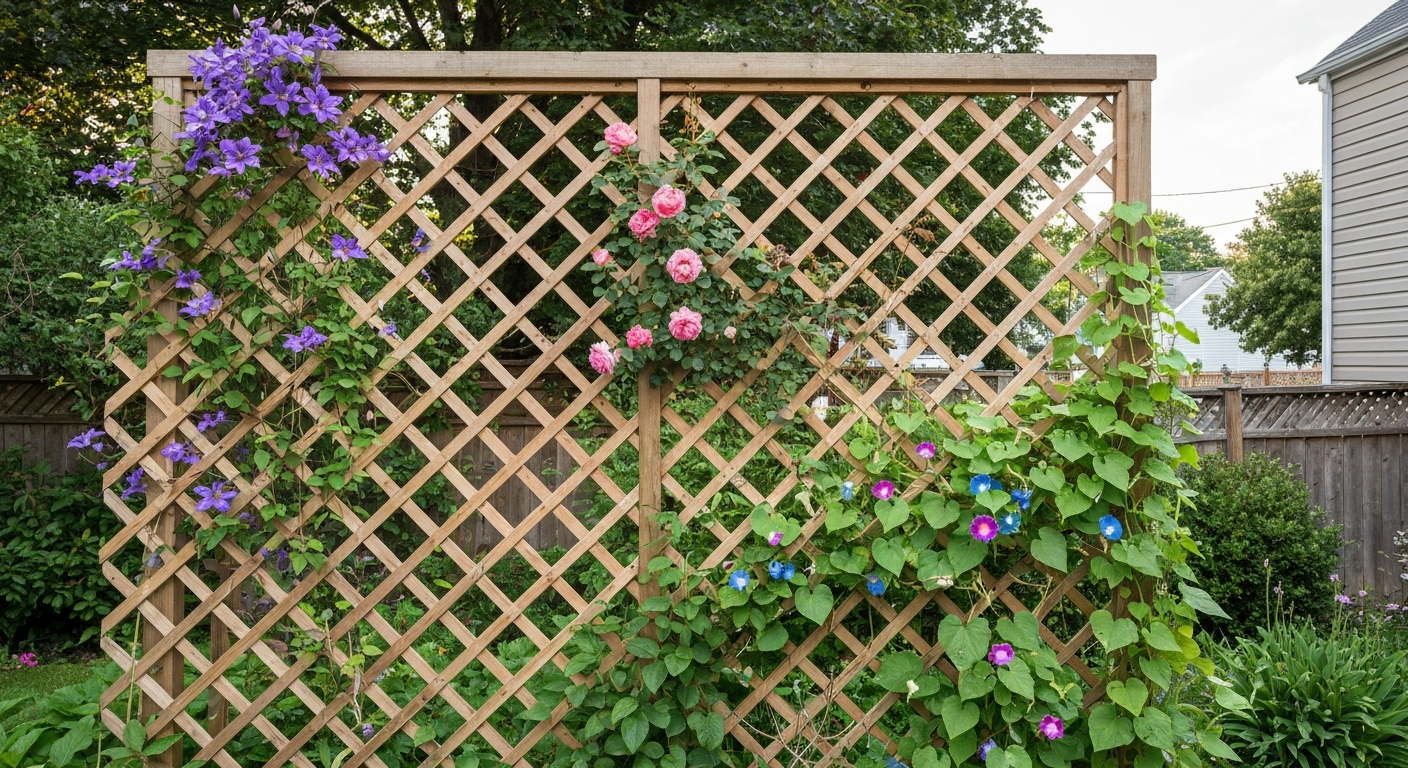
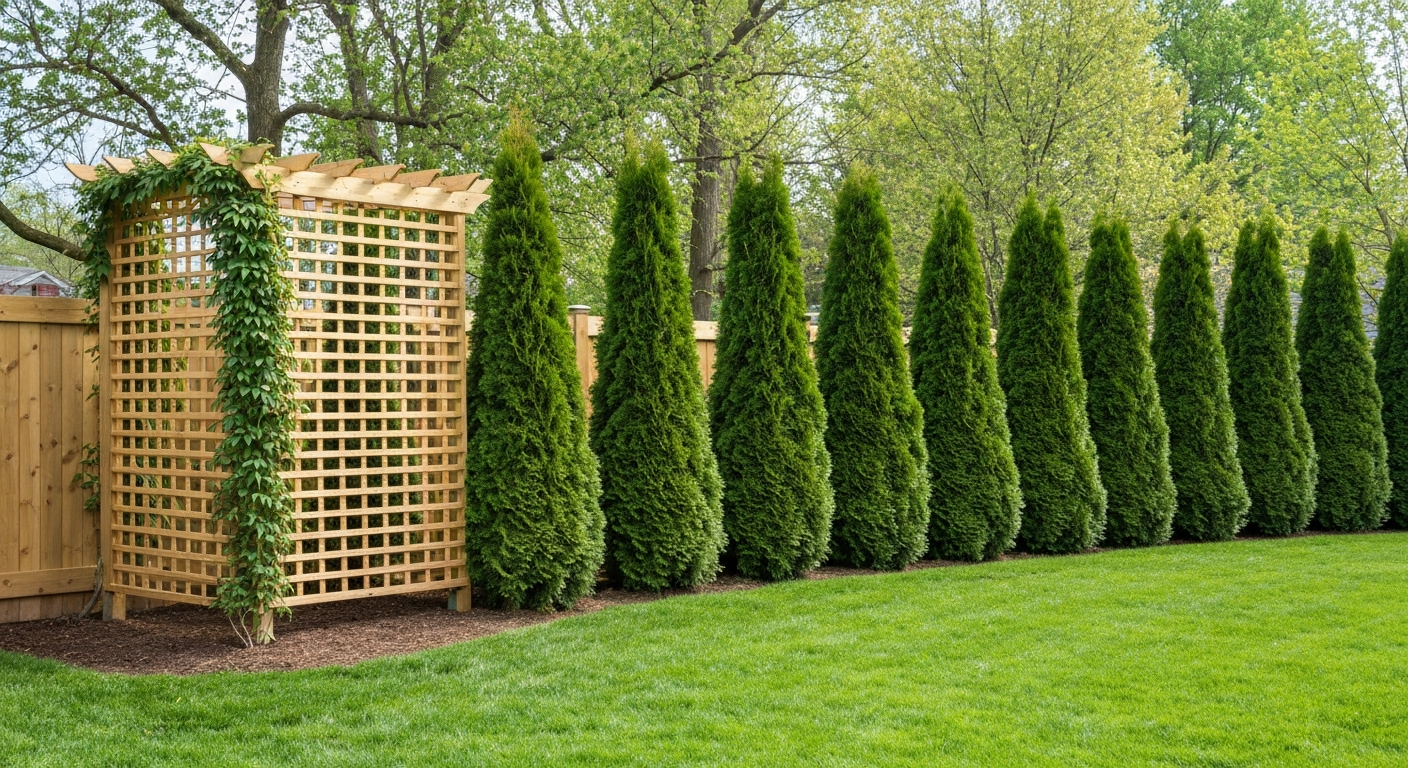
For most yards, Thuja 'Green Giant' is the single best answer: it reliably adds 3 to 4 feet per year, tops out at 40 to 60 feet, tolerates most soils, and stays evergreen year-round. If you need privacy within a single season, pair it with a fast annual climber like cypress vine on a temporary trellis while the thujas fill in. The right choice depends on your USDA zone, soil, available space, and whether you need privacy in two months or two years, and this guide walks through every combination.
What Plants Grow Tall Fast for a Privacy Screen, Top Picks
Rachel Hartley
25 Jul 2026
Top Picks at a Glance
Before diving into zone-by-zone details, here are the most reliable performers across each plant category. These are the ones I keep recommending because they deliver height on a predictable schedule without constant babysitting.
| Category | Best Fast Pick | Annual Growth Rate | Mature Height | USDA Zones | Best For |
|---|---|---|---|---|---|
| Evergreen Tree | Thuja 'Green Giant' | 3–4 ft/yr | 40–60 ft | 5a–8b | Year-round screening, most soils |
| Evergreen Tree | Leyland Cypress | 3–4 ft/yr | 50–70 ft | 6–10 | Quick dense hedge, mild climates |
| Deciduous Tree | Hybrid Poplar | 6–10 ft/yr | 50–70 ft | 3–9 | Fast temporary screen, large spaces |
| Shrub/Hedge | Arborvitae 'Emerald Green' | 1–2 ft/yr | 12–15 ft | 3–8 | Narrow lots, foundation screens |
| Running Bamboo | Phyllostachys aureosulcata | Up to 30 ft in yr 1 | 20–35 ft | 5–10 | Dense barrier (contained only) |
| Clumping Bamboo | Fargesia robusta | 2–3 ft/yr | 10–15 ft | 5–9 | Cold climates, no barrier needed |
| Climber (fast fill) | Wisteria / Clematis armandii | 10–20 ft/yr | 30+ ft on support | 5–9 | Lattice and fence coverage |
| Climber (annual) | Cypress Vine / Hyacinth Bean | 15–20 ft/season | 10–20 ft | All zones annual | Instant seasonal coverage |
A note on Leyland cypress: it earns its place on this list for speed, but I have watched mature plantings turn into expensive removal projects when they are not pruned regularly and start developing interior dieback or Seiridium canker. Go in with eyes open. Thuja 'Green Giant' handles neglect considerably better and holds its shape without constant intervention.
Fast Growers by Climate and USDA Zone
The 2023 USDA Plant Hardiness Zone Map update shifted a surprising number of zip codes one half-zone warmer compared to the 2012 map, so if you have not checked recently, look it up before buying plants rated for your old zone. What worked in zone 6b may now be comfortably zone 7a where you live.
Cold Climates (Zones 3–5)
In zones 3 through 5, winters eliminate a lot of the flashier options, but you have solid choices. Thuja 'Green Giant' is hardy to zone 5a and performs well throughout that range. For zones 3 and 4, shift to native arborvitae (Thuja occidentalis 'Techny' or 'Brandon') or the cold-tolerant clumping bamboo Fargesia robusta, which handles temperatures down to around -10°F without die-back and requires zero containment. Hybrid poplars (Populus deltoides × nigra clones) are a sleeper pick for the cold north: they push 6 to 10 feet of height per year under good conditions, survive zone 3 winters, and give you a tall visual screen in two to three growing seasons. The trade-off is they are deciduous, so winter privacy disappears, and the root systems are aggressive near pipes and foundations. Plant them at least 30 feet from any structure or utility line.
Temperate Zones (Zones 6–7)
This is the sweet spot for the widest selection. Thuja 'Green Giant' thrives here. Leyland cypress works well in zone 6 and 7 before heat and humidity start causing disease problems in zone 8 and warmer. Cryptomeria japonica 'Yoshino' is worth adding to your shortlist for zone 6b to 7b: it grows 2 to 3 feet per year, resists most diseases that plague Leyland, and develops a graceful pyramidal form that looks intentional rather than just functional. Running bamboo like Phyllostachys aureosulcata becomes viable in zone 6, though containment is absolutely non-negotiable (more on that below). For flowering privacy, Elaeagnus x ebbingei grows fast (2 to 3 feet per year), tolerates dry spells, and produces fragrant autumn flowers, it is one of the most underused screening shrubs in temperate gardens.
Warm and Tropical Zones (Zones 8–11)
Heat and humidity open up a whole different plant palette. Clusia rosea (pitch apple) is a standout: it tolerates aerosol salt, grows into a dense 20 to 25-foot screen, and handles drought once established. In deep South and Gulf Coast gardens (zones 9 to 11), Areca palm creates a lush tropical screen at 6 to 8 inches of height growth per month in the growing season. For zone 8 in the Southeast, Nellie Stevens holly packs on 3 feet per year, stays dense from top to bottom, and handles the humidity that kills Leyland cypress. In California's zone 9 to 10, Italian cypress (Cupressus sempervirens) is the go-to columnar screen: slow by this list's standards at about 2 feet per year, but nearly bulletproof in dry heat and drought.
Sun, Shade, and Soil: Matching the Plant to Your Actual Site
Most fast-growing privacy plants want full sun, at least 6 hours of direct sun per day. If your screening spot only gets 3 to 4 hours, your options narrow but do not disappear. For narrow, partially shaded walkways, check the guide on the best plants to grow between stepping stones for low-growing, shade-tolerant options that handle light foot traffic. Growth rates in shade will be roughly half of what you see in full sun, so adjust your timeline expectations accordingly.
Full Sun (6+ Hours)
This is where Thuja 'Green Giant', Leyland cypress, Nellie Stevens holly, hybrid poplars, and running bamboo all perform at their fastest. If you have full sun and decent drainage, you are working with the best conditions this list has to offer. Prioritize these in full sun over shade-tolerant alternatives, you will see noticeably faster establishment.
Part Shade (3–5 Hours) and Deep Shade
For part shade, American holly (Ilex opaca) and Inkberry (Ilex glabra) are honest performers. They grow more slowly (1 to 2 feet per year) but tolerate 3 to 4 hours of sun and wet conditions most conifers would not survive. Clumping bamboos like Fargesia nitida actually prefer afternoon shade in hot climates and maintain reasonable upward growth. In deep shade, under large deciduous canopies with less than 3 hours of direct sun, your realistic fast-privacy options are limited. Tall grasses like Miscanthus giganteus (giant miscanthus) can reach 10 to 12 feet in a single season and are surprisingly shade-tolerant, though they die back to the ground each winter.
Difficult Soils: Clay, Sandy, and Wet
- Clay soil: Thuja 'Green Giant' handles clay better than most conifers provided drainage is not waterlogged. Red twig dogwood (Cornus sericea) and Ilex species also tolerate clay well and can be massed into a functional screen.
- Sandy soil: Wax myrtle (Morella cerifera) thrives in poor sandy soil in zones 6 to 9, grows 3 to 5 feet per year, and provides year-round screening. Vitex agnus-castus (chaste tree) also tolerates sandy, dry conditions and grows rapidly once established.
- Wet or poorly drained soil: Baldcypress (Taxodium distichum) grows 2 to 3 feet per year in standing water or saturated soil and is one of the few tall trees that thrives in boggy sites. River birch (Betula nigra) grows fast in wet soil and adds beautiful multi-trunk structure, though it is deciduous.
- Salt-affected soil: In coastal zones where soil salinity is high, bayberry (Morella pensylvanica) and rugosa rose are among the toughest performers — though neither will give you 30 feet of height.
Container, Balcony, and Small-Space Privacy
Growing tall plants in containers for privacy is absolutely doable, but you need to be realistic about two things: root space and long-term maintenance. A plant that grows 4 feet per year in the ground will grow 1 to 2 feet per year in a pot, and it will need repotting or root pruning every two to three years to avoid becoming rootbound and stalling out entirely.
For balconies and patios, the best options are columnar or narrow-habit plants that stay manageable without constant pruning. Sky Pencil holly (Ilex crenata 'Sky Pencil') reaches 8 to 10 feet in a large container and stays under 2 feet wide, making it ideal for tight spaces. Bamboo in containers gets a lot of attention, but here is the honest reality: running bamboo in pots is not a sustainable long-term solution. The University of Maryland Extension's guide 'Containing and Removing Bamboo | University of Maryland Extension' warns that growing running bamboo in pots is not a reliable long-term containment method because rhizomes can escape through drain holes or fracture pot walls. Rhizomes will eventually escape through drainage holes or fracture the pot walls as the colony develops. Clumping bamboos like Fargesia in containers are much more manageable and will hold their form for several years before needing division.
Use containers that are at least 24 inches wide and 24 inches deep for columnar evergreens; 30 inches wide and deep for bamboo. When you buy nursery stock, check the root ball: if roots are tightly circling the inside of the pot, make four shallow vertical relief cuts down the sides of the root ball before planting or repotting, or gently tease the outer roots loose. Circling roots left uncorrected will eventually girdle the trunk and kill a plant that seemed perfectly healthy for years. When planting into a new container, go one size up, overpotting into something massively larger tends to hold excess moisture around roots before the plant has enough root mass to use it efficiently.
- Sky Pencil holly: 8–10 ft, stays 2 ft wide, zones 5–9, excellent in 24-inch containers
- Clumping bamboo (Fargesia spp.): 8–15 ft, works in large containers for 3–5 years before dividing, zones 5–9
- Columnar arborvitae 'Emerald Green': 10–15 ft, 3–4 ft spread, manageable in a half-barrel for 5+ years
- Italian cypress: 20–30 ft, 3 ft spread, containers in zones 7–10 (bring inside in cold climates)
- Tall grasses (Miscanthus sinensis 'Gracillimus'): 6–7 ft, lush seasonal screening, very container-friendly
Poolside Plants: Salt, Chlorine, Debris, and Safety
Choosing plants near a pool involves more trade-offs than almost any other garden situation. You are balancing privacy screening with pool maintenance, water safety, and plant survival in a sometimes harsh microclimate. Let me break down the key considerations before getting to specific plants.
Aerosol salt tolerance is the critical factor in coastal locations, and it is different from soil salinity tolerance. A plant might handle salty soil just fine but get scorched by salt spray blown from the ocean. UF/IFAS ratings identify Clusia rosea (pitch apple) as a high aerosol salt-tolerant species, which is why it appears so frequently in Florida pool landscaping. Areca palm (Dypsis lutescens) is rated moderate for aerosol salt and is one of the most pool-friendly tall screening plants in zones 9 to 11: it drops minimal debris, has no toxic components, and creates a lush tropical backdrop without the cleanup burden of flowering or fruiting trees.
Chlorine splash is less of a problem than people assume, occasional splash is tolerable for most plants, but constant overspray will damage foliage of sensitive species. The bigger pool-related problems are deciduous trees that drop leaves into the water (clogging filters and raising maintenance costs), plants with toxic berries or foliage near a space where children swim, and trees with invasive root systems near the pool structure.
| Plant | Aerosol Salt | Debris Risk | Toxicity Concern | Zones | Notes |
|---|---|---|---|---|---|
| Clusia rosea (Pitch Apple) | High | Low | Sap irritant | 9–11 | Best all-around poolside screen |
| Areca Palm | Moderate | Low-Moderate | None | 9–11 | Tropical, clean, lush |
| Podocarpus macrophyllus | Moderate | Low | Berries mildly toxic | 7–11 | Dense, columnar, easy to maintain |
| Thuja 'Green Giant' | Low | Low | Mildly irritant sap | 5–8b | Avoid coast; excellent inland pools |
| Nellie Stevens Holly | Low-Moderate | Moderate (berries) | Berries toxic | 6–9 | Keep berries away from water |
| Miscanthus (ornamental grass) | Low | Moderate (seeds) | None | 4–9 | Seasonal; debris management needed |
For more detail on plants that thrive specifically in pool settings, including root-safe choices near pool structures, there is a dedicated guide to plants that grow well around a pool on this site worth consulting alongside this one. See the site's guide on what plants grow well around a pool for a detailed list of root-safe, low-debris, and non-toxic options.
Realistic Growth Timelines: What to Expect Year by Year
The most common mistake I see is buying a plant for its mature height without factoring in how long it will take to get there, or worse, believing marketing descriptions that lump together growth in ideal nursery conditions. Here are honest, site-appropriate timelines for the most useful screening plants.
| Species | Year 1 | Year 3 (cumulative height from planting) | Year 5 (cumulative height) | Mature Height |
|---|---|---|---|---|
| Thuja 'Green Giant' | 3–4 ft added | 10–14 ft total | 18–24 ft total | 40–60 ft |
| Leyland Cypress | 3–4 ft added | 12–14 ft total | 20–25 ft total | 50–70 ft |
| Hybrid Poplar | 6–10 ft added | 18–30 ft total | 30–45 ft total | 50–70 ft |
| Nellie Stevens Holly | 2–3 ft added | 8–12 ft total | 16–20 ft total | 20–25 ft |
| Running Bamboo (Phyllostachys) | Culms reach full height yr 1 | Dense grove forming | Established grove | 20–35 ft |
| Clumping Bamboo (Fargesia) | 1–2 ft added | 5–8 ft total | 8–12 ft total | 10–15 ft |
| Italian Cypress | 1.5–2 ft added | 6–8 ft total | 10–12 ft total | 40–70 ft |
| Annual Climber (on trellis) | 10–15 ft in one season | N/A (annual) | N/A | 10–20 ft season height |
A note on bamboo: running bamboo culms genuinely reach their full height in the first year they emerge. What takes time is the colony thickening and filling in horizontally. So in year one you might have five culms at 20 feet tall with lots of gaps between them. By year three, if the colony has been properly contained and fed, those gaps close. The speed is real, but the instant-screen promise is slightly misleading if you start with a small nursery division.
Paulownia (empress tree) deserves a mention because it genuinely does grow multiple meters per year under managed conditions, some sources document more than 15 feet in a single growing season. I am not recommending it broadly because it is invasive across much of the eastern United States, produces enormous quantities of viable seed, and resprouts aggressively if cut. Unless you are in a region where it has been assessed as non-invasive and you are willing to actively manage seed removal, the risk of it escaping into adjacent wild areas is too high.
Short-Term vs Long-Term Privacy: Pairing Fast Fillers with Permanent Screens
The smartest privacy strategy I know is layered timing: plant your long-term structure now, then fill the gaps for the next three to five years with fast, inexpensive fillers while the permanent plants mature. This is almost always better than either waiting years for slow permanent plants or relying entirely on fast-growing species that require intensive long-term management.
A good example combination: plant Thuja 'Green Giant' at 8-foot spacing as your permanent backbone, then plant annual climbers like hyacinth bean or cypress vine on a temporary wire fence in the gaps during the first two summers. By year three, the thujas are typically 12 to 15 feet tall and beginning to close canopy, and you can remove the temporary support entirely. Another pairing that works particularly well is planting ornamental grasses like Miscanthus 'Gracillimus' between young arborvitaes: the grasses reach 6 to 7 feet in the first season and provide immediate summer screening while the trees establish. The grasses can be reduced or removed once the conifers fill in.
For fence-based screening while trees mature, fast-growing lattice climbers (like climbing hydrangea, Clematis armandii, or evergreen jasmine depending on your zone) can cover a fence in two to three seasons and provide year-round or near-year-round coverage. That topic connects naturally to the site's guide on plants that grow well on lattice if you are considering a structure-based approach for part of your screen.
| Role | Plant Options | Timeline to Coverage | Lifespan Strategy |
|---|---|---|---|
| Immediate filler (seasonal) | Annual climbers, tall grasses, Miscanthus | 1 season | Remove or reduce as permanent plants mature |
| Medium-term filler (3–5 yr) | Leyland cypress, fast shrubs, ornamental grasses | 2–3 seasons | Optionally thin or remove at year 5–7 |
| Long-term permanent screen | Thuja 'Green Giant', Nellie Stevens holly, Cryptomeria | 5–10 yr to full effect | Remain as primary screen indefinitely |
| Lattice/fence coverage | Clematis, evergreen jasmine, climbing hydrangea | 2–3 seasons on structure | Maintain on structure; trim annually |
Bamboo: The Speed Champion with Real Strings Attached
I want to give bamboo its own section because the advice here is non-negotiable if you want to avoid a serious problem. Running bamboos, the Phyllostachys species that most people buy for screens, are genuinely among the fastest privacy plants available. They are also the ones most likely to invade your neighbor's property, crack concrete, and cause legal headaches.
University of Maryland Extension and University of Georgia Extension both specify the same containment standard: install a continuous underground barrier 30 to 36 inches deep using minimum 60 mil HDPE or polypropylene sheeting (80 mil for vigorous species), with the top edge of the barrier left 6 to 8 inches above ground level. The barrier must be inspected every spring when shoots emerge and any rhizomes attempting to cross over the top must be cut back immediately. Mulch and leaf litter should be kept clear of the barrier lip, it gives rhizomes a ramp over the top edge and defeats the whole system.
Growing running bamboo in a pot as a containment strategy is a myth. Rhizomes escape through drainage holes or eventually fracture pot walls as the colony develops pressure. Do not trust a pot alone for long-term running bamboo containment unless you are actively repotting and dividing every single year.
If your climate is zone 5 to 8 and you want bamboo without the containment headache, Fargesia robusta (clumping bamboo) is the answer. It grows in a tidy expanding clump, reaches 10 to 15 feet, and has never given me a rhizome problem. It is slower, but the trade-off in maintenance saved is worth it for most home gardeners.
Neighbor, Legal, and Invasiveness Considerations
Before you plant anything near a property line, spend ten minutes on two things: checking your local municipal code for hedge and fence height restrictions, and talking to your neighbor. Many jurisdictions have specific rules about how tall a hedge or screen can be before it constitutes a nuisance, and those rules vary enormously from town to town.
On encroachment: in most U.S. states, a property owner has the right to trim branches or roots that cross their property line back to the line, but liability for damage caused by that trimming, notice requirements before cutting, and what happens with a boundary tree (one straddling the line) vary significantly by state. If you are planting near a shared boundary and the trees are likely to overhang or root into a neighbor's property within a few years, it is worth a short conversation upfront. It is also worth checking your state's invasive species list before purchasing, several fast-growing trees, including some Populus clones and Paulownia, are on restricted or prohibited lists in certain states.
How to Plant and Care for Fast-Growing Privacy Plants
Speed of growth is as much about what you do at planting and in the first growing season as it is about species choice. I have seen people plant the fastest-growing conifer available into compacted, unamended clay, give it a handful of fertilizer, and then wonder why it barely moved. Here is a method that actually works.
Soil Preparation and Amendments
Dig your planting hole two to three times the width of the root ball and the same depth, no deeper. Planting too deep is one of the most reliable ways to kill a tree slowly. If your soil is compacted clay, loosen the surrounding soil area with a broadfork or subsoiler to at least 18 inches depth before digging individual holes. Amending the hole with straight compost sounds helpful but can actually create a drainage trap that holds water around roots in clay soils. Instead, mix compost broadly into the surrounding planting area, not just into the hole. For sandy soils that drain too fast, incorporating a layer of aged compost or organic matter throughout the bed improves water retention without creating compaction.
Mulching
Apply 3 inches of coarse wood chip mulch in a 3 to 4-foot diameter circle around each plant, keeping it 2 to 3 inches away from the trunk. This single step reduces moisture competition, moderates soil temperature, and suppresses weeds that would otherwise compete with young roots during the critical establishment period. I consider mulching non-negotiable for fast-growing privacy plants, the research on root zone moisture retention consistently shows measurable growth improvement.
Staking
Most container-grown privacy trees do not need staking unless you are on a very exposed, windy site or the root ball is seriously top-heavy relative to canopy. If you do stake, use wide, nonabrasive tie material (flat nylon webbing, not wire) placed low on the trunk, around the bottom third, and plan to remove stakes within one growing season, two at the absolute maximum. Leaving stakes longer than that prevents the trunk from developing the taper and strength it needs, and tight ties left in place will girdle a tree within a few years.
Watering Schedule
The first six to twelve months after planting are when water is most critical, and also when most people either overwater (drowning roots in heavy soil) or underwater (letting new transplants stress in summer heat). A reliable rule of thumb for most newly planted trees and shrubs: water deeply once or twice per week in the absence of rain during the first full growing season, targeting the root ball directly rather than a wide area. After the first year, gradually reduce frequency to encourage roots to go deeper seeking moisture. By year two or three, most established conifers and hardy shrubs need supplemental water only during drought periods.
Fertilizing for Maximum Height Gain
For conifers like Thuja and Leyland cypress, a slow-release balanced fertilizer (10-10-10 or similar) applied in early spring as growth resumes is the standard approach. Do not fertilize in late summer or fall in cold climates, pushing new growth in August or September means that tender growth will not harden off before frost and you will lose it. For bamboo, nitrogen is the key driver of culm height: a high-nitrogen fertilizer (like a 30-10-10) applied in spring when shoots first emerge and again six weeks later will meaningfully increase both culm count and height. Deciduous fast-growers like hybrid poplars respond well to a spring application of granular nitrogen, and because they are growing so aggressively, they can take a second application in early summer without the cold-climate risk concern.
Pruning for Privacy Shape and Health
For evergreen conifers used as a privacy screen, the most important pruning job is formative: establish a single central leader early by removing competing tops, and allow lower branches to remain as long as possible in the early years to build a dense base. Avoid heavy shearing, which removes the outer foliage layer and exposes brown interior wood that will not regenerate. Use thinning cuts instead, cutting branches back to a lateral rather than shearing across the whole surface. For spring-flowering privacy shrubs (like Forsythia or Viburnum used as informal screens), prune immediately after bloom since they set next year's flower buds on old wood. Summer-blooming shrubs used for screening should be pruned in late winter or early spring before growth resumes, per Penn State Extension guidelines.
Seasonal Timing Summary by Climate
| Task | Cold Zones (3–5) | Temperate Zones (6–7) | Warm Zones (8–11) |
|---|---|---|---|
| Best planting window | Spring (after last frost) or early fall | Spring or fall | Fall through early spring |
| Fertilize (conifers/shrubs) | Early spring (May) | March–April | February–March |
| Bamboo nitrogen feed | May + June | April + May | March + April |
| Mulch refresh | Spring before heat | Spring | Fall or spring |
| Prune evergreen screens | Late winter, avoid fall | Late winter to early spring | Late winter |
| Remove stakes | After first full season | After first full season | After first full season |
| Bamboo rhizome inspection | May–June (shoot season) | April–May | March–April |
One final thought on the whole project: if you are screening for privacy, the combination of a solid evergreen backbone planted well with proper soil preparation, consistent watering, and an annual feed will almost always outperform a fast-growing tree planted into a poorly prepared site with no follow-up. Plants that grow well on lattice or as ground covers can also contribute to a layered landscape that provides screening at multiple heights, privacy is often as much about filling mid-level sight lines as it is about sheer height.
FAQ
Which fast-growing trees, shrubs, bamboos and climbers are best for an effective privacy screen?
Top reliable, fast options by plant type: trees — Thuja 'Green Giant' (evergreen), Leyland cypress, hybrid poplars and silver maple (deciduous); shrubs — Ligustrum (privet), Elaeagnus umbellata (silverberry) where not invasive, Photinia × fraseri; bamboo — clumping species (Fargesia spp.) for low-risk; running bamboos (Phyllostachys spp.) for very fast screening but require strict containment; climbers — evergreen: Trachelospermum jasminoides (star jasmine), Bignoniaceae vines for rapid summer cover, and fast deciduous vines like Pueraria (kudzu is invasive — avoid). Choose evergreen conifers for year‑round screening and deciduous trees/shrubs when summer privacy suffices.
How fast will these plants reach screening height (growth timelines I can expect)?
Typical growth rates under good conditions: Thuja 'Green Giant' and Leyland cypress ~3–4 ft (0.9–1.2 m)/yr; vigorous hybrid poplars and some Paulownia clones can average 3–10 ft (1–3 m)/yr (Paulownia has invasive risk); many fast deciduous trees (silver maple) ~2–6 ft (0.6–1.8 m)/yr; clumping bamboos often produce 2–6 ft/yr of new culms height in suitable climates; running bamboo can produce full-height culms in the first season and spread laterally many feet/yr if uncontained. Container-grown specimens and poor soils slow these rates; irrigation, fertilizer and correct planting speed establishment dramatically.
Which species are best by USDA hardiness zones and sun/shade conditions?
General guidance: Zones 5–8: Thuja 'Green Giant', Leyland cypress (full sun to part shade); Zones 7–10: many bamboos (Phyllostachys, Fargesia), Photinia, Elaeagnus; cold climates (zones 3–5): hybrid poplars, fast maples; shade: choose shade‑tolerant evergreens/shrubs (Fatsia japonica, some hollies, Fargesia clumping bamboo) or train shade‑tolerant climbers on supports. Always check the specific cultivar hardiness and the USDA Plant Hardiness Zone Map for your ZIP (USDA ARS interactive lookup).
What are the best container options for fast privacy plants and which species should I avoid in pots?
Good container choices: clumping bamboos (Fargesia spp.), evergreen hollies (Ilex crenata), Thuja 'Green Giant' temporarily (large tubs while young), fast-growing shrubs like Ligustrum in large containers. Avoid long‑term containment of running bamboo (Phyllostachys) — pots often fail to contain rhizomes long‑term. Use large, frost‑resistant containers (≥30–40 gal for multi‑year growth), high‑quality soilless mix, regular feeding and annual pot size increases or root pruning to maintain vigor.
How should I plant and prepare soil to speed establishment and vertical growth?
Stepwise planting/care to maximize early height: pick correct species for the site and season (spring/fall best for most zones); dig a planting hole 1.5–2× root-ball width, loosen backfill to encourage roots, incorporate modest organic matter only if soil is very poor, avoid deep planting (top of root ball flush with soil). Tease circling roots or make vertical relief cuts on container stock. Install irrigation/drip lines for consistent moisture while roots establish. Apply a low‑salt, slow‑release balanced fertilizer after the first growing season or per species recommendations. Mulch 2–3 in (50–75 mm) away from trunk to conserve moisture and moderate soil temperature.
What pruning and maintenance schedule will keep a tall screen dense without weakening plants?
Young plants: formative pruning to select and maintain central leaders and desired profile. Hedges/evergreen screens: light annual thinning or selective cuts rather than heavy shearing; time pruning by flowering habit (prune spring‑flowering shrubs immediately after bloom; prune new‑wood bloomers in late winter/early spring). For fast conifers (Leyland), prune 1–2×/yr to control width and encourage interior foliage; avoid removing all lower branches or heavy top cuts that stress trees. Remove dead/diseased wood promptly. Fertility/water checks midseason maintain steady growth to avoid leggy plants requiring severe cutting.
Next Article
What Plants Grow Well on Lattice: Best Climbers & Care
Best plants for lattice: privacy, edible, ornamental, evergreen & indoor. Choose lattice, plant, train, prune, maintain.