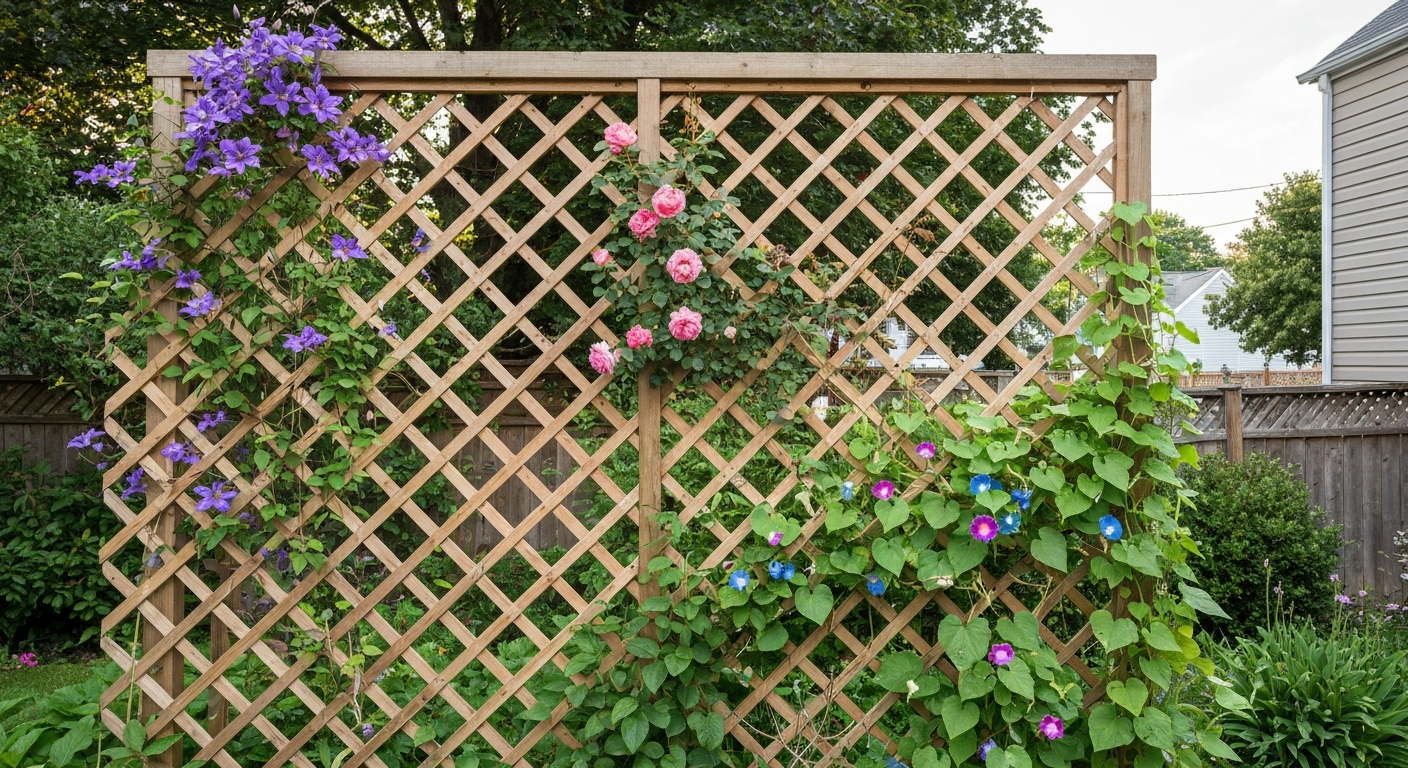
The best plants for lattice are climbing roses, clematis, jasmine, sweet peas, morning glories, passionflower, cucumbers, beans, Virginia creeper, and hops, depending on whether you want food, flowers, shade, or a year-round screen. The right pick comes down to four things: what you want the plant to do, how your lattice is built, how much sun the spot gets, and whether you're planting in the ground or a container. Get those four factors right and almost any climber you choose will perform well.
What Plants Grow Well on Lattice: Best Climbers & Care
Rachel Hartley
18 Jul 2026
When and why lattice actually makes sense in a garden
Lattice earns its place in a garden by turning vertical space into productive or beautiful real estate. A bare fence line, a blank wall, the side of a shed, or the edge of a deck can all become a living feature once you give climbers something to grab. Beyond looks, lattice does practical work: it creates privacy screens in tight urban yards, blocks wind, shades a hot patio, hides utility areas, and adds a second growing layer to small spaces. If you're growing edibles, climbing beans and cucumbers on a lattice also keep fruit off the ground and cut down on disease pressure.
Lattice is especially worth using when you need privacy or screening but want to avoid the visual weight of a solid fence or wall. A lattice covered in foliage looks open and natural from certain angles while still blocking sightlines. It's also a smart choice for renters or anyone who doesn't want a permanent structure, since a freestanding lattice panel in a large pot can be moved when you need to.
Quick decision checklist: pick your plant, lattice, and timeline in 5 minutes
Run through these questions before you buy anything. Each answer points you toward a specific section of this article where you'll find matching plant recommendations.
- What do you want from the plant? (Privacy screen, food, flowers, evergreen coverage, or indoor decoration) — go to the purpose section.
- How tall and strong is your lattice? Panels under 6 ft and lightweight wood can only support annual vines or young clematis. Heavy wooden or metal lattice can handle wisteria, grapes, or kiwi.
- How much sun does the spot get? Full sun (6+ hours), part shade (3–6 hours), or deep shade (under 3 hours) — each has a dedicated plant list below.
- Are you in a container or planting in the ground? Containers limit root volume and restrict which perennial climbers will thrive long-term.
- What's your USDA hardiness zone? Check the 2023 interactive USDA map if you're unsure. Zone determines whether a perennial climber survives winter at your location.
- How fast do you need coverage? If you need a screen by late summer, choose a fast annual (morning glory, scarlet runner bean). If you're playing a longer game, perennials build better structure.
- How much time can you give it? Wisteria and roses need regular pruning. Morning glories and sweet peas are basically self-managing.
How lattice type, height, and strength shape your plant options
Not every lattice can support every climber, and this is where a lot of gardeners run into trouble. A lightweight pressure-treated cedar lattice panel from a hardware store is fine for lightweight annual vines but will buckle under the weight of a mature wisteria or an established grape. Before you even think about the plant, look hard at the structure.
Lattice materials and what they can hold
| Lattice Type | Max Weight Suitable For | Best Plant Matches | Lifespan |
|---|---|---|---|
| Thin cedar/pine panel (3/8 in strips) | Lightweight annuals only | Morning glory, sweet pea, lightweight beans | 5–10 years |
| Thick hardwood or redwood (1 in+ strips) | Medium perennial vines | Clematis, passionflower, climbing rose | 15–25 years |
| Metal (powder-coated steel or aluminum) | Heavy woody vines | Wisteria, kiwi, grape, trumpet vine | 25+ years |
| PVC/vinyl lattice | Lightweight to medium annuals and perennials | Morning glory, clematis, jasmine | 20+ years but flexible — avoid heavy vines |
| Welded wire or cattle panel | Any vine including heavy producers | Hops, grapes, cucumbers, kiwi, beans | 20+ years with proper posts |
Opening size matters as much as strength. Most twining vines need supports with a diameter under 1 to 2 inches so they can wrap around them. Large solid boards or thick posts offer nothing for a tendril to grab. Diamond-pattern lattice with 2 to 4 inch openings works well for most tendril and twining climbers. Very small openings (under 1 inch) can actually slow adhesive-root climbers, which need surface contact more than gaps.
Height is a practical constraint too. If your lattice tops out at 6 feet, hops will simply run out of room, since they routinely hit 16 to 25 feet in a single season. Match the ultimate height of your plant to the height of the structure, or plan to redirect growth outward once it tops the lattice.
Choosing by purpose: privacy, edibles, ornamentals, evergreens, and indoor lattice
Privacy screens
For a fast privacy screen, Virginia creeper, hops, or scarlet runner beans get you covered in a single season. Virginia creeper is a perennial that adds 3 to 6 feet per year and gives you fall color as a bonus. For a denser evergreen screen, English ivy (Hedera helix) holds its foliage year-round in Zones 4 through 9, though it needs a strong structure and disciplined management to stop it spreading where you don't want it. Evergreen clematis (Clematis armandii) is a good choice in Zones 7 to 9 for a flowering evergreen screen. If you want tall, fast, and manageable, check out recommendations for fast-growing tall plants for privacy screening, which pairs naturally with lattice setups. For specific suggestions, see our guide on what plants grow tall fast for a privacy screen. For more detailed lists and site-specific picks, see our guide to the best plants to grow for privacy.
Edibles on lattice
Cucumbers, pole beans, and scarlet runner beans are the easiest edible climbers for lattice. They're annuals, so there's no winter management, and they fruit better when grown vertically because air circulation reduces mildew. Passionfruit (Passiflora edulis) is a stunning edible option for Zones 9 to 11 and is worth the effort if you're in a warm climate. Grapes and kiwi are productive long-term edible climbers but need heavy, permanent trellis and take 2 to 4 years to hit productive age. For grapes in containers, use a minimum of 15 to 20 gallons per vine, and for kiwi go even larger. Hops are worth growing if you brew beer or want a dramatic summer screen, reaching 16 to 25 feet in a single season on a tall, sturdy support.
Ornamental climbers
Clematis is the ornamental climber most experienced gardeners reach for first, and for good reason. It flowers prolifically, comes in hundreds of cultivars spanning Zones 4 to 9, and combines beautifully with climbing roses. Climbing roses add structure and repeat blooms but need ongoing deadheading and light pruning. Passionflower (Passiflora) brings exotic, striking blooms in summer. Jasmine (Jasminum officinale) is fragrant and fast-growing, suited to Zones 7 to 10. For a dramatic, fast result, trumpet vine (Campsis radicans) is hard to beat in Zones 4 to 9, though it will spread aggressively if you don't stay on top of it.
Evergreen options
Most popular climbers are deciduous, which means your lattice looks bare from November through March in colder zones. For year-round coverage, English ivy is the most reliably evergreen option in temperate climates. Star jasmine (Trachelospermum jasminoides) is evergreen in Zones 8 to 10 and carries a strong fragrance. Clematis armandii covers the evergreen clematis role in mild climates. In colder zones (4 to 6), the honest answer is that truly evergreen screening vines are rare, and you may need to accept deciduous coverage or supplement with an evergreen shrub espaliered behind the lattice.
Indoor and balcony lattice
For indoor or covered balcony use, pothos (Epipremnum aureum), climbing philodendrons, and Ficus pumila are reliable lattice climbers in containers. They attach readily to surfaces and tolerate lower light than outdoor climbers. Keep pots deep enough (at least 12 inches) and away from cold drafts. Outdoors on a covered balcony, sweet peas and morning glories in 5-gallon pots with a lattice panel are a neat, seasonal solution that doesn't require any structural commitment.
How climbing plants actually grab: knowing the growth habit before you buy
Every climber attaches to supports differently, and choosing the wrong plant for your lattice type is one of the most common reasons climbers fail or damage structures. There are four main climbing strategies you need to know.
Twining vines
Twining vines wrap their stems directly around supports. They need supports with a diameter under 1 to 2 inches so the stem can encircle them. Wisteria, morning glory, hops, honeysuckle, and scarlet runner bean are all twiners. These plants work brilliantly on open lattice, wire, or thin posts. The catch with twiners is that they can squeeze thin supports very tightly over time. Wisteria stems become woody and thick enough to crush PVC pipes and crack weak wooden frames over decades, so always pair twiners with supports rated for the mature vine weight.
Tendril climbers
Tendril climbers use modified leaves or stem structures to locate and coil around thin supports. Grapes, passionflower, peas, cucumbers, and many squash family plants use this strategy. They need thin vertical wires, open lattice, or string to feel and grab. Tendrils usually work best when lattice openings are 2 to 4 inches and there are thin horizontal or vertical elements to coil around. These plants won't self-attach to a flat wall and don't need any tying once the tendrils find a support.
Adhesive-root climbers
English ivy, Virginia creeper, Boston ivy, and Ficus pumila produce rootlets or adhesive pads that stick directly to surfaces, including masonry, brick, wood, and concrete. They don't need open lattice in the same way twiners do. In fact, they'll cover a flat wall entirely without any lattice at all. The downside is that those adhesive structures can lodge in mortar cracks, retain moisture, and cause slow structural damage to historic or soft masonry over time. On a purpose-built lattice or wood fence, they're fine. Don't grow them on a brick house wall you care about.
Espaliered shrubs and scrambling plants
Some plants don't truly climb at all but can be trained flat against a lattice with ties and regular attention. Climbing roses are technically scrambling shrubs with hooked thorns that lean rather than climb. Espalier fruit trees (apple, pear, fig) can be trained in flat, formal patterns against a lattice or wall. These plants require the most active management but create some of the most attractive and productive vertical features you can build.
The ranked lists: best plants for lattice overall and by purpose
Overall top performers
- Clematis (Groups 1, 2, and 3 combined) — widest range of zones, colors, and sizes; pairs well with any medium-strength lattice
- Morning glory (Ipomoea purpurea) — fastest coverage for annual screens, easiest to grow, excellent in containers
- Climbing rose — best combination of beauty and structure; suits any medium to heavy lattice
- Virginia creeper (Parthenocissus quinquefolia) — best perennial for fast, wide coverage and fall color; very low maintenance once established
- Passionflower (Passiflora caerulea) — most dramatic flowers, surprisingly tough in Zones 6 to 9
- Sweet pea (Lathyrus odoratus) — best fragrant annual, ideal for spring coverage before summer perennials fill in
- Cucumber — best edible annual for lattice; productive and easy to harvest when grown vertically
- Scarlet runner bean — best dual-purpose edible and ornamental annual; striking red flowers, fast coverage
- Jasmine (Jasminum officinale or Trachelospermum jasminoides) — best fragrant perennial for warm zones
- Hops (Humulus lupulus) — best for dramatic seasonal height; 16 to 25 feet in a single growing season
Top picks by purpose
| Purpose | Top Pick | Runner-Up | Zones | Notes |
|---|---|---|---|---|
| Privacy screen (fast) | Virginia creeper | Hops | 3–9 | Virginia creeper is perennial; hops die back annually |
| Privacy screen (evergreen) | English ivy | Star jasmine | 4–9 (ivy); 8–10 (star jasmine) | Ivy needs management to prevent spread |
| Edible | Cucumber | Pole beans / Scarlet runner bean | Annual | Both thrive in containers or in-ground |
| Productive perennial edible | Grape (Vitis spp.) | Kiwi (Actinidia arguta) | Grape Z5–9; Kiwiberry Z4–9 | Need heavy trellis and 2–4 yrs to produce |
| Ornamental flowers | Clematis | Climbing rose | 4–9 (most cultivars) | Pair together for best display |
| Fragrance | Sweet pea (annual) | Jasmine (perennial) | Sweet pea: any; Jasmine Z7–10 | Sweet pea fades in summer heat |
| Indoor/balcony container | Pothos | Climbing philodendron | Indoor / Zones 10–12 outdoors | Tolerates low light |
| Dramatic height | Hops | Wisteria (strong structure required) | Hops Z4–8; Wisteria Z5–9 | Wisteria needs heavy permanent support |
Speed, maintenance, and seasonal performance
Fast growers for quick coverage
If you need a screen by the end of summer, stick to annuals. For smaller-scale ideas or groundcover alternatives, see our guide to the best plants to grow between stepping stones for low-growing, foot-tolerant options that pair well with lattice-backed plantings. Morning glories and sweet peas can reach 8 to 15 feet in a single season from direct-sown seed. Scarlet runner beans reach 6 to 10 feet with edible pods. Hops are in a category of their own, hitting 16 to 25 feet from dormant rhizomes in one season, but they need a very tall support and you need to be comfortable with the fact that the whole top growth dies back each winter. blank" rel="noopener noreferrer">Florida Edible Garden Plants: Hops (UF/IFAS) reports hops can reach 16–25 feet in a single season. Among perennials, trumpet vine and wisteria are the fastest, adding 5 to 15 feet per year under good conditions, but both require serious structural support and disciplined pruning or they'll take over.
Low-maintenance choices
Virginia creeper is the lowest-maintenance perennial climber for lattice. Plant it, water it for the first season, and it largely takes care of itself. Boston ivy is similar. Both are deciduous and provide spectacular fall color in Zones 4 to 9. Among flowering climbers, passionflower is surprisingly self-sufficient once established: it blooms heavily, dies back in colder zones and re-sprouts from the root, and needs very little intervention. For annual options, morning glories and nasturtiums need almost no attention once established. Avoid wisteria and trumpet vine if you want low maintenance, they're beautiful but genuinely demanding.
Seasonal performers and timing
Sweet peas are a cool-season performer. In most of the US they go in as soon as the soil is workable in late winter or early spring (January or February in mild climates like coastal California or the Southeast; March to April in the Northeast and Midwest), and they fade when temperatures hit the upper 70s consistently. Morning glories are the opposite: plant them after your last frost date and they peak in late summer through fall. Clematis timing depends on pruning group (more on that below). Group 3 clematis like Jackmanii bloom on new wood and can be cut back hard in early spring to refresh; Group 1 bloom on old wood and should not be pruned in fall.
Pruning and training: the basics that save you from big mistakes
The single most common mistake with lattice climbers is not knowing when to prune. With clematis especially, pruning at the wrong time means no flowers that year. Clematis fall into three pruning groups: Group 1 bloom on old wood in early spring and should only be lightly tidied after flowering. Group 2 bloom on both old and new wood and need light pruning in late winter plus tidy cuts after the first flush. Group 3 bloom only on current-season growth and can be cut back to 12 inches from the ground in late winter without losing any blooms. Always confirm your cultivar's group before you make a cut.
For annual vines, training is simple: direct young stems toward the lattice at planting, use a few loose ties to point them in the right direction, and they'll self-navigate from there. For climbing roses, tie new canes horizontally along the lattice as they grow. Horizontal training stimulates more lateral shoots, which produces far more flowers than letting canes grow straight up. Wisteria needs two pruning sessions per year: a hard cut in late winter to reduce whippy growth to two or three buds from the main framework, and a summer shortening of new shoots to about 5 leaves in July to August. Skip either session and the plant becomes a tangled, non-flowering mass.
Best plants for specific sites: sun, shade, and tough spots
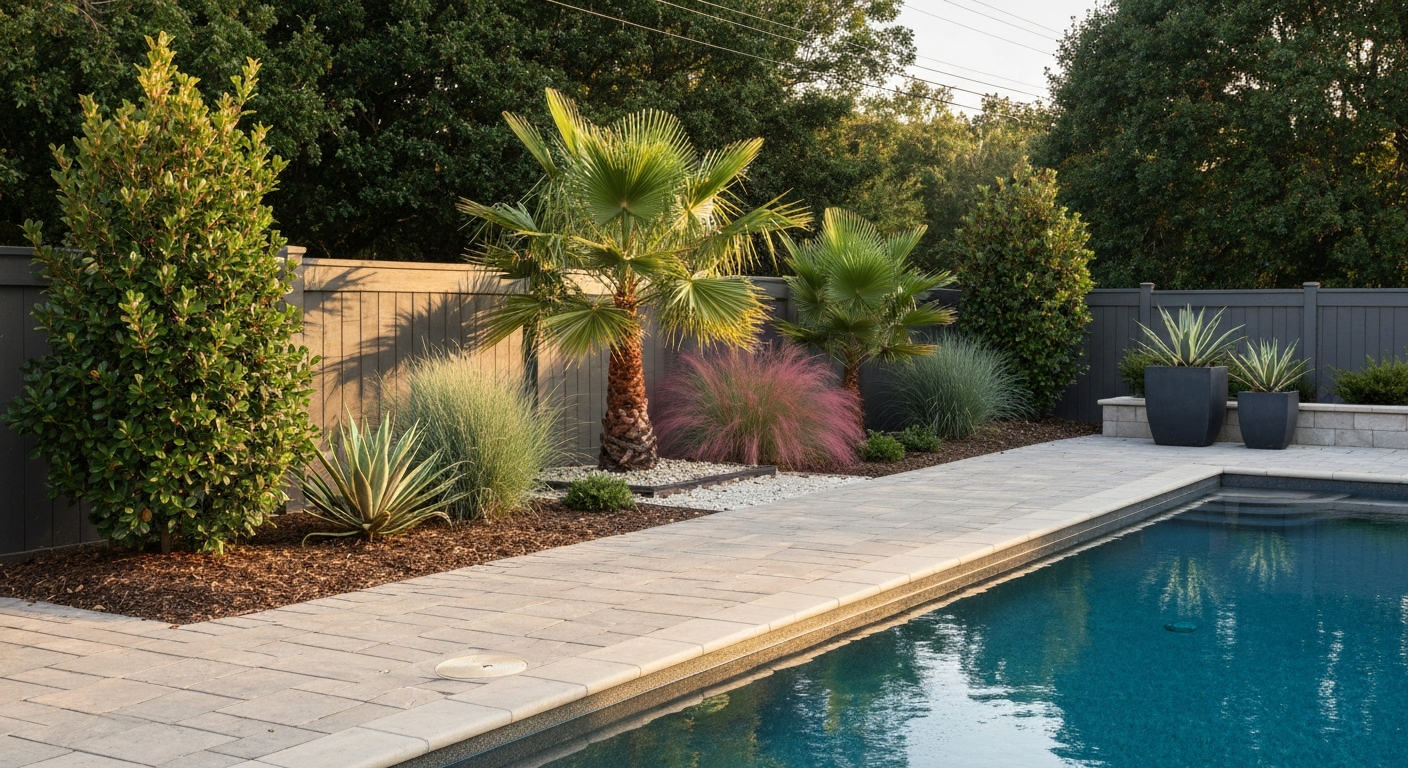
Site conditions narrow your choices faster than almost anything else. Here's how to match plants to your actual spot, not an idealized one. If you're planting near water, check our guide on what plants grow well around a pool for species that tolerate splash, chlorine, and high humidity. For low-maintenance solutions that complement lattice plantings, see best ground cover for hard to grow areas.
Full sun (6 or more hours of direct sun)
Most climbers perform best in full sun. Morning glory, scarlet runner bean, hops, trumpet vine, passionflower, climbing rose, and grape all want maximum sun. Clematis is slightly different: the classic RHS guidance is 'heads in sun, roots in shade,' meaning the flowers want sun but the root zone should be kept cool. In hotter climates like Texas or Arizona in August, a light mulch over the root zone or a companion low shrub in front of the clematis will make a measurable difference in plant health and flowering.
Part shade (3 to 6 hours of sun)
Sweet peas actually prefer cooler, part-shaded conditions and will bolt to seed faster in full sun during warm spells. Climbing hydrangea (Hydrangea anomala petiolaris) is one of the best choices for a shadier wall lattice, reaching 30 to 80 feet eventually with adhesive rootlets, white lace-cap flowers, and good fall color. Shade-tolerant jasmine cultivars and some clematis (particularly the late-flowering viticella types) also manage well in dappled shade, though flowering is reduced compared to full sun.
Deep shade (under 3 hours of sun)
Options thin out in deep shade, but English ivy and Ficus pumila will cover a lattice reliably with minimal light. Climbing hydrangea will tolerate deep shade on a north-facing wall, though it grows more slowly. For flower interest in shade, try the shade-tolerant Clematis montana types. Avoid trying to grow edible climbers in deep shade: cucumbers, beans, and all fruiting vines need genuine sun to produce.
Exposed and windy spots
Wind is harder on large-leaved climbers than on small-leaved or wiry ones. Virginia creeper, ivy, and climbing roses with smaller leaves handle wind better than large-leaved tropical climbers. In exposed coastal settings, check Sunset climate zones alongside USDA hardiness: a Zone 9 USDA rating doesn't tell you whether a plant handles salt air or persistent marine layer fog. Sunset's system integrates ocean influence, which matters enormously along the West Coast and Gulf Coast.
Zone guide for perennial climbers
| Climber | USDA Zones | Sun | Deciduous / Evergreen |
|---|---|---|---|
| Clematis (most varieties) | 4–9 | Full sun to part shade | Deciduous (most) |
| Climbing rose | 4–9 (varies by cultivar) | Full sun | Deciduous |
| Virginia creeper | 3–9 | Full sun to full shade | Deciduous |
| English ivy | 4–9 | Part to full shade | Evergreen |
| Wisteria (American species) | 5–9 | Full sun | Deciduous |
| Passionflower (P. caerulea) | 6–9 | Full sun | Semi-evergreen |
| Trumpet vine | 4–9 | Full sun | Deciduous |
| Star jasmine | 8–10 | Full sun to part shade | Evergreen |
| Climbing hydrangea | 4–8 | Part to full shade | Deciduous |
| Hops | 4–8 | Full sun | Deciduous (herbaceous) |
| Kiwi (A. arguta/kiwiberry) | 4–9 | Full sun | Deciduous |
| Grape (Vitis spp.) | 5–9 (varies) | Full sun | Deciduous |
Container vs in-ground: what really changes when you're growing in a pot
The rules change significantly when you move a climber from the ground to a container. Root volume is the limiting factor: the bigger and more permanent the plant, the larger the pot needs to be. Annual climbers like morning glory, sweet peas, and cucumbers are genuinely well-suited to containers because their total root demand in a single season is modest. A 5-gallon pot with a lattice panel zip-tied to a balcony railing is a completely legitimate setup for any of these.
Woody perennial climbers are a different story. Grapes need a minimum of 15 to 20 gallons per vine for reliable multi-year performance, and larger (25 to 30 gallons) is better if you want to actually harvest fruit. Kiwi similarly needs a generous container. Wisteria can be container-grown in large pots and actually flowers more reliably when slightly root-restricted, but you still need at least a 15 to 20 gallon pot to prevent the plant drying out in summer. Clematis does adapt well to deep containers: give it a pot at least 18 inches deep, shade the outside of the pot to keep roots cool, and use a moisture-retentive but well-draining mix.
Container setup checklist
- Drainage holes are non-negotiable. Waterlogged roots kill climbers quickly, especially clematis and roses.
- Use a mix of quality potting soil and perlite (roughly 3: 1) for most climbers. Add extra grit for lavender or Mediterranean climbers.
- Anchor your lattice panel before you plant. Driving stakes through a planted container damages roots. If the lattice is freestanding in the pot, stake through to the bottom of the container.
- Water more frequently than in-ground. Containers in full sun may need watering every day in peak summer. Drip irrigation is worth setting up for any pot over 10 gallons.
- Feed container climbers with a slow-release granular fertilizer at the start of the season plus a liquid balanced feed every 2 to 3 weeks during active growth.
- In cold zones (Zones 5 and below), move containers to a sheltered spot or wrap them in insulating material to protect roots, which are more exposed to freezing than in-ground roots.
- Repot woody climbers every 2 to 3 years or top-dress with fresh compost annually when the pot size is at its practical limit.
Common problems and how to avoid them
Powdery mildew is the most common disease problem on lattice climbers, especially climbing roses, cucumbers, and clematis. It shows up as white powder on leaves in late summer, usually when nights cool down but days are still warm. Good air circulation is the best prevention: space plants properly and don't overcrowd a single lattice panel. Aphids congregate on young, fast-growing shoot tips. A strong spray of water knocks most of them off and ladybug populations usually handle the rest. Japanese beetles are a real threat to roses and grapes in the Eastern US from late June through August: hand-pick early in the morning when they're sluggish, or use neem oil as a deterrent.
Structural damage is the other failure mode worth taking seriously. English ivy and Virginia creeper's adhesive rootlets will eventually find their way into gaps in fence boards, mortar, or siding. Inspect annually and trim back any growth advancing toward surfaces you want to protect. If you ever need to remove an established ivy from masonry, the dried rootlets left behind are extremely difficult to remove without specialist cleaning. Plan your plant placement now with removal in mind. If a clean-exit plan matters to you, grow the plant on a freestanding lattice panel rather than directly against a wall.
Step-by-step: planting a climber on a lattice (any situation)
- Confirm your lattice is secure and rated for the mature plant weight. Retrofit reinforcement before planting if needed.
- Position the plant at least 6 to 8 inches away from the base of the lattice, not right against it. This keeps air circulating and prevents the stem from being pinched.
- Dig a hole twice as wide as the root ball and the same depth (or slightly deeper for clematis, which benefits from planting 2 to 4 inches deeper than the nursery soil line to protect the crown).
- Backfill with good garden soil or a compost-amended mix. Firm gently to eliminate air pockets.
- Water thoroughly at planting and keep consistently moist for the first 4 to 6 weeks until the plant shows new growth.
- Apply a 2 to 3 inch layer of mulch around the base, keeping it off the main stem to prevent rot.
- Loosely tie the first few stems to the lowest rungs of the lattice using soft twine or stretchy plant ties. Do not pull stems tight against the structure.
- Check ties every 4 to 6 weeks and loosen any that are starting to cut into growing stems.
Final thoughts on making the right choice
The most important decision you'll make isn't which plant to choose, it's whether your lattice structure is actually strong enough for the plant over its full life. Match the ambition of the plant to the strength of the support, give it the right light, and get the zone right. After that, almost any climber you pick will reward you. Start with an annual in the first season if you're unsure, morning glory on a new lattice is genuinely one of the easiest, most satisfying things you can grow. Once you see how your site performs with a lightweight vine, you'll have far better information for committing to a perennial.
FAQ
What types of climbing mechanisms matter when choosing plants for lattice?
Climbers attach by twining stems, tendrils, or adhesive/rootlets (some use hooks). Twining vines (wisteria, morning glory) need narrow supports or open lattice to wrap around; tendril climbers (grape, passionflower, cucurbits) need verticals, wires or widely spaced lattice so tendrils can find holds; adhesive-root climbers (English ivy, Boston ivy, creeping fig) self-attach to masonry and solid surfaces but can damage historic or delicate walls.
Which plants are best for privacy screening on lattice (fast, dense coverage)?
Fast deciduous/evergreen screeners: Parthenocissus (Virginia/Boston ivy) for rapid coverage and fall color; Hedera helix (English ivy) for evergreen cover in mild climates; evergreen clematis (aromatic climbers) and vigorous woody twining vines like wisteria for dense coverage when supported by very strong structures. For seasonal fast screens use annuals: morning glory, sweet pea, scarlet runner bean.
Which edible plants grow well on lattice and what support do they need?
Grapes and kiwifruit require permanent, strong trellises (wire or T-bar) and full sun; hops need tall twine/vertical supports and full sun for cone production; cucumbers and pole beans use tendrils and do well on widely spaced lattice or vertical wires; kiwiberry and hardy Actinidia need large supports and may require male/female plants unless self-fertile cultivars are chosen.
What are top ornamental choices for lattice (flowers, scent, seasonal interest)?
Clematis (various pruning groups) for abundant flowers and many cultivar choices; climbing roses on strong lattice for repeat blooms; honeysuckle and trumpet vine for scent and pollinators (note invasiveness in some regions); clematis combined with roses gives layered blooms. Annual ornamentals: morning-glory and nasturtium for quick color.
How do I match plant growth habit to lattice type and strength?
Lightweight lattice (thin wood/plastic) suits annual twining vines and small tendril climbers. Medium-duty lattice works for clematis, climbing roses and perennial tendril vines. Heavy, permanent lattice (reinforced posts, metal framing) is required for woody twining vines like wisteria, long-lived grape or kiwi—they become heavy over years and need load-bearing supports.
What site constraints should affect my plant choice (sun/shade, container vs in-ground, zones, poolside)?
Full sun: grapes, hops, kiwi, many clematis and roses. Part shade: some clematis, honeysuckle, ivy, many shade-tolerant vines. Containers: choose annuals or smaller perennials unless container is large (15–30+ gallons) for productive woody vines. Poolside: avoid self-adhesive climbers that trap moisture against walls; choose salt-tolerant, low-litter plants. Always check USDA hardiness zones (and Sunset zones if local microclimate matters) to confirm winter survival.
Next Article
what plants grow well around a pool: Smart, Safe Picks by Region
What plants grow well around a pool: safe, low-debris, salt-tolerant trees, shrubs, groundcovers + placement & care tips