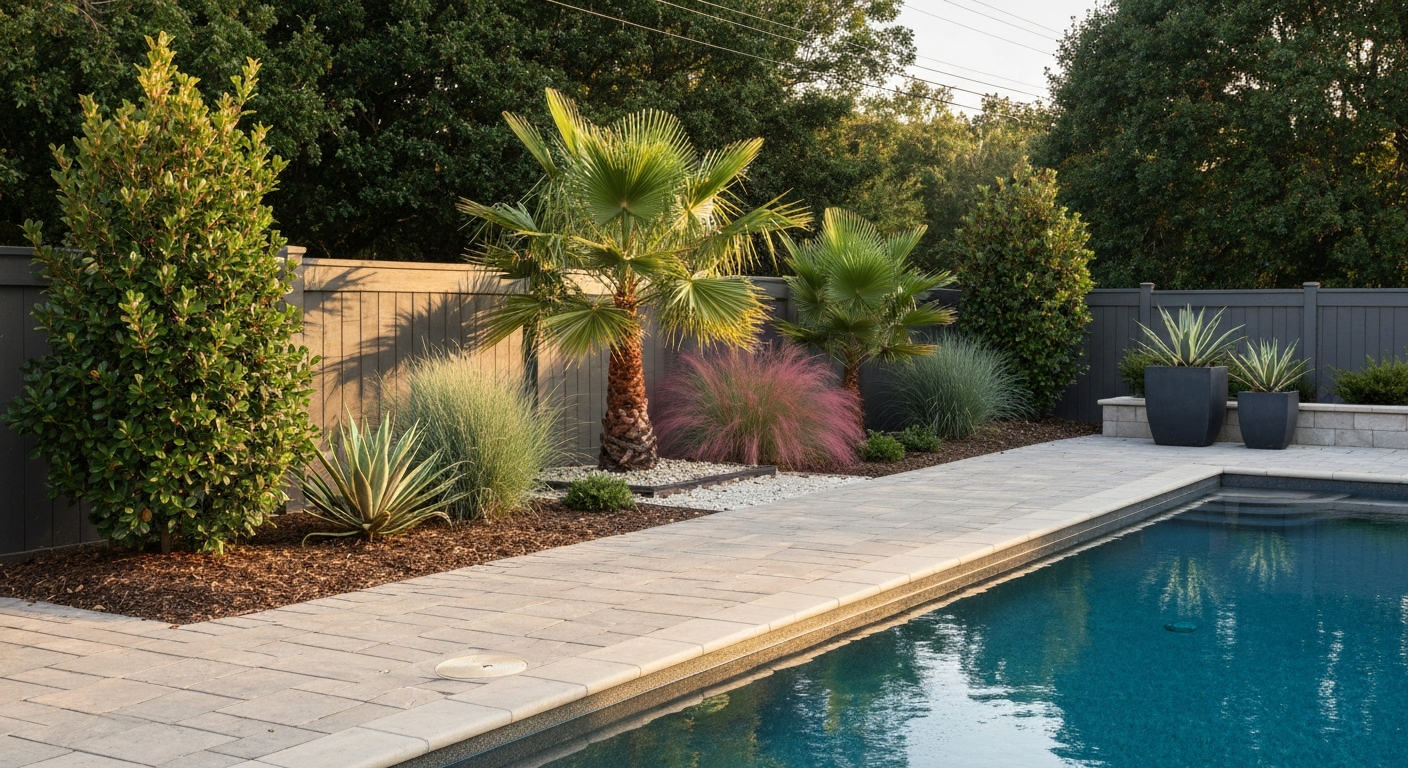
The best plants for around a pool are ones that stay evergreen or nearly so, drop minimal litter, have non-invasive roots, and can handle the occasional splash of chlorinated or salt water. Think clumping palms, ornamental grasses like muhly or blue oat grass, evergreen shrubs like loropetalum and pittosporum, succulents such as agave and aloe, and low-mess trees like crape myrtle positioned well back from the water. The specific winners depend on your climate zone, how much sun your deck gets, and whether privacy or pure aesthetics is the priority, all of which this guide works through in practical detail.
what plants grow well around a pool: Smart, Safe Picks by Region
Rachel Hartley
13 Jul 2026
What makes a plant actually pool-friendly
Not every pretty garden plant belongs near a pool. The poolside environment is harder on plants than most people expect, and the wrong choices create constant maintenance headaches, or worse, cracked paving and cloudy water. Before picking a single plant, it helps to understand the five filters that separate good pool candidates from bad ones.
Low debris output
Leaf litter is the biggest daily frustration. Research on forest leaf-fall quantifies why: mature deciduous trees can drop several hundred grams of leaf and organic debris per square meter per year, and even a modest-sized tree directly over a pool can mean running your skimmer around the clock. Evergreen plants drop leaves too, but they do it gradually and in much smaller volumes. Fruiting trees are another hazard, berries, seed pods, and sticky sap are worse than plain leaves. If a tree or shrub produces anything that falls into the pool in large quantities, keep it far from the water edge or skip it entirely.
Non-invasive and manageable roots
Tree and shrub roots spread much further than most people assume. A practical rule used by arborists and urban landscape designers is that roots commonly extend 1.5 to 3 times the canopy radius outward, and the majority of fine feeder roots sit in the top 1 to 3 feet of soil. For a pool, that matters enormously, aggressive surface roots crack paving, infiltrate plumbing, and can eventually work into pool walls. Species like willow, poplar, silver maple, and eucalyptus are notorious offenders. Clumping grasses, palms, and shrubs with fibrous (rather than tap-rooted or spreading) root systems are far safer choices.
Salt and chlorine tolerance
Pool water splashes. Overflow happens. In salt-water pools, the soil around the pool edge gradually accumulates sodium and chloride ions, which suppress plant growth and eventually kill sensitive species, the same mechanism documented in coastal saltwater intrusion studies from UF/IFAS and UGA Extension. Even in chlorinated pools, frequent splash raises soil pH and can scorch foliage. Truly salt-tolerant plants like agave, yucca, sea oats, beach sunflower, and certain palms handle this well. Shade-loving tropical plants with soft foliage generally don't.
Sun and shade fit
Most pool decks are in full sun for good reason, nobody wants to swim in shade. That means the planting areas immediately surrounding the pool also tend to bake. Plants that need afternoon shade or consistently moist soil will struggle without deliberate irrigation and mulching. On the flip side, the north side of a house pool (in the Northern Hemisphere) may be shaded for most of the day, which opens up different options. Assess your specific sun angles before buying anything.
Safety for kids and pets
This one is non-negotiable if you have children or animals. The ASPCA and Pet Poison Helpline both maintain searchable databases of plants toxic to dogs, cats, and other pets, and quite a few common ornamentals, oleander, sago palm, lantana, some euphorbias, are genuinely dangerous when ingested. See The Official Top 10 Pet Toxins of 2023 (ASPCA) and ASPCA plant/toxin resources for the ASPCA's searchable lists of toxic and non‑toxic plants to dogs, cats, and horses. Kids around pools tend to grab things and put them in their mouths. Always cross-check your shortlist against veterinary toxicology resources before planting anything in a pool zone where children or pets will be unsupervised.
Site assessment: what to figure out before you buy a single plant
Walk around your pool at different times of day and take notes. Fifteen minutes of honest observation saves hundreds of dollars in dead plants. Here is a practical checklist to work through before choosing anything.
- Sun exposure: note which areas get full sun (6+ hours), part sun (3-6 hours), and shade — and at what time of day. West-facing beds get brutal afternoon heat in summer, especially in zones 7-10.
- Wind patterns: identify the prevailing wind direction. Wind accelerates soil drying, increases salt spray near the pool, and snaps brittle plants. Note any existing windbreaks or structures.
- Pool type: salt-water pools release more sodium chloride into surrounding soil over time, so salt-tolerant species become more important. Chlorinated pools have slightly lower but still real splash impact.
- Microclimate: is the pool area sheltered by walls or a fence? Does the paving radiate extra heat? Enclosed courtyards can raise the effective growing zone by half a zone or more in winter.
- Soil type and drainage: sandy soil near pools drains fast and requires drought-tolerant species or drip irrigation. Clay soil retains salt and water, which favors different choices.
- USDA Hardiness Zone: look yours up using the 2023 USDA Plant Hardiness Zone Map. It determines which perennials actually survive your winters and filters your entire plant selection.
- Maintenance appetite: be honest. A pool already takes time. Do you want to deadhead, prune, and rake weekly, or would you rather set it up and barely touch it? Your answer should drive every plant decision.
- Existing invasive species risk: check USDA APHIS and your state noxious weed list before planting any vigorous spreader. Some popular screening plants (certain privets, Chinese tallow, running bamboos) are regulated or invasive in many states.
Exact placement rules and root-distance guidelines
Placement is where most poolside planting mistakes happen, and it is almost entirely about roots, not aesthetics. Here are the rules I use and recommend.
Minimum setback distances
- Small shrubs (under 5 ft mature height, clumping root type): plant no closer than 3-4 feet from the pool coping.
- Medium shrubs and ornamental grasses (5-10 ft): keep at least 5-8 feet from the pool edge.
- Small accent trees and palms (under 25 ft): set at least 10-15 feet from the pool wall.
- Medium trees (25-45 ft): minimum 20-25 feet from the pool structure.
- Large or aggressive-rooted trees: at least 35-50 feet from the pool — and honestly, consider keeping these out of the pool zone entirely.
Root barriers: when and how to use them
Root barriers are physical panels or liner rolls installed in a trench between a plant and the structure you want to protect. Engineered root barrier panels (brands like DeepRoot and NDS make widely used products) come in standard heights of 12, 18, 24, 36, and 48 inches. For pool-adjacent plantings, an 18- to 24-inch panel is adequate for most shrubs and ornamental grasses. For trees, use 36 inches minimum. Install with the top edge slightly below the finished soil surface, above-surface edges become a trip hazard and eventually degrade. The barrier slows lateral root spread but doesn't stop deep tap roots, so barriers are not a substitute for proper setback distances with large trees.
Planting depth and bed design
Plant at native grade or slightly raised, never deeper than the root ball. Sunken planting beds against pool coping hold water, concentrate salt, and promote root rot. For salt-water pools or coastal locations, raised planting beds with imported, well-draining soil give you the ability to leach excess sodium by running fresh water through the bed occasionally, which is the approach recommended by both UF/IFAS and UC Cooperative Extension for managing salt accumulation near pools and coastal landscapes.
Planting plans by yard size and privacy need
Here are three ready-to-use frameworks. Adjust species for your USDA zone using the variety lists further down in this article.
Small courtyard pool (under 400 sq ft deck area)
Space is tight, so every plant needs to work hard. Prioritize vertical interest without aggressive root systems. A pair of clumping pygmy date palms (Phoenix roebelenii) in large containers anchor the corners and provide tropical scale without root risk. Fill the perimeter with low, spreading groundcovers like blue star creeper or dymondia between pavers, with a row of dwarf pittosporum or compact loropetalum along any fencing. Skip trees entirely, use a sail shade or pergola for overhead cover instead. This setup takes under an hour a week to maintain.
Suburban backyard pool (400-1,200 sq ft deck area)
You have room to layer: groundcover at the coping edge, a mid-height shrub border 4-6 feet back, and screening plants along the fence line 10-15 feet from the water. In warm-to-hot climates (zones 8-11), a backbone of mid-height clumping bamboo or green giant arborvitae along the fence, flanked by loropetalum or Indian hawthorn shrubs, and edged with liriope or Gulf muhly grass at the paving gives you privacy, minimal debris, and year-round structure. In cooler zones (5-7), swap in cherry laurel, ornamental grasses (feather reed grass, blue oat grass), and compact boxwood or yew.
Resort-style large pool with full landscape design
Large spaces allow for a full plant palette but also carry higher risk of picking the wrong trees. The resort look typically combines queen palms or Mediterranean fan palms (zones 8-11) or ornamental trees like crape myrtle and Japanese maple (zones 5-9) at 15-25 feet from water, backed by a continuous privacy screen of large evergreen shrubs or clumping bamboo at the property perimeter, with ornamental grasses and succulent beds filling the mid-ground. Bold container plants (agaves, bird of paradise, large aloes) on the deck itself add drama without any root risk. Incorporate a mulched planting buffer strip on the prevailing wind side of the pool to intercept debris before it hits the water.
Trees for poolsides: the right ones for your climate
I want to be direct here: most trees do not belong close to a pool. But used at the correct setback, the right trees deliver shade, privacy, and visual scale that nothing else can. The key is choosing varieties with predictable root behavior and manageable litter.
| Tree | Best Zones | Mature Height | Root Behavior | Debris Level | Setback from Pool |
|---|---|---|---|---|---|
| Crape myrtle (Lagerstroemia indica) | 6-9 | 15-30 ft | Non-invasive, fibrous | Low-medium (petals only) | 15-20 ft |
| Italian cypress (Cupressus sempervirens) | 7-11 | 40-70 ft (columnar form) | Moderate, manageable | Very low | 20-25 ft |
| Queen palm (Syagrus romanzoffiana) | 9-11 | 25-50 ft | Non-invasive, fibrous | Low (fronds seasonal) | 10-15 ft |
| Windmill palm (Trachycarpus fortunei) | 7-11 | 20-40 ft | Non-invasive, fibrous | Low | 10-15 ft |
| Japanese maple (Acer palmatum) | 5-8 | 10-25 ft | Non-invasive, shallow fibrous | Medium (fall leaves) | 15-20 ft |
| Little Gem magnolia (Magnolia grandiflora 'Little Gem') | 7-10 | 15-20 ft | Moderate, generally manageable | Low-medium | 20 ft |
| Olive (Olea europaea — fruitless cultivars) | 8-11 | 20-30 ft | Moderate, surface roots possible | Low (fruitless = no mess) | 20-25 ft |
| Pineapple guava (Feijoa sellowiana) | 8-11 | 10-15 ft | Non-invasive, compact | Low | 12-15 ft |
A few practical notes on this list. Crape myrtles are one of the most pool-friendly flowering trees in the South and Mid-Atlantic, the petal drop is light and short-lived, roots are well-behaved, and they thrive in full sun and heat. Italian cypress is excellent for narrow spaces and provides vertical screening without root drama. With palms, stick to fibrous-rooted species (queens, windmills, pygmies, Mediterranean fans) and avoid anything with large, messy fruit drop like Washingtonia palms, which drop heavy skirts of dead fronds and produce enormous quantities of small berries. Always check toxicity: sago palms look elegant but are dangerously toxic to dogs and cats, every part of the plant is poisonous.
Fast-growing privacy screens and tall plants for immediate screening
Privacy is one of the main reasons people add plants around a pool in the first place. For specific recommendations on screening and timing, see a guide to the best plants to grow for privacy that lists fast-growing, low-debris options suited to poolside use. The challenge is that most fast-growing plants come with trade-offs: aggressive roots, invasive tendencies, or high litter. Knowing what grows tall fast for a privacy screen is only useful if the plant also passes the pool-safety tests, roots, debris, and maintenance. For specific recommendations on what plants grow tall fast for a privacy screen, consult our guide on what plants grow tall fast for a privacy.
Best fast-growing privacy options near pools
- Green Giant arborvitae (Thuja standishii x plicata 'Green Giant'): grows 3-5 feet per year in zones 5-8, reaches 30-40 ft at maturity, minimal litter, non-invasive roots, deer resistant. One of the best all-around privacy screens for suburban pool areas.
- Emerald Green arborvitae (Thuja occidentalis 'Emerald Green'): slower at 6-9 inches per year but stays narrow (4-5 ft wide) and compact in zones 3-8 — ideal for tight fences. Reaches 10-15 ft.
- Clumping bamboo (Fargesia spp. or Bambusa multiplex): grows fast, stays in a tight clump, and creates genuine tropical privacy. Safe for zones 5-10 depending on species. Details and cautions in the bamboo section below.
- Podocarpus (Podocarpus macrophyllus): zones 7-11, grows 12-24 inches per year, creates a dense formal screen with minimal litter and non-invasive roots. One of the cleanest privacy plants available for warm climates.
- Leyland cypress (x Cuprocyparis leylandii): zones 6-10, very fast at 3-4 ft/year but needs pruning to stay manageable. Keep well back from pool — 20+ feet — and monitor for bagworm and root crowding at maturity.
- Viburnum (Viburnum odoratissimum or 'Chindo'): zones 7-10, grows 2-3 ft/year, fragrant flowers, dense screening habit, minimal debris. Excellent mid-height screen at 8-15 ft.
- Wax myrtle (Morella cerifera): zones 6-11, native to the Southeast, fast-growing to 10-15 ft, salt-tolerant, wildlife-friendly, minimal mess near pool.
A word of caution about Leyland cypress: it is incredibly popular because it grows fast and looks great for the first 8-10 years. After that, the trees get very large, develop dead brown interiors, and become difficult to maintain at pool scale. If you plant them, keep them at the far perimeter and plan to replace them eventually, or switch to Green Giant arborvitae which ages better. Avoid Lombardy poplar for screening near pools, it grows fast but has extremely aggressive, invasive roots that will find your plumbing.
Shrubs that actually work near pools
Shrubs are the workhorses of poolside planting. They fill the mid-ground, soften the transition between paving and grass or fence, and create year-round structure without the root and debris risks of trees. These are the varieties I come back to repeatedly across different climates.
| Shrub | Zones | Height | Sun | Salt Tolerance | Maintenance | Notes |
|---|---|---|---|---|---|---|
| Loropetalum (Loropetalum chinense) | 7-10 | 4-10 ft | Full to part sun | Moderate | Low | Burgundy foliage, pink flowers, minimal mess, evergreen |
| Indian hawthorn (Rhaphiolepis indica) | 7-11 | 3-6 ft | Full sun | Good | Low | Excellent near salt pools, spring flowers, very tough |
| Pittosporum (Pittosporum tobira) | 8-11 | 6-12 ft | Full to part sun | Good | Low-medium | Fragrant, dense, tolerates coastal conditions |
| Drift roses (Rosa 'Drift' series) | 4-11 | 1.5-2 ft | Full sun | Moderate | Low | Repeat blooming, minimal petals in water, disease-resistant |
| Dwarf yaupon holly (Ilex vomitoria 'Nana') | 7-11 | 3-5 ft | Full to part sun | Very good | Very low | Native, salt-tolerant, nearly no litter, non-toxic |
| Boxwood (Buxus sempervirens compact cultivars) | 5-8 | 2-5 ft | Full to part shade | Low | Medium | Formal structure, cool climates; watch for blight |
| Cherry laurel (Prunus laurocerasus) | 6-9 | 6-15 ft | Full to part sun | Moderate | Low | Dense screening, low litter — note: berries mildly toxic |
| Mexican sage (Salvia leucantha) | 8-11 | 3-4 ft | Full sun | Good | Low | Drought-tolerant, pollinators, minimal debris, stunning color |
Indian hawthorn is genuinely underrated for warm-climate pools. It is tough, compact, handles salt spray well (which fits with the salt-management guidance from UGA and UC Extension for coastal landscapes), produces pretty spring flowers, and barely sheds a leaf into the pool. Loropetalum is my go-to for zones 7-10, the deep burgundy cultivars (like 'Ruby' or 'Plum Delight') look dramatic year-round and the weeping flower display in spring is brief and mostly tidy. For colder zones (5-7), a combination of dwarf boxwood, blue holly, and ornamental grasses creates a clean, year-round border with minimal pool impact.
Seasonal timing for shrub installation
In zones 8-11, early fall (September through November) is the best planting window for shrubs around a pool. The soil is still warm enough to encourage root establishment, air temperatures are falling, and you avoid summer stress. In zones 5-7, spring planting (after last frost, typically April to May) is safer for most shrubs, giving a full growing season before the first hard freeze. Avoid planting anything during peak summer heat in full-sun pool areas, even heat-tolerant species struggle to establish when soil temperatures exceed 90°F.
Grasses, bamboo, and clumping ornamentals
Ornamental grasses and clumping bamboo are some of the most pool-friendly plants in existence when you choose the right species. They move beautifully in wind, add tropical or architectural texture, and most are naturally low-mess. The risks are specific and manageable if you know what to watch for.
Best ornamental grasses for poolsides
- Gulf muhly grass (Muhlenbergia capillaris): zones 6-10, 3-4 ft tall, spectacular pink fall plumes, drought and salt tolerant, nearly zero litter. One of the best poolside grasses in the South.
- Blue oat grass (Helictotrichon sempervirens): zones 4-9, 2-3 ft, steely blue foliage, evergreen, very low maintenance, clumping habit with no spreading.
- Feather reed grass (Calamagrostis x acutiflora 'Karl Foerster'): zones 4-9, 4-6 ft, upright, architectural, minimal litter, one of the cleanest grasses for pool areas in cool climates.
- Mexican feather grass (Nassella tenuissima): zones 6-10, 1-2 ft, airy and delicate, drought tolerant — note: considered invasive in some Western states, so check local regulations before planting.
- Liriope (Liriope muscari): zones 5-10, 12-18 inches, evergreen, salt tolerant, extremely tough edging plant for coping transitions.
- Dwarf fountain grass (Pennisetum alopecuroides 'Hameln'): zones 5-9, 2-3 ft, well-behaved clumping habit, light buff plumes in fall — check invasive status in your specific state.
- Blue grama grass (Bouteloua gracilis): zones 3-9, native, low-growing, drought-proof, excellent no-mow groundcover for sunny pool surrounds in dry climates.
Bamboo: the potential and the problem
Bamboo gets a bad reputation around pools, and honestly, much of it is deserved, but the reputation belongs to running bamboo, not clumping bamboo. Running bamboos (Phyllostachys species like golden bamboo, black bamboo) spread via underground rhizomes that can travel 15-20 feet in a single growing season and have been known to crack pool walls, invade plumbing, and cross property lines. Several running bamboo species are listed as invasive or noxious in certain states. Never plant running bamboo near a pool without a deep, continuous root barrier installed correctly to at least 36 inches, and even then, monitor aggressively.
Clumping bamboos are a completely different story. Species like Fargesia robusta (umbrella bamboo, zones 5-9), Fargesia murielae (fountain bamboo), and Bambusa multiplex cultivars (zones 8-11) expand slowly from a central clump and do not send out invasive rhizomes. They create lush, tropical-looking screens 8-15 feet tall, tolerate wind, and produce minimal litter near a pool. The main maintenance task is removing dead culms every few years and dividing overgrown clumps. For pool screening, clumping bamboo is genuinely one of the best tools available in zones 7-11.
Root management for bamboo and grasses
For any bamboo planted within 20 feet of a pool structure, I recommend installing a 36-inch root barrier regardless of whether it is clumping or running. For running bamboo specifically, use a 36-48 inch continuous liner with the top edge 2 inches above grade so you can visually monitor any rhizomes attempting to escape over the barrier (they will try). Inspect the barrier perimeter every spring. For ornamental grasses, root barriers are generally unnecessary, they have fibrous, well-contained root systems. The main task with grasses is cutting them back hard (to about 4-6 inches) in late winter before new growth emerges, which prevents the buildup of dry thatch that becomes a debris issue near the pool.
Succulents and agaves as poolside accents
Agaves, aloes, and other succulents are among the most genuinely pool-compatible plants available. They are drought-tolerant, produce virtually zero litter, have contained root systems, and handle salt splash well. For low-maintenance, sun-loving options that sit nicely between paving, see a short list of the best plants to grow between stepping stones. In zones 8-11, large agave species like Agave americana, Agave attenuata (soft-leaf agave, no sharp spines, better for pool areas with children), and Aloe vera or Aloe marlothii create dramatic focal points on a pool deck with almost no maintenance. The gotcha with most agaves: the leaf tips are extremely sharp. Use soft-leafed or smooth-edged varieties (Agave attenuata, Agave desmettiana) in areas where people will be walking barefoot or children will be playing. One more note: most agaves are monocarpic (they die after blooming), so factor that into your long-term design.
FAQ
What are the most important criteria for choosing plants around a pool?
Choose plants that (1) produce low litter and minimal fruit/flower drop, (2) have non‑invasive, shallow root systems or are clump‑forming, (3) tolerate the local water chemistry (chlorine/salt spray/irrigation salinity), (4) are non‑toxic or low‑toxicity for children and pets, (5) match sun/shade exposure and hardiness zone, and (6) meet maintenance expectations (pruning frequency, pest susceptibility). Prioritize clumping palms, evergreen shrubs, succulents, ornamental grasses, and selected groundcovers and container plants to minimize debris and root problems.
Which trees are recommended near a pool and how far should they be set back?
Recommended pool‑side trees: small clumping palms (e.g., Pygmy Date Palm, European Fan Palm in suitable climates), dwarf magnolias, crape myrtle (low‑seed cultivars), Japanese maple (in cool climates), and small evergreen trees like olive (varietal dependent) or dwarf conifers. Setback rules: position trees so root spread will not threaten pool shell or plumbing — a practical guideline is 1.5–3× the mature canopy radius away from pool edges and equipment. For easier management, keep mature trunk at least 10–15 ft from pool hardscape for small/medium trees; larger trees require greater distance. Use root barriers for closer plantings.
Which shrubs and hedges are low‑debris and good for poolside screens?
Best shrubs: clumping, evergreen types that drop little leaf litter — e.g., dwarf boxwood, Italian or dwarf pittosporum, rosemary (also aromatic, drought‑tolerant), dwarf photinia (low‑fruit cultivars), nandina (non‑fruiting/pruned cultivars), and certain euonymus. For privacy, use fast, dense options like clumping bamboo (contained, clump varieties only), Leyland cypress (if tolerated and maintained), and holly cultivars with small leaves. Choose cultivars labeled ‘low‑litter’ or ‘non‑fruiting’ where available.
Which grasses, groundcovers and succulents minimize debris and maintenance?
Low‑debris choices: ornamental grasses that don’t shatter seeds (e.g., Pennisetum 'Hameln' short varieties, Festuca glauca), low groundcovers like creeping thyme, mondo grass (Ophiopogon japonicus), Blue Star Creeper, and succulents such as agave, aeonium, and sedum. Succulents and evergreen groundcovers shed little foliage and tolerate hot, dry microclimates near pool decking. Avoid spreading lawn close to pool; grass clippings and frequent mowing generate debris.
What vines work well on trellises or lattices without creating root problems?
Choose non‑aggressive vines that climb structures without heavy leaf drop: star jasmine, evergreen mandevilla (in warm climates), Bougainvillea (on strong trellis, low leaf litter when pruned), Climbing rosemary, and trained honeysuckle (species dependent). Avoid aggressive root‑spreading vines like English ivy in climates where it's invasive. Use containers or root barriers for vigorous climbers.
Are there pool‑friendly edible/container plants worth using?
Yes — container edibles reduce debris and allow control over roots/salinity. Pool‑side winners: herbs (rosemary, thyme, basil in summer, chives), dwarf citrus in frost‑free zones (keep fruit minimal), cherry tomatoes and peppers in containers, and potted succulents for ornament. Use pots with good drainage, raised potting mix, and flush containers periodically to avoid salt accumulation.
Next Article
Best Ground Cover for Hard to Grow Areas: A Guide
Choose the best ground cover for tough sites like dry shade, heat, wet spots, compact soil, slopes, and weeds with plant