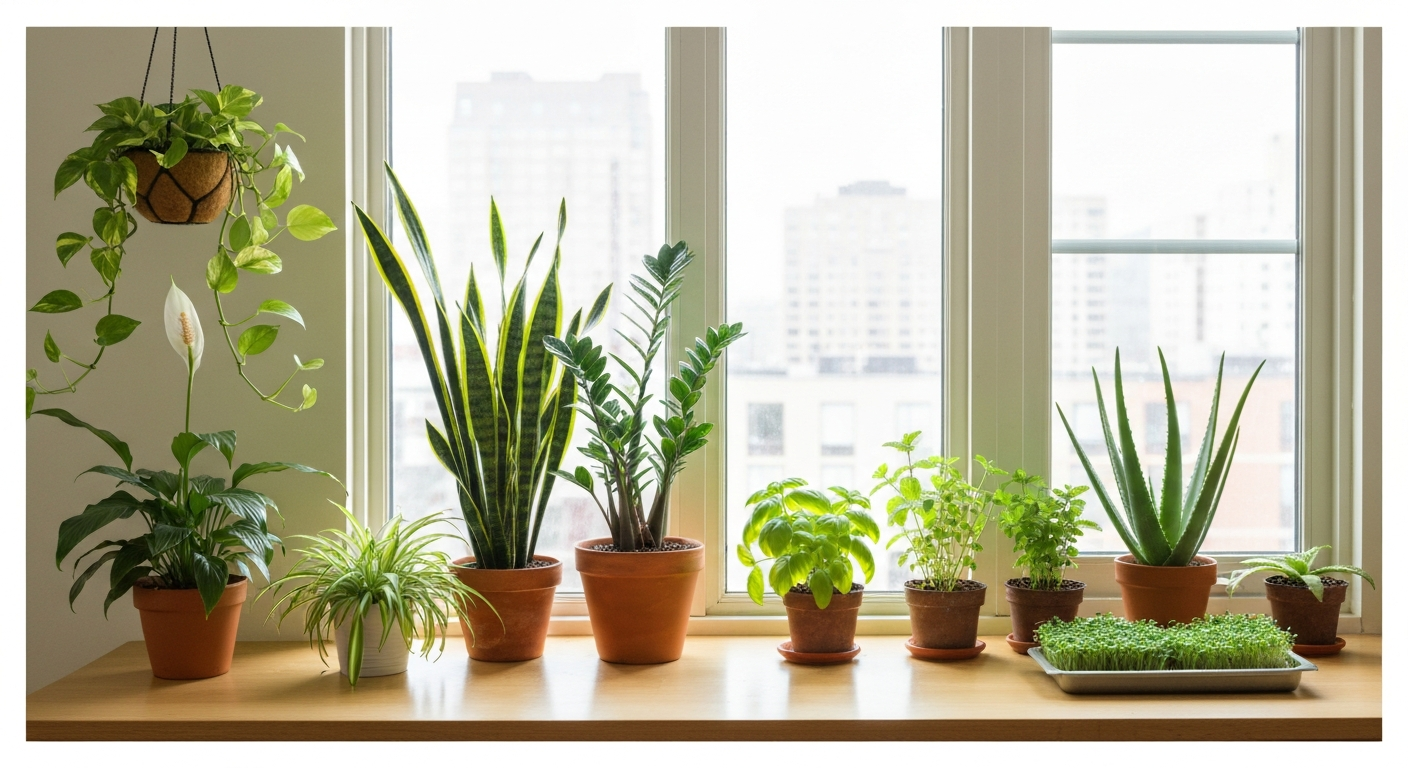
The best plants to grow in a dorm room are ones that survive on neglect, fit on a windowsill, and won't get you written up by your RA. Pothos, snake plants, spider plants, and ZZ plants cover the low-light majority of dorm windows. If you've got a south- or east-facing window with real sun, small succulents and herbs open up. And if you want something edible in under two weeks with zero soil mess, a microgreen tray is hard to beat. The trick is matching the plant to your actual light, your actual schedule, and your actual housing rules before you buy anything.
Best Plants to Grow in Dorm Room: Low-Maintenance Guide & Care Plans

Rachel Hartley
12 Aug 2026
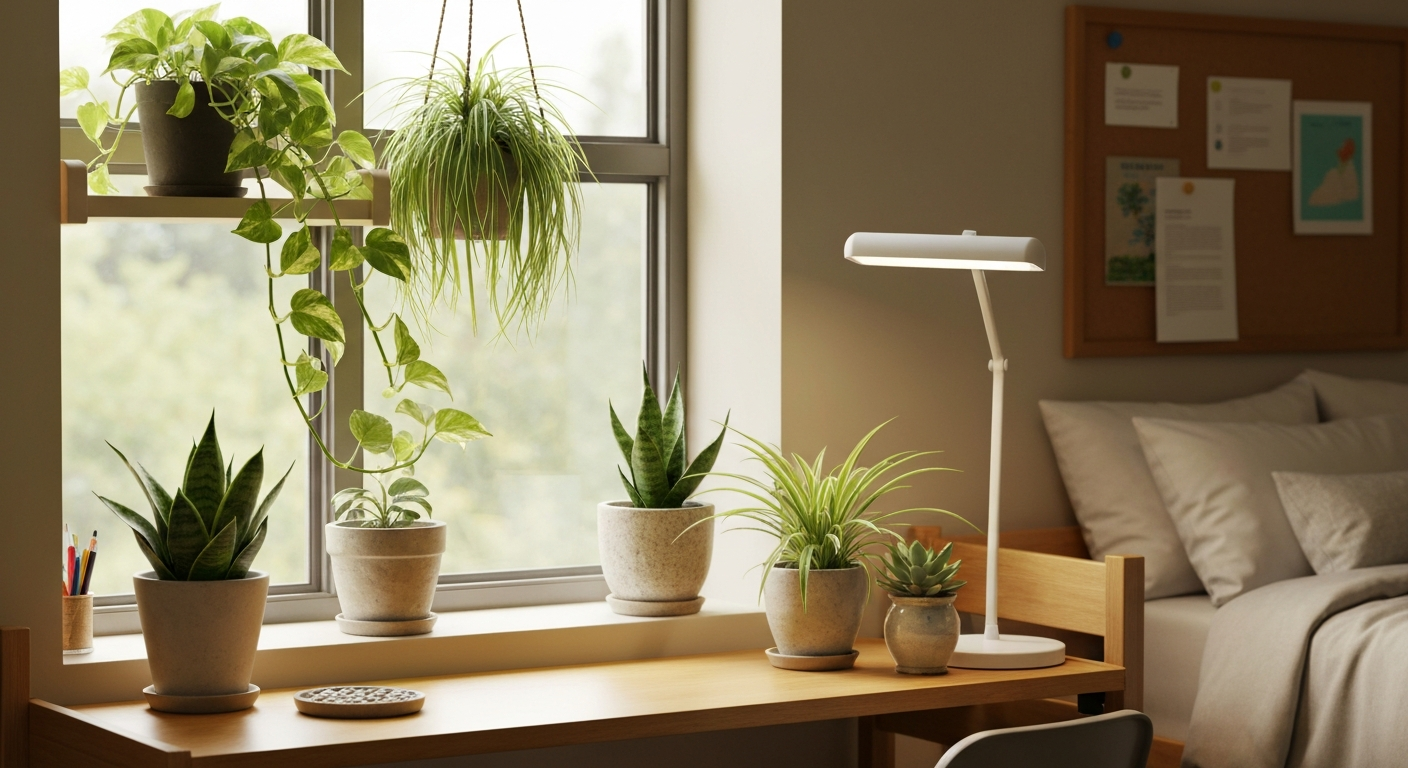
Why plants work in dorms (and what to expect)
Plants in small spaces like dorm rooms, apartments, and classrooms deliver real, measurable benefits: reduced stress, improved focus, and a livable feel in what is often a pretty sterile box of a room. Studies aside, the practical case is simple. A pothos on your desk or a spider plant on your bookshelf adds something alive to the space without asking much in return. The same logic applies to classroom plants and apartment windowsills, which face nearly identical constraints of limited light, inconsistent watering, and shared-space rules. For more on choosing classroom-friendly options, see what is the best plant to grow in a classroom. For suggestions and easy-to-manage options, see our guide to the best classroom plants to grow.
That said, be honest with yourself about expectations. A dorm room in August (at least here in the Northern Hemisphere, as we head into the final weeks of summer 2026) may have decent light right now, but come November when the sun drops low and daylight shrinks, a north-facing window will barely sustain a fern. The right plant for your room in September might need reassessment by January. Seasonal awareness is part of the deal.
Quick-start checklist before you buy a single plant
Skipping this step is the number one reason dorm plants die within the first month. Take five minutes to confirm each item before you spend money at a nursery.
- Read your housing agreement's prohibited items section. Many universities, including Florida Tech, explicitly state that live trees and cut vegetation are prohibited, while potted houseplants are acceptable as long as they don't create fire or health hazards. Stanford's 2025-26 Residence Agreement uses similar language. Your school's version may differ, so look it up.
- Measure your window orientation. Face the window and note which direction it faces (a compass app on your phone works). South-facing gets the most light, east gets gentle morning sun, west gets strong afternoon sun, and north gets indirect light only.
- Confirm roommate constraints. Do they have plant allergies or sensitivities to soil mold? Do they have a pet visiting on weekends? Get this sorted before you bring home a peace lily or pothos if there's a cat in the picture.
- Check whether you're allowed a drip tray and drainage holes. Most RAs are fine with standard potted plants in saucers, but no one wants water damage on dorm furniture. A waterproof tray under every pot is non-negotiable.
- Decide on your watering commitment honestly. Weekly? Fine. Every two weeks? That rules out basil and peace lily but keeps succulents and ZZ plants in the running.
- List your supplies: a pot with drainage holes, a saucer or waterproof tray, potting mix appropriate to the plant type, and a small watering can or spray bottle.
How to evaluate a plant before you pick it
Every plant recommendation I make is filtered through six factors. Run any plant you're considering through this same lens and you'll avoid most beginner mistakes.
- Light level: Match the plant's light needs to your measured foot-candles, not just a vague guess. More on measuring this below.
- Space footprint: How wide and tall will this plant get at maturity? Compact cultivars, hanging pots, and trailing vines are your friends in tight quarters.
- Housing and roommate rules: Confirmed above, but also factor in noise-free maintenance and scent. Flowering plants like jasmine can be invasive in a shared room.
- Pet and allergy safety: The ASPCA maintains a toxic/non-toxic plant list that is the most reliable resource for screening species before bringing them into shared spaces. Spider plants and calatheas get a pass; pothos and peace lily do not if a pet is present.
- Maintenance level: Count how many times per week you realistically want to interact with a plant. Low-maintenance means watering every 1-2 weeks and fertilizing a few times a year. High-maintenance means daily attention, which rarely survives a midterm week.
- Season and region: A succulent that sails through a sunny Phoenix dorm window in August will struggle in a north-facing Minnesota dorm by October. Seasonal light shifts are real, and plants feel them.
How to measure light and find your best spot
Light is the variable beginners most consistently get wrong because they eyeball it. The room feels bright to you, but your eyes adjust; the plant doesn't. Indoor light is measured in foot-candles (fc) or lux. University extension programs classify levels roughly like this: low light is around 25-100 fc (270-1,080 lux), medium is 75-500 fc (800-5,400 lux), and high is 250-1,000+ fc. For detailed guidance on measuring and classifying indoor light levels, see Lighting for Indoor Plants | University of Maryland Extension. You can buy a basic light meter for under $20, or use a free smartphone app like Lux Light Meter to take a reading at midday, which is the peak reading you'll ever get.
In practice, here's how dorm windows tend to map out. A south-facing window in late summer (right now, in August) can push 1,000+ fc within a foot of the glass, which supports succulents and herbs. By December, that same window might drop to 300-500 fc at best. A north-facing window rarely breaks 100 fc and should be treated as low-light year-round. East-facing gives you 200-500 fc in the morning hours, dropping off by noon. West-facing gives strong afternoon light, often 500-800 fc in summer, but can run hot in warm climates. If you only have north-facing light, a grow light on a timer (12-14 hours per day) changes the equation completely and opens up herbs and even some succulents.
The practical takeaway: measure at the exact spot where the plant will sit, not just near the window. Light drops off fast with distance. Two feet from the glass can mean half the foot-candles of one foot from the glass.
Best low-light plants for dorm rooms
Most dorm rooms fall into this category. If your reading is consistently under 150 fc, these are your realistic options and they're genuinely great plants, not consolation prizes.
Pothos (Epipremnum spp.)
Pothos is the dorm plant. It tolerates low light, bounces back from irregular watering, and trails beautifully off a shelf or desk. Let the top inch of soil dry out before watering again. Use a well-draining potting mix and a pot with drainage holes. Repotting is only needed every 12-24 months when roots start circling the bottom. One real caveat: pothos contains calcium oxalate crystals and is mildly toxic to pets and people. If there's a cat or dog in the room even occasionally, keep it out of reach or choose the spider plant instead.
Snake plant (Dracaena trifasciata)
If pothos is the most forgiving dorm plant, the snake plant is the most resilient. It will sit in a dim corner and ask for almost nothing. Water it every 2-3 weeks in summer and even less in winter, when its growth slows dramatically. Overwatering causes root rot, which is the main way people kill this plant. For small spaces, look for the 'Hahnii' (bird's nest) cultivar, which stays compact at 6-8 inches tall instead of the 2-4 feet of standard varieties. Note that it's mildly toxic to pets.
Spider plant (Chlorophytum comosum)
Spider plants are one of the few houseplants listed as non-toxic to both cats and dogs by the ASPCA, which makes them the clear choice for pet-sensitive dorms or classrooms. They do well in low to medium indirect light, prefer soil that is evenly moist but never soggy, and produce trailing 'baby' plantlets you can propagate and give to friends. Hang them in a small macrame hanger near a window and they'll reward you all semester.
ZZ plant (Zamioculcas zamiifolia)
The ZZ plant is built for low-light, low-water conditions. It stores water in its thick rhizomes and can go two to three weeks without watering without any visible drama. It's a slow grower, which means it stays compact in a small pot for a long time. The trade-off: it has mild to moderate toxicity and should stay out of reach of pets and small children. For a solo dorm room with no animals, it's nearly fail-proof.
Peace lily (Spathiphyllum spp.), with a condition
Peace lilies do well in low to medium indirect light and will even bloom in lower light than most flowering plants. The catch: they need consistent moisture and will dramatically droop when dry, which can feel alarming. More importantly, they are toxic to cats and dogs (calcium oxalate crystals) and should be avoided entirely in rooms with pets. If the room is pet-free and you can commit to regular watering, they're beautiful and rewarding. Otherwise, choose the spider plant.
| Plant | Light Tolerance | Watering Frequency | Pet Safe? | Space Footprint |
|---|---|---|---|---|
| Pothos | Low to bright indirect | Every 1-2 weeks | No | Small to medium (trails) |
| Snake plant 'Hahnii' | Low to medium | Every 2-3 weeks | No | Very small (6-8 in) |
| Spider plant | Low to medium | Every 1-2 weeks | Yes | Small to medium (trails) |
| ZZ plant | Low to medium | Every 2-3 weeks | No | Small to medium |
| Peace lily | Low to medium | Every 1 week | No | Medium |
Bright-window picks for east and south-facing dorms
If you're lucky enough to have a south- or east-facing window with consistent sun, your options expand considerably. These plants will genuinely thrive rather than just survive.
Pothos and spider plant (again, but better)
Both of the low-light favorites listed above grow noticeably faster and fuller in bright indirect light. If you have the window, give pothos and spider plant a spot within two feet of east-facing glass and watch them take off.
Calathea / Maranta (prayer plants)
For east-facing windows specifically, calatheas and prayer plants are stunning choices. They need bright indirect light (never direct sun, which bleaches the leaves), consistent moisture, and higher humidity. A small pebble tray with water under the pot handles the humidity without a humidifier. They're non-toxic to pets, which is a bonus. The trade-off is that they're fussier than pothos: inconsistent watering causes brown leaf tips and curling.
Aloe vera
Aloe vera sits right at the junction between bright-window and succulent categories. It wants 4-6 hours of direct or very bright indirect light per day, a fast-draining cactus mix, and infrequent watering (every 2-3 weeks in summer, monthly in winter). It's practically useful for minor burns and skin irritation, which makes it a reasonable first-aid plant for a dorm. Keep it away from cats and dogs; it's toxic to pets.
Succulents and cacti for sunny, low-maintenance setups
If your south-facing window gets at least 4-6 hours of direct sunlight, succulents and small cacti are the lowest-maintenance option you'll find. The key rule is soak-and-dry: water thoroughly until it drains from the bottom, then wait until the soil is completely dry before watering again. During winter dormancy indoors, that can mean once every 3-6 weeks. The single most common failure with succulents in dorms is overwatering, often combined with a pot that doesn't drain.
Echeveria
Echeverias are the classic rosette succulent, and compact varieties stay under 4-6 inches in diameter for months. They need bright, direct light to maintain their tight rosette shape and color. Without enough light, they etiolate (stretch out and lose their form) fast. A south-facing window in late summer is ideal. In winter, supplement with a small grow light if your window light drops significantly.
Haworthia
Haworthias are the succulent for people who don't quite have enough light for echeverias. They tolerate bright indirect light and even lower light levels than most succulents, making them a bridge option for east-facing windows. They stay small (under 5 inches typically), are slow-growing, and have very low water needs. If you're on the fence between succulents and low-light plants, Haworthia is your answer.
Sedum (stonecrop)
Compact sedums, particularly trailing varieties like Sedum morganianum (burro's tail), look great in small hanging pots near a sunny window. They're summer-active, so water them more frequently (every 1-2 weeks) during summer and cut back significantly in fall and winter.
Small cacti
A small barrel cactus or Mammillaria fits in a 3-4 inch pot and may not need watering more than once a month in winter. They're excellent for the student who travels home for long weekends. Just handle with care during setup and repotting, and keep them out of high-traffic spots where someone might brush against them.
Herbs and edible microgreens for small kitchens and classroom projects
Edible plants in a dorm room are completely doable if you have a bright window or a grow light. August is actually a great time to start herbs, since you're heading into the school year with long late-summer days and windows still catching decent light. By October, you may need to supplement with a small LED grow light (12-14 hours per day) to keep herbs productive.
Windowsill herbs
Chives, thyme, and mint are the most forgiving indoor herbs. Basil and parsley work too but need 6+ hours of direct or very bright light to stay bushy and productive. The extension consensus is to harvest regularly, cutting stems back by a third, to encourage dense regrowth rather than leggy stretching. Use compact varieties when available, grow in pots with drainage, and fertilize lightly every 3-4 weeks with a balanced liquid fertilizer during active growth. Mint spreads aggressively, so always grow it in its own pot rather than mixed with other herbs.
Microgreens: the fastest edible project in a dorm
Microgreens are the best edible option for students who want quick results and minimal setup. You're harvesting in 7-14 days from seed, there's no ongoing plant maintenance, and the tray takes up about the same footprint as a laptop. The basic process: fill a 10x20 inch tray (or a smaller version) with sterile seed-starting mix or coir, seed densely, cover for 2-5 days of darkness, then expose to 12-16 hours of light per day. Radish microgreens are ready in about 7-10 days; sunflower and pea shoots take 10-14 days. Bottom-water by setting the tray in a shallow container of water rather than watering from above. This reduces surface moisture and the mold risk that comes with dense seeding in a small indoor space.
One important safety note: microgreens are different from sprouts. Sprouts are grown under warm, humid conditions directly from seed in water or jars with minimal airflow, and the FDA has flagged commercial sprout production for elevated bacterial risk (Salmonella, E. coli) due to those warm, moist conditions. Microgreens grown in trays with good airflow and normal room temperatures don't carry the same risk profile, but always use clean trays, sterile growing medium, and high-quality seeds for any edible indoor growing project.
| Crop | Light Needed | Days to Harvest | Best For | Difficulty |
|---|---|---|---|---|
| Radish microgreens | 12-16 h grow light or bright window | 7-10 days | Dorm, classroom | Very easy |
| Sunflower shoots | 12-16 h grow light or bright window | 10-14 days | Dorm, classroom | Easy |
| Pea shoots | 12-16 h grow light or bright window | 10-14 days | Dorm, classroom | Easy |
| Broccoli microgreens | 12-16 h grow light or bright window | 8-12 days | Classroom projects | Easy |
| Chives | 6+ h bright indirect light | Ongoing harvest | Windowsill kitchen | Easy |
| Basil | 6+ h direct/very bright light | Ongoing harvest | Sunny south window | Moderate |
| Thyme | 6+ h direct/very bright light | Ongoing harvest | Sunny south window | Easy |
Container options and growing setups
Standard plastic or terracotta pots with drainage holes and a saucer are the simplest and cheapest option. Terracotta dries out faster, which is actually ideal for succulents and cacti. For herbs and moisture-loving plants, self-watering pots (which have a reservoir in the base) are a practical upgrade for the student who tends to forget watering for a few days. Hydroponic herb kits (countertop LED models) remove the soil question entirely, eliminate drainage concerns, and work well in dorms where soil spills on furniture could be an issue. They cost more upfront (usually $40-100) but are nearly foolproof for herbs and microgreens. Microgreen trays are specifically suited to the classroom plant guide context too, making them a natural starting point for group projects.
A simple weekly care routine
Most dorm plant failures come from inconsistency, not incompetence. A three-minute weekly check covers almost everything.
- Check soil moisture with a finger: push one inch into the soil and water only if dry (for most houseplants) or fully dry (for succulents).
- Rotate the pot a quarter turn so all sides get even light exposure.
- Remove any yellowing or dead leaves to keep the plant healthy and reduce mold risk.
- Check for pests: look under leaves for webbing (spider mites), sticky residue (scale or aphids), or white fluff (mealybugs). Catch these early and a cotton swab dipped in rubbing alcohol handles most infestations.
- For herbs: harvest or pinch back growth to keep the plant compact and productive.
- Once a month: fertilize with a diluted balanced liquid fertilizer during the active growing season (spring through early fall). Skip fertilizing in winter when growth slows.
Seasonal adjustments to make as the school year progresses
Starting plants in August (right now) means you're working with late-summer conditions: long days, reasonable light, warm temperatures. As fall arrives and daylight shrinks, here's what to adjust. Move plants closer to windows as light levels drop. Reduce watering frequency for most plants, since shorter days mean slower growth and lower water uptake. Stop fertilizing by mid-October and resume in March. If you have herbs in a south window and you're in a northern state or Canada, plan to add a small grow light by November or accept that production will slow significantly. Succulents and cacti shift into dormancy in winter and need even less water than usual, sometimes just once a month indoors.
Where to buy plants and what to look for
For dorm move-in season (late July through September), most big-box garden centers and grocery store plant sections stock the basics: pothos, snake plant, small succulents, and sometimes spider plants. Local nurseries usually have healthier specimens and staff who can answer care questions. If you're looking for specific recommendations, check our guide to the best nursery plants to grow for small spaces. When buying, look for plants with no yellowing leaves, no visible pests, firm stems, and soil that isn't bone dry or waterlogged in the display pot. Avoid any plant that looks leggy, pale, or like it's been sitting in standing water. Starter kits for microgreens (seed packet sets with trays and growing medium) are widely available online and at garden retailers, and they're an easy, low-cost gift or classroom project starter.
If you're also setting up an apartment rather than a dorm, the same principles apply, though you often have more flexibility on pot size, drainage, and plant variety. For apartment-specific plant picks and care tips, see plants I can grow in my apartment. For more suggestions tailored to longer-term living spaces, see a guide to the best plants to grow in an apartment (internal resource). The core question is always the same: what light do you actually have, and how much time do you realistically want to spend on plant care each week? Nail those two answers and the right plant practically selects itself.
FAQ
What primary authoritative sources should I consult to write a location- and season-aware dorm-room plant guide?
Use land‑grant university Cooperative Extension publications and major horticultural authorities for regional, seasonal, and practical plant-care info (examples: University of Maryland Extension, University of Arizona Extension, UF/IFAS, NC State, Clemson, University of Missouri). For toxicology and pet safety consult ASPCA lists. For institutional housing rules cite specific campus residence agreements or housing guides. For food‑safety when recommending sprouts/microgreens refer to FDA guidance. (See links: UMD, UA, UF/IFAS, NC State, Clemson, Missouri Extension, ASPCA, FDA.)
How should I measure and classify indoor light so plant recommendations match dorm sites and seasons?
Recommend measuring with an inexpensive foot‑candle (fc) or lux meter or a trusted smartphone app and take mid‑day readings. Use common extension ranges as a baseline: low ≈ 25–100 fc (≈270–1,080 lux), medium ≈ 75–500 fc (≈800–5,400 lux), high >250+ fc. Map window orientation (N/E/S/W) and seasonal sun angle to expected fc ranges and include margin for winter low light. (See: UMD Extension, UA Extension, UF/IFAS.)
Which selection criteria must the guide always cover for dorms, apartments, and classrooms?
Include: measured or estimated light level, available footprint and potting surface, roommate and housing rules (fire/allergy/pet restrictions), pet/toxicity risk (check ASPCA), maintenance level (watering/pruning frequency), season and regional daylight/temperature patterns, expected adult size and growth rate, and propagation/repotting schedule. Advise compact cultivars, hanging/trailing forms, and seasonal adjustments.
What low‑footprint, low‑maintenance plants are reliable for low‑light dorm rooms and which safety notes apply?
Good low‑light picks: pothos (Epipremnum spp.) — bright indirect to low (tolerates shade), allow topsoil to dry; snake plant (Dracaena trifasciata) — very drought tolerant, avoid overwatering, consider compact 'Hahnii'; ZZ plant (Zamioculcas zamiifolia) — low light and drought tolerant but mildly toxic; spider plant (Chlorophytum comosum) — tolerates low/medium light and is non‑toxic to pets (ASPCA). Note toxicity: pothos, snake plant and ZZ have calcium oxalate/mild toxicity — keep out of reach of children/pets. (See Clemson HGIC, Missouri Extension, NC State, ASPCA.)
What plants should I recommend for bright windows, succulents, and herbs in dorms?
Bright windows: compact herbs (basil, chives, parsley, thyme) — need ~6+ hours direct/bright light or 12–14h LED; succulents/cacti (Echeveria, Haworthia, small Sedum) — require bright light and soak‑and‑dry watering, reduce water in winter; compact ornamental species like dwarf peperomia and small ficus cultivars for bright filtered light. Follow extension guidelines for light and seasonal dormancy. (See RHS succulent advice, Iowa State Extension for indoor herbs.)
Are microgreens and edible plants safe for dorm/classroom growing and what precautions are required?
Microgreens (radish, sunflower, pea, broccoli, mustard) are well suited: fast harvest (7–14 days), small trays, low footprint. Use sterile seed‑starting mix or coir, dense seeding, and bottom watering to reduce canopy moisture/mold. Do not recommend raw sprouts for dorm consumption without seed sanitation and strict food‑safety controls — FDA sprout guidance applies. Always label produced food, store/refrigerate promptly, and explain microbial risk to users. (See AgriPure microgreen protocols and FDA produce/sprout guidance.)},{
Next Article
Plants I Can Grow in My Apartment: Best Picks for Any Space
Plants I can grow in my apartment: practical, low‑care picks, light/humidity tips, edible & pet‑safe options.