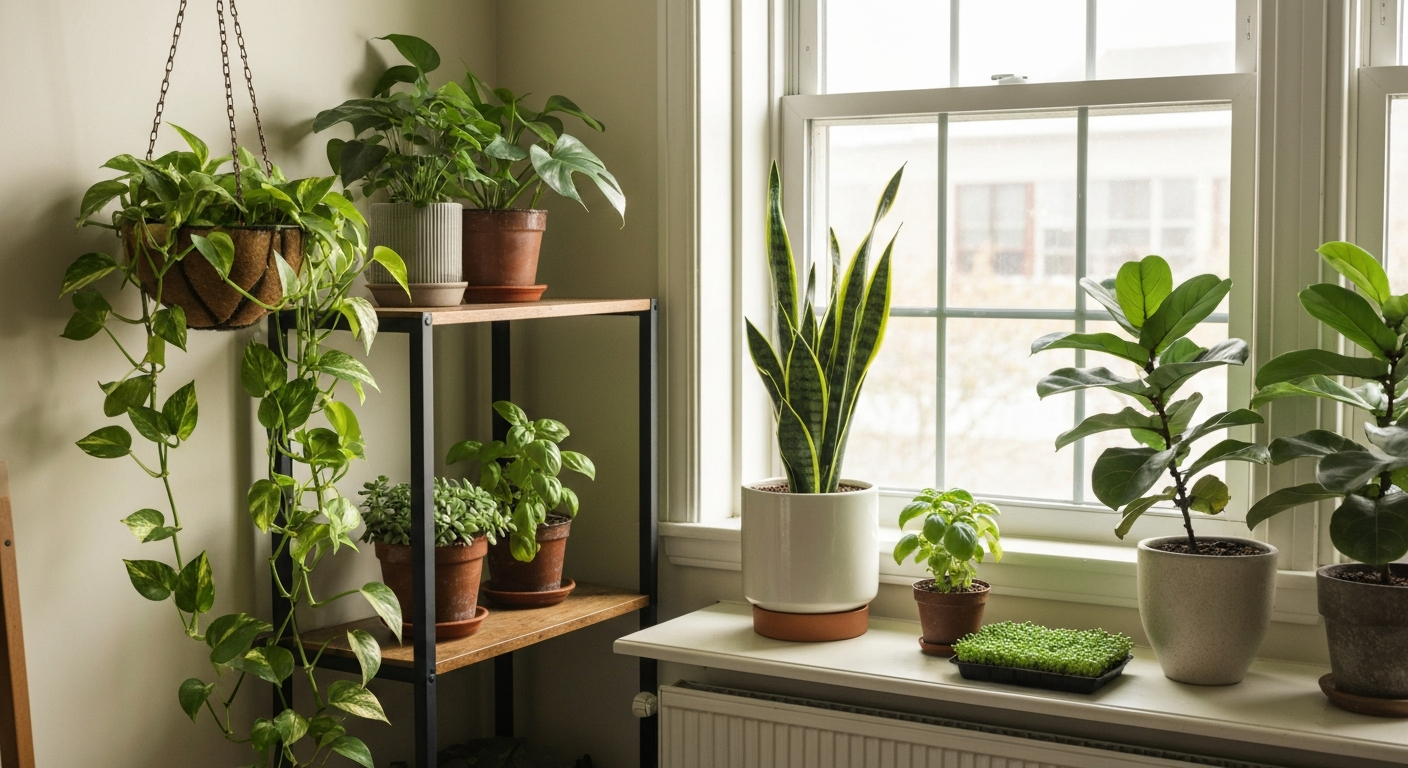
The best plants to grow in an apartment right now are pothos, snake plants, ZZ plants, peace lilies, and spider plants for low-light situations, and herbs like basil and mint, plus succulents and fiddle-leaf figs, for sunnier spots. The best plants to grow in an apartment right now are pothos, snake plants, ZZ plants, peace lilies, and spider plants for low-light situations, and herbs like basil and mint, plus succulents and fiddle-leaf figs, for sunnier spots plants i can grow in my apartment. Which ones are actually right for you depends on four things: how much light your windows give you, how much space you have, how much time you want to spend, and whether you have pets. Get those four factors straight and the list practically writes itself.
Best Plants to Grow in an Apartment: Easy Picks by Light

How to choose apartment plants (light, space, time, pets)

Light is the single biggest factor, and most apartment dwellers underestimate how dim their space actually is. A room that feels bright to your eyes can be surprisingly dark for a plant. A practical way to think about it: if your window gets fewer than five hours of direct sunlight, you're working with low to medium light. Within about five feet of a south- or west-facing window, you're in the bright indirect zone (roughly 250 to 1,000 foot-candles). On a sunny south-facing windowsill with actual direct sun hitting the glass, you can push 1,000 to 2,000 foot-candles or more. Know which category you're in before you pick anything.
Space matters almost as much. A studio apartment has room for one large statement plant or a cluster of small ones on a shelf. If you have a deep windowsill, that's a prime growing zone. Vertical space is often underused: wall shelves, hanging planters, and tiered plant stands let you grow more without sacrificing floor space. Think in three dimensions, not just square footage.
Time is an honest conversation to have with yourself. Some people are excited about plants in week one and forget them by week three. If that's you, lean heavily toward drought-tolerant species that forgive a missed watering or two. If you genuinely enjoy fussing over plants, you can try more demanding picks like fiddle-leaf figs or fresh herbs. Neither choice is wrong, but matching the plant to your real lifestyle keeps things alive.
Pets change the equation fast. Many popular houseplants, including pothos, philodendrons, and peace lilies, are toxic to cats and dogs. If you have a curious cat or a dog that chews things, you need to filter your list by pet safety from the start. If you are keeping houseplants around pets, UMN Extension recommends using a dedicated plant/pet safety resource and filtering your plant choices for practical safety considerations pet safety from the start. Safe options that also work well indoors include spider plants, Boston ferns, calatheas, areca palms, and most herbs like basil and rosemary. The ASPCA toxic plant database is worth bookmarking before you buy anything.
Best easy houseplants for low light and beginners
These are the plants that genuinely thrive in dimmer apartments and forgive beginner mistakes. They're not just tolerating bad conditions, they're actually adapted to them.
- Pothos (Epipremnum aureum): Nearly indestructible, trails beautifully from a shelf, tolerates low light and irregular watering. Not pet-safe.
- Snake plant (Dracaena trifasciata): Handles low light and drought better than almost anything. Water it once every two to four weeks and it's happy. Not pet-safe.
- ZZ plant (Zamioculcas zamiifolia): Thick rhizomes store water, making it extremely drought tolerant. Slow grower but nearly impossible to kill. Not pet-safe.
- Peace lily (Spathiphyllum): One of the few flowering plants that blooms in low light. Droops visibly when it needs water, which makes it easy to read. Not pet-safe.
- Cast iron plant (Aspidistra elatior): Lives up to its name. Handles low light, temperature swings, and neglect without complaint. Pet-safe.
- Spider plant (Chlorophytum comosum): Great for hanging baskets, produces babies you can propagate, and is one of the safest options for homes with cats and dogs. Pet-safe.
- Heartleaf philodendron: Trails or climbs, grows fast in low to medium light, and only needs watering when the top inch of soil is dry. Not pet-safe.
If you're brand new to plants, start with a pothos or a snake plant. They're widely available, inexpensive, and give you the best feedback loop for learning without punishing your mistakes. Once you've kept one of those alive for a few months, you'll have the intuition to try almost anything else on this list.
Best plants for bright apartments (windowsill to direct sun)

If you have a south- or west-facing window that gets several hours of direct sun, you're sitting on prime growing real estate. A lot of the most rewarding apartment plants, including edibles and blooming species, need this kind of light to do their best work.
- Succulents and cacti: Built for direct sun and dry conditions. Water deeply once every one to two weeks in spring and summer, less in winter. Echeverias, haworthias, and jade plants are all great apartment choices.
- Fiddle-leaf fig (Ficus lyrata): Dramatic, tall, and perfect for a bright corner. Needs consistent bright indirect light and hates being moved around. Water when the top two inches of soil are dry.
- Monstera deliciosa: Thrives in bright indirect light and grows fast enough to be satisfying. Iconic split leaves make it a statement piece. Not pet-safe.
- Rubber plant (Ficus elastica): Handles bright indirect light well and grows into a beautiful tree-like form. Dramatic dark foliage, low watering needs.
- Croton (Codiaeum variegatum): Needs bright light to keep its vivid orange, red, and yellow colors. Stunning in a sunny window but fades fast in dim rooms.
- Fresh herbs (basil, rosemary, thyme, chives): Genuinely productive in a south-facing window. Basil especially grows fast and rewards regular harvesting.
- Cherry tomatoes and compact peppers: If you have a deep, sunny windowsill or a small balcony adjacent to your apartment, determinate varieties like Tumbling Tom tomatoes or mini bell peppers will produce in containers.
One thing to watch with direct-sun windows: glass can intensify heat in summer, especially if you're in a high-rise. If plants are visibly scorching or soil is drying out in a day, move them back a foot or add a sheer curtain to diffuse the light slightly.
Best low-maintenance apartment plants by goal
Not everyone wants the same thing from their plants. Here's how to match your goal to the right pick.
For air quality and a cleaner-feeling space
Plants do filter some VOCs and particulate matter, but you'd need a jungle to meaningfully change air chemistry. That said, peace lilies, spider plants, and Boston ferns are frequently cited for removing common indoor pollutants. More practically, any plants you add increase humidity through transpiration, which many people find makes a dry apartment feel more comfortable, especially in winter when heating systems dry everything out.
For beauty and visual impact

If aesthetics are your main goal, think in layers: a tall snake plant or fiddle-leaf fig as a floor anchor, a medium pothos or philodendron trailing from a shelf, and a small succulent arrangement or calathea on a table. Calatheas (now classified as Goeppertia) are especially striking for their patterned leaves but need a bit more humidity and consistent moisture than most beginner plants. If you can manage that, they're stunning.
For edibles and herbs
Herbs are the most realistic edible option for most apartments. Basil, mint, chives, and parsley all grow well in 4 to 6-inch pots on a bright windowsill. Mint spreads aggressively so keep it in its own container. If you want something more ambitious, microgreens are excellent for apartments because they're grown on a tray under any decent light source, harvested in 7 to 14 days, and don't need soil depth. Cherry tomatoes and dwarf pepper varieties can work on a very sunny balcony or south-facing window, but they need consistent watering and feeding to produce.
For medicinal or functional plants
Aloe vera is the standout here. It grows easily in a bright window, needs almost no watering (once every two to three weeks is plenty), and the gel from a broken leaf is genuinely useful for minor burns and skin irritation. Lavender is another option if you have a very sunny windowsill, though it's harder to keep thriving indoors long-term without supplemental light. Chamomile can be grown in a container and harvested for tea, though it prefers cooler conditions and a dormancy period.
Plants that thrive in containers: watering habits and pot and soil tips
Container gardening is the default for apartments, and getting your pot and soil setup right matters more than most people realize. Here's what actually makes a difference.
Choosing the right pot
Drainage holes are non-negotiable. Decorative pots without holes trap water at the root zone and lead to rot, which is one of the most common ways apartment plants die. If you love a pot that has no hole, use it as a cachepot by placing a plain nursery pot inside it, then remove the nursery pot to water and let it drain before returning it. Terra cotta pots dry out faster than plastic or ceramic, which is actually an advantage for drought-tolerant plants like succulents and snake plants. Plastic retains moisture longer, which suits thirstier plants like peace lilies and ferns.
Soil matters more than people think
Generic all-purpose potting mix works fine for most tropical houseplants, but it's too dense and moisture-retentive for succulents and cacti. For succulents, mix standard potting soil with perlite at roughly a 50/50 ratio to improve drainage. For heavy-watering plants like peace lilies or calatheas, a peat or coco coir-based mix with good moisture retention works better. For example, peace lilies are described as visibly wilting when thirsty, which can make it easier to tell when to water peace lilies wilt visibly when they are thirsty. One practical tip: never use garden soil in containers. It compacts badly, doesn't drain well, and often introduces pests.
Watering habits by plant type
| Plant | Watering frequency | Key tip |
|---|---|---|
| Pothos / Philodendron | Every 7–10 days | Water when top inch of soil is dry |
| Snake plant / ZZ plant | Every 2–4 weeks | Err on the side of underwatering |
| Succulents / Cacti | Every 1–2 weeks in summer, less in winter | Soak deeply, then let soil dry completely |
| Peace lily | Every 5–7 days | Plant will droop slightly when thirsty, water then |
| Herbs (basil, mint) | Every 2–3 days | Keep soil moist but never waterlogged |
| Aloe vera | Every 2–3 weeks | Allow soil to dry completely between waterings |
| Fiddle-leaf fig | Every 7–10 days | Check top 2 inches; consistent schedule is key |
Seasonal and location-based picks: what to grow right now
It's late April 2026, which means you're in a genuinely great window for starting plants indoors across most of the Northern Hemisphere. Days are getting longer, light intensity through windows is increasing compared to winter, and most houseplants are either already in active growth or about to kick into it. This is the right time to pot up new additions, repot anything that's been root-bound over winter, and start herbs from seed or seedling.
For herb growers: basil seedlings planted now will establish quickly as days warm. In warmer climates (zones 8 and above, think the US Southeast, Southwest, Southern California, and similar latitudes globally), you can start basil near a south-facing window or on a balcony now without risk of cold shock. In cooler northern apartments (think Chicago, the Pacific Northwest, Northern Europe), keep herbs on the warmest, sunniest sill you have and wait until late May before moving anything to a balcony.
Succulents and cacti are waking up from their winter slow-down right now and are ready to resume regular watering. If you've been holding back on water through February and March, this is the moment to restart a normal watering schedule. Tropical houseplants like pothos, monsteras, and snake plants will also show new growth over the next six to eight weeks as light improves, so spring is a good time to fertilize with a balanced liquid fertilizer at half strength.
What to avoid buying right now: large, finicky outdoor-only plants marketed as 'patio plants' at garden centers. They often get moved inside by hopeful apartment dwellers and struggle or die without the intensity of outdoor sun. Stick with plants bred or well-adapted for indoor conditions, especially if your apartment gets less than four hours of direct sun per day.
Location nuance: If you're in the Southern Hemisphere (Australia, southern South America, South Africa), you're heading into autumn, which means light levels will drop over the next few months. This is a better time to focus on truly low-light-tolerant plants like ZZ plants, cast iron plants, and pothos rather than starting sun-hungry herbs or succulents that will struggle as winter approaches.
Common apartment plant problems and quick fixes
Overwatering and root rot
Overwatering kills more apartment plants than anything else. The symptoms look counterintuitively like underwatering: yellowing leaves, wilting, mushy stems. The fix is to check the soil before you water every single time, not on a calendar schedule. Stick your finger an inch or two into the soil. If it's still damp, wait. If the pot feels heavy, wait. If you've already overwatered and see mushy brown roots when you unpot the plant, cut away the rotted roots with clean scissors, let the root ball air-dry for an hour, and repot in fresh dry soil. Catch it early enough and most plants recover.
Yellowing leaves
Yellow leaves have several causes, which is what makes them frustrating to diagnose. Overwatering is the most common culprit (see above), but low light, low humidity, and nutrient deficiency all show up as yellowing too. If lower leaves are yellowing and the plant is otherwise growing, it's often just natural leaf turnover and not a problem. If yellowing is spreading upward from multiple points, check your watering habits first, then assess your light situation. Moving a plant two feet closer to a window can make a measurable difference in light intensity.
Leggy, stretched growth
When a plant stretches toward the light, growing long spindly stems with wide gaps between leaves, it's telling you it needs more light. This is called etiolation. The fix is to move the plant closer to a window, or supplement with a grow light. Inexpensive full-spectrum LED grow bulbs that fit standard lamp sockets work well in apartments. Position the bulb 6 to 12 inches above the plant and run it 12 to 14 hours a day. You won't reverse the leggy growth that's already happened (you can prune it back), but new growth will come in compact and healthy.
Fungus gnats
Those tiny flies hovering around your plants are almost certainly fungus gnats, and their larvae live in moist soil and chew on roots. The root cause is consistently wet topsoil. Let the top inch or two of soil dry out between waterings and you'll break their breeding cycle. For faster control, yellow sticky traps catch the adults, and a layer of horticultural sand or fine gravel on top of the soil prevents females from laying eggs. Hydrogen peroxide diluted to 3% and mixed with water (one part peroxide to four parts water) can be used as a soil drench to kill larvae without harming the plant.
Spider mites and mealybugs
Spider mites show up as fine webbing on leaves, usually when the air is dry and the plant is stressed. Mealybugs look like small cottony white clusters at leaf nodes and stem joints. Both spread fast to neighboring plants. Isolate the affected plant immediately. For spider mites, wipe leaves with a damp cloth and spray with diluted neem oil or insecticidal soap. For mealybugs, dab individual bugs with a cotton swab soaked in rubbing alcohol, then follow up with neem oil spray. Repeat weekly for three weeks to break the life cycle.
Your next steps
The smartest move is to pick one or two plants that match your actual light conditions, not the ones you wish you had. If you're not sure about your light, spend a sunny afternoon watching where direct sun falls in your apartment. That tells you everything. Start with a pothos or snake plant if you're uncertain, get them established, then build from there.
For a classroom, the best choice is usually a hardy, low-maintenance plant that tolerates typical indoor light and can handle occasional missed watering best plant to grow in a classroom. If you want classroom-friendly picks that can handle everyday neglect, use this guide to find the best classroom plants to grow for your space.
Once you're comfortable keeping those alive, adding a herb pot on the windowsill or a statement plant in a bright corner is a natural and satisfying next step. To find the best nursery plants to grow, pick sturdy, healthy seedlings that match your light and watering routine nurseries that carry healthy starters. Start by choosing plants that match your light and space, then look for nurseries that carry healthy starters suited to container growing adding a herb pot.
If you're setting up a dorm room or shared space with similar constraints, many of the same principles apply, though the plant scale and pot sizes may be different. If you're looking for the best plants to grow in a dorm room, start with low-light friendly choices like pothos or snake plants and match them to your window light best plants to grow in dorm room.
Don't overbuy at the start. One thriving plant beats five struggling ones every time, and you'll learn more from watching one plant closely than from managing a chaotic collection you don't have time for. Once you've got the basics down, the options open up considerably.
FAQ
How can I tell if my apartment light is “low” or “bright indirect” without special tools?
Do a simple test: in the same spot near your usual plant location, stand for 10 to 15 minutes and note whether you can read small text comfortably without leaning toward the light. If it feels dim and you need extra light to read, treat it like low light. For bright indirect, you should be able to read easily, with soft, even illumination and no obvious harsh glare on the floor or curtains.
What’s the safest first plant for someone who forgets watering?
Choose a plant that tolerates drying and use a soil-check habit. Snake plants and ZZ plants are usually better than peace lilies for irregular watering. Avoid starting with finicky tropicals (like many calatheas) unless you can commit to consistent moisture and humidity.
If I have a pet, should I avoid all the plants listed as “toxic”?
Not always, but you need a plan. If your cat or dog chews plants, skip pothos and peace lilies entirely. If they do not chew, you may still keep many houseplants but place them out of reach, use hanging or high shelves, and keep a pet-safe fallback option nearby (spider plants or herbs like basil and rosemary).
Are herbs like basil and mint the same light requirement as houseplants?
No, herbs generally demand more consistent light than low-light houseplants. Even indoors, basil and mint usually do best on a genuinely sunny sill, or near a window that gets several hours of direct sun. If your apartment is mostly low-light, choose chives or parsley instead, and expect slower growth.
Can I grow succulents in the same room as my low-light plants?
Usually not. Succulents need significantly brighter light to stay compact, otherwise they stretch and become weak. If you keep succulents, place them in the brightest spot you have, ideally near a south or west window, and keep low-light plants farther back from the glass.
What pot size should I use for apartment plants, especially when starting from a small nursery plant?
A common mistake is jumping to a much larger pot. For most houseplants, pick a container about 1 to 2 inches wider than the nursery pot, so the soil doesn’t stay wet too long. Oversized pots increase overwatering risk because roots take time to colonize the extra soil.
How often should I repot, and when is it actually necessary?
Repot when roots circle the pot, the plant dries out extremely fast, or growth stalls despite good light and watering. Many apartment plants do fine with only an occasional upgrade every 1 to 2 years. Also, avoid repotting at the first sign of a pest outbreak, focus on fixing the problem first.
My plant’s leaves yellow but the soil isn’t soaking wet, what should I check next?
Run a quick checklist in order: light level, watering accuracy, and nutrient status. Yellowing that spreads upward often points to insufficient light or inconsistent watering, even if you are not overwatering. If low leaves yellow while the plant otherwise grows steadily, it may be normal turnover. Move it closer to the window by 1 to 2 feet and reassess over 2 to 3 weeks.
What’s the quickest way to stop overwatering, once it’s already started?
Stop watering and confirm with a soil check, then act fast if roots smell or feel mushy. If you unpot and see brown, soft roots, trim rotted parts with clean scissors, air-dry the healthy root ball briefly (about an hour), then repot into fresh, dry mix. After repotting, wait until the top inch of soil is dry before you water again.
How do I fix a leggy plant that’s stretching toward the window?
Etiolation usually needs more light than you currently provide. Prune any severely stretched growth, then move the plant closer to the brightest window possible. If your apartment light is consistently weak, use a full-spectrum LED grow bulb 6 to 12 inches above the plant, for about 12 to 14 hours per day, and expect compact new growth rather than instant recovery.
What should I do if I see fungus gnats hovering around my plants?
Treat them as a soil moisture problem, not a flying insect problem. Let the top inch or two of soil dry between waterings, and consider adding a thin dry top layer (horticultural sand or fine gravel) to block egg laying. Sticky traps reduce adults while the drying interrupts the breeding cycle.
Can I use the same potting mix for every plant in my apartment?
Better not. One mix often fails for at least one plant. Use a well-draining mix for succulents (often standard potting soil plus perlite) and a more moisture-retentive mix for plants that prefer evenly moist conditions (like peace lilies and many calatheas). If you mix everything together in one batch, you’ll usually end up with overwatering for the drought-tolerant ones.
Do grow lights help, and where should I place them?
They can help a lot in apartments, especially for herbs, succulents, and compact growth. Place the light 6 to 12 inches above the plant, aim for consistent exposure, and choose a schedule like 12 to 14 hours per day. If leaves start bleaching or curling, raise the light slightly or shorten the daily run time.
Is humidity really important for calatheas and other “humidity lovers”?
Yes, but you can manage it without complicated setups. Calatheas often struggle if your indoor air is very dry, especially with heat running. If you choose them, keep them away from vents and drafty windows, and use a consistent watering routine. If you cannot maintain steady conditions, stick with more tolerant options like spider plants or peace lilies.
Best Pot Plants to Grow Indoors: Practical Guide for Apartments
Best pot plants to grow indoors: apartment-friendly picks with light, pot, watering, difficulty and seasonal tips.