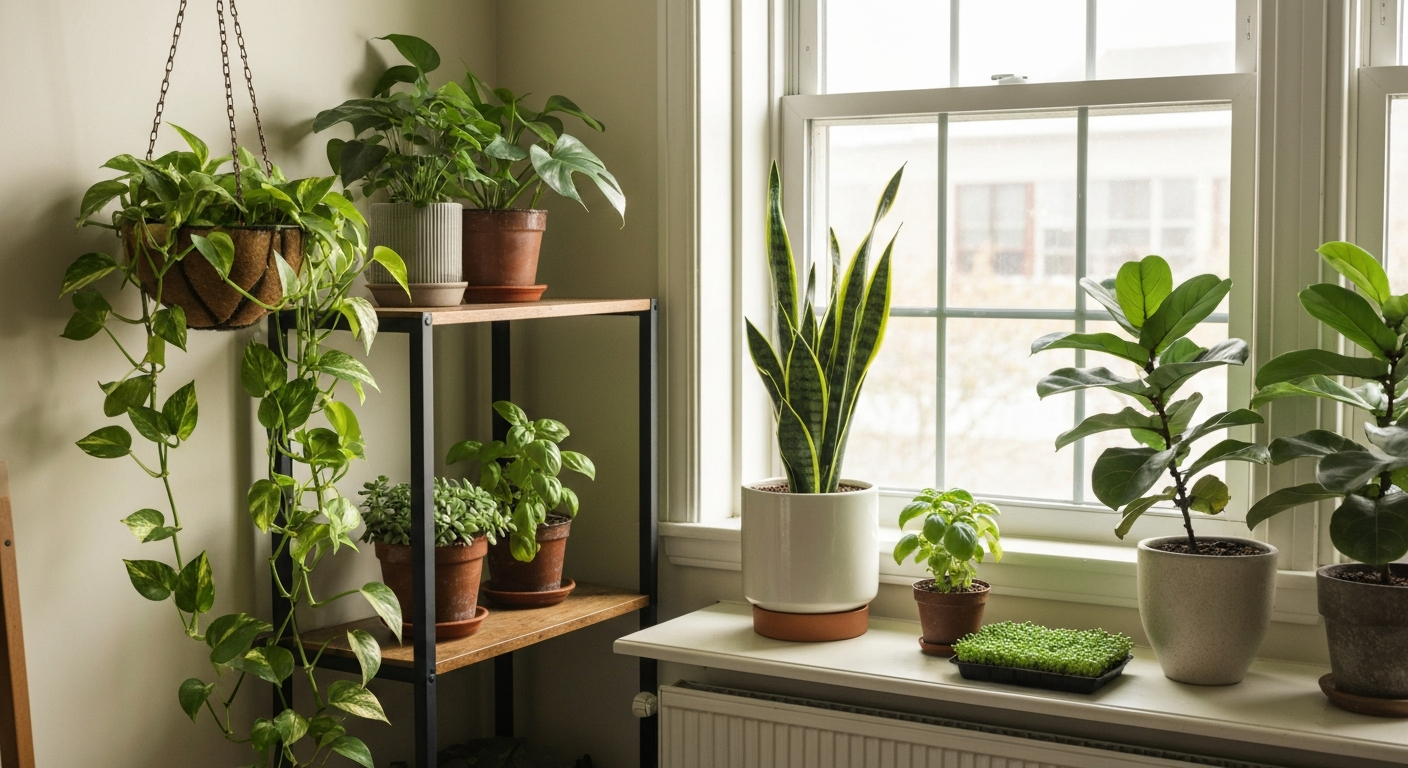
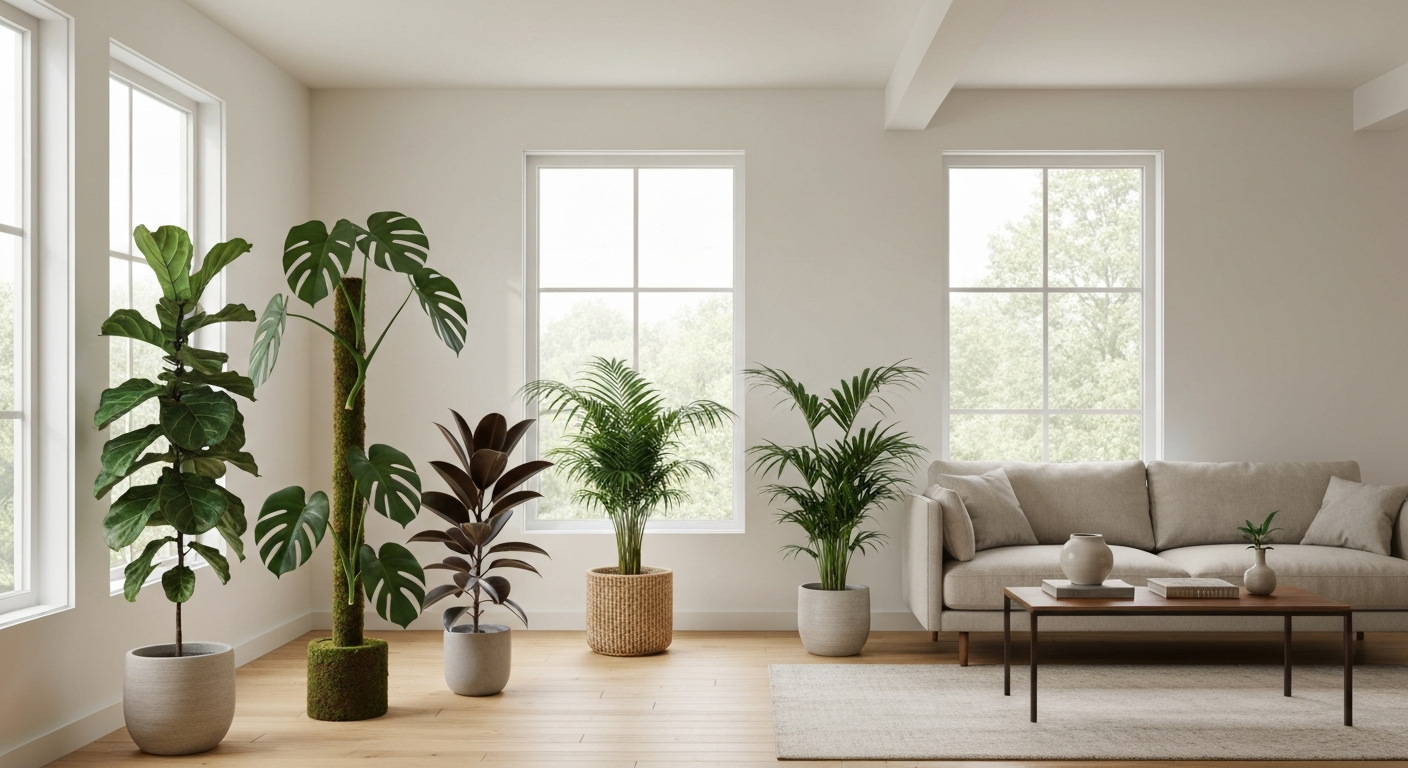
The best tall indoor plants for most homes are fiddle-leaf fig, rubber plant, Monstera deliciosa, Dracaena marginata, Kentia palm, Areca palm, Schefflera, and tree philodendron. Each can reliably reach 1.5 metres or more indoors, and the right pick depends on your light level, ceiling height, maintenance appetite, and whether you have pets or kids. This guide walks you through every variable so you end up with a plant that actually fits your space, not just one that looks good in a photo. For more options focused on container suitability, see our guide to the best pot plants to grow indoors.
Best Indoor Plants That Grow Tall: Top Picks & Care Guide
Rachel Hartley
6 Aug 2026
Who this guide is for
Whether you're furnishing a bright apartment living room, trying to fill an awkward corner in a dim hallway, or looking for something dramatic in a sunroom, tall indoor plants do things that furniture simply cannot. They draw the eye upward, soften hard lines, and make a room feel finished. But the failure rate on tall houseplants is high, mostly because people buy for looks and ignore light. This guide is for anyone from a first-time plant owner to an experienced indoor gardener who wants honest, condition-specific advice on which tall plants will thrive where they actually live. You'll get a quick decision framework, a vetted shortlist with real care profiles, curated lists by light, maintenance and purpose, realistic height expectations, and troubleshooting for common problems.
Quick decision guide: light, space, season, and goal
Before you buy anything, spend five minutes figuring out your light. University of Arizona extension guidance describes indoor light in measurable foot-candle (fc) bands: low light is roughly 25 to 75 fc (about 270 to 800 lux), medium is 75 to 250 fc (800 to 2,700 lux), bright indirect is 250 to 1,000 fc (2,700 to 10,800 lux), and direct sun is above 1,000 fc. A cheap handheld light meter or a free smartphone lux app measured at leaf level on a representative day will tell you exactly where you fall. North-facing rooms in winter often drop to low or barely medium. South-facing rooms in summer can hit bright indirect easily. That single reading narrows your shortlist by half.
| Your situation | Best pick | Why it works |
|---|---|---|
| Bright indirect light, want drama | Fiddle-leaf fig or Monstera deliciosa | Both thrive with 250–1,000 fc and deliver bold foliage at height |
| Medium light, low maintenance | Dracaena marginata or Kentia palm | Tolerant of 75–250 fc; slow and forgiving growers |
| Low light corner (25–75 fc) | Pothos on a tall totem or Dracaena | Among the few that stay healthy below 100 fc |
| Sunroom or south window | Areca palm or Schefflera actinophylla | Handle bright light and grow faster with warmth |
| Pet-safe household | Areca palm or Kentia palm | Both are non-toxic to cats and dogs per ASPCA |
| Want edible height | Lemon tree (dwarf) or indoor banana | Productive at 1.5–2 m with bright light and a big pot |
| Want fragrance at height | Gardenia standard or tall jasmine on trellis | Scented bloom at eye level, needs bright indirect light |
| Apartment with low ceilings (~2.4 m) | Rubber plant or Dracaena marginata | Easily managed at 1.5–1.8 m with light pruning |
Season matters more than most people expect. In winter, especially in northern states or any apartment above the second floor facing north, your light levels can halve. Plants that do fine in your summer bright spot may stall or drop leaves from October to February. If you're buying in August, test the same spot in January before committing to a species like fiddle-leaf fig that punishes low winter light with dramatic leaf drop.
How to pick the right tall plant for your constraints
Walk through these steps in order. Skip any that don't apply to you, but don't skip the light step.
- Measure your light: Use a meter or app at leaf level at 10 a.m. on a typical day. Note whether it's a winter or summer reading. If you're reading in summer, subtract roughly 30–50% for your winter baseline in temperate climates.
- Measure your ceiling clearance: Allow at least 30 cm (12 inches) between the plant's mature canopy and the ceiling for air circulation. A 2.4 m ceiling means you want a plant that tops out at around 1.8–2 m indoors.
- Assess your window exposure: North-facing rooms stay in the low-to-medium band year-round. East and west windows give medium to bright indirect. South-facing rooms with unobstructed glass reach bright indirect to direct sun.
- Honest maintenance check: If you travel frequently or forget to water, skip ficus and fiddle-leaf fig entirely. Go for Dracaena, Kentia palm, or a large pothos on a totem. They handle neglect far better.
- Pet and child safety check: If animals or small children share the space, shortlist Areca palm, Kentia palm, or spider plant (which won't reach impressive height). Most aroids — Monstera, Philodendron, Dieffenbachia — cause oral irritation and vomiting if ingested, per ASPCA guidance.
- Pick your pot size: For a plant you want to grow tall, start in a pot that allows two to four inches of clearance around the root ball. Repot in spring by no more than one pot size (roughly 5 cm / 2 inches in diameter) to avoid waterlogging from excess soil volume.
- Match humidity: Aroids and palms prefer 40–60% relative humidity. Dry, heated apartments in winter often sit at 20–30%. A small humidifier near the plant or a pebble tray with water makes a genuine difference, especially for Monstera and Areca palm.
The top tall indoor plants: full care profiles
These are the plants I'd actually recommend to someone standing in a garden center asking what to buy. Each profile gives you what you need to know without the fluff.
Fiddle-leaf fig (Ficus lyrata)
Fiddle-leaf fig is the showstopper of tall houseplants and also the most high-maintenance on this list. Missouri Botanical Garden notes it reaches 60 to 100 feet in its native West African habitat but typically stays between 2 and 3 metres indoors when given consistent bright indirect light (aim for 500 to 800 fc at leaf level). Growth is moderate at its best, perhaps 30 to 60 cm per year under good conditions, but it will stall or drop leaves if you move it, change its light, or let the roots sit wet. Water when the top 5 cm of soil is dry, cut back watering from October through February, and watch for scale insects, mealybugs, and spider mites. Use a pot with drainage and a well-draining peat or coir mix with 30% perlite. Prune the central leader in spring if you want a shorter, bushier shape. Not safe for pets.
Monstera deliciosa (Swiss-cheese plant)
Monstera is a native liana that can hit 30 metres in the wild, but as a supported indoor climber it commonly reaches 2 to 3 metres with a moss pole or trellis and bright indirect light. Monstera deliciosa, Missouri Botanical Garden Plant Finder notes the species is a native liana that can reach tens of metres in the wild but commonly grows to about 2–3 m indoors with support, and that higher indoor humidity improves leaf fenestration (aim ~40–60%) Monstera deliciosa — Missouri Botanical Garden Plant Finder. The relationship between light and leaf quality here is real and measurable: low light produces small, un-fenestrated leaves; bright indirect light (above 300 fc) produces the large, split leaves most people want. Aim for 40 to 60% humidity for best results. Water when the top 2 to 5 cm of soil dries out. Use a chunky aroid mix (bark, perlite, and coir) rather than a dense potting mix to keep roots aerated. Growth under good conditions is moderate to fast, 50 cm or more per year. Mildly toxic to pets and humans if ingested.
Rubber plant (Ficus elastica)
Rubber plant is one of the most forgiving of the tall ficus species. BBC Gardeners' World and RHS guidance describe indoor plants commonly growing to 1.8 to 3 metres depending on pot size and cultivar. The dark green, burgundy, or variegated cultivars (such as 'Burgundy' and 'Tineke') are all similarly sized. It tolerates bright indirect light and handles medium light better than fiddle-leaf fig. Water when the top 2 to 3 cm of soil is dry, and prune or 'top' the plant in spring to control height and encourage branching. The milky sap is a skin irritant and mildly toxic to pets. Repot in spring when roots show at the drainage holes, moving up one pot size at a time.
Dracaena marginata (Madagascar dragon tree)
Dracaena marginata is the pick for anyone who needs height without stress. Clemson HGIC lists it at 1.2 to 1.8 metres (commonly 4 to 6 feet) in indoor settings, though given time and a large pot it can push higher. Growth is slow to moderate at 10 to 30 cm per year, which is actually a feature: you won't be fighting the ceiling every spring. It tolerates medium and even lower-medium light better than almost any other species on this list. Allow the surface soil to dry slightly between waterings, feed monthly during active growth with a balanced liquid fertilizer, and avoid fluoride in tap water (Dracaena is sensitive: use filtered or rainwater if brown leaf tips appear). Safe approach for low-maintenance growers. Mildly toxic to pets.
Kentia palm (Howea forsteriana)
Kentia palm is the palm most recommended by interior landscapers for a reason: it tolerates low to medium light far better than most palms, doesn't need constant repotting, and is non-toxic to pets. RHS notes indoor specimens reach 1.8 to 3.5 metres over several years, and wild plants on Lord Howe Island grow much taller, so it has genuine vertical ambition given time. Water carefully: Kentia is sensitive to overwatering and root rot. Allow the top third of the soil to dry between waterings. It prefers moderate humidity and consistent temperatures. Growth is slow, which means it's a long-term investment, but it's also virtually impossible to kill quickly. A great choice for north-facing rooms that get at least 50 to 75 fc.
Areca palm (Dypsis lutescens)
Areca palm brings tropical energy with its multi-stemmed, arching fronds and can reach 3 metres or more indoors given a large pot and bright indirect light, per NC State Extension. Unlike Kentia, it grows faster and prefers brighter light (aim for 300 fc or more). It needs consistently moist soil and does best at 40 to 60% humidity, making it a natural for sunrooms or south-facing conservatories. Feed monthly in spring and summer with a palm-specific or balanced fertilizer. Brown frond tips are the most common complaint, usually caused by dry air or fluoride in tap water. Areca is non-toxic to pets and one of the few genuinely pet-safe options at this height range.
Schefflera (umbrella tree)
There are two species worth knowing. Schefflera arboricola (dwarf umbrella tree) tops out at around 1.2 to 1.8 metres indoors, while Schefflera actinophylla can reach 2 to 3 metres. Both prefer bright indirect to medium light and tolerate moderate indoor conditions reasonably well. They're fast growers when happy and can get leggy in low light, so give them as much light as you can. Prune leggy stems in spring to encourage bushier, more upright growth. The sap contains calcium oxalate crystals and is mildly irritating to skin and toxic to pets. Worth knowing if you're comparing options with a hanging plant in the same room; the visual language is very different from a trailing species.
Tree philodendron (Thaumatophyllum bipinnatifidum)
Tree philodendron is the philodendron that actually earns the 'tree' label. UF/IFAS interiorscape guidance describes indoor specimens reaching 1.5 to 2 metres or more depending on light and container. It has a self-heading (non-vining) habit so it doesn't need a support structure to grow tall, which makes it easier to place than Monstera or pothos. It prefers bright indirect light but tolerates medium. Use a chunky, well-draining aroid mix and water when the top few centimetres dry out. Like all aroids, it's toxic to pets and humans if ingested. Growth is moderate at roughly 30 to 50 cm per year under good indoor conditions.
Golden pothos on a tall totem (Epipremnum aureum)
Pothos is usually thought of as a hanging or trailing plant, but trained up a tall moss pole or trellis it can reach the ceiling of a standard room, producing progressively larger leaves as it climbs higher. University of Arizona extension guidance notes it tolerates low to medium light, but for genuine height and large-leaf development you want bright indirect light. Node contact with a moist moss pole triggers aerial root attachment and faster vertical growth. If you're looking for height on a small budget in a challenging light situation, a large pothos on a 1.8 m totem is one of the best options available. Mildly toxic to pets. Interested in the trailing version? That crosses over into hanging plant territory. For more hanging and trailing options, see a guide to the best hanging plants to grow indoors.
Tall indoor plants by light level
Bright indirect light (250–1,000 fc): best options
- Fiddle-leaf fig: needs consistent bright indirect to thrive and grow at its best pace
- Monstera deliciosa: produces its signature fenestrated leaves and fastest growth in this band
- Areca palm: prefers the higher end of bright indirect, especially in winter
- Rubber plant: grows fastest in bright indirect; tolerates slightly lower light but slows noticeably
- Schefflera actinophylla: benefits from bright light to avoid legginess
- Tree philodendron: does well in bright indirect and rewards it with larger leaf spread
Medium light (75–250 fc): reliable picks
- Dracaena marginata: genuinely adapted to medium light and still maintains good form
- Kentia palm: one of the most medium-light tolerant tall palms available
- Rubber plant: manages medium light reasonably well; growth slows but it won't deteriorate quickly
- Schefflera arboricola: handles medium light better than its larger cousin
- Pothos on a totem: grows more slowly and produces smaller leaves but survives medium light
Low light (25–75 fc): honest expectations
Very few plants will grow tall in true low light. What you can do at 25 to 75 fc is maintain existing height and slow-grow species that already have some size. Dracaena marginata and Kentia palm are the two most reliable. Pothos survives but produces small leaves and minimal upward growth. Fiddle-leaf fig, Monstera, Areca palm, and Schefflera will all struggle below 75 fc: expect leaf drop, no new growth, and eventual decline over winter months. If your room genuinely sits below 100 fc in winter, consider a grow light on a timer (12 to 14 hours at 200 to 400 fc supplemental) before investing in a large, expensive plant.
Tall indoor plants by maintenance level
Low maintenance: hard to kill at height
- Dracaena marginata: slow grower, handles inconsistent watering, forgiving of low light
- Kentia palm: drought-tolerant once established, slow-growing, rarely gets pests
- Pothos on a totem: extremely forgiving, revives quickly from underwatering, pest-resistant
Medium maintenance: worth the modest effort
- Rubber plant: regular watering in growing season, annual pruning to shape, occasional pest checks
- Monstera deliciosa: benefits from humidity, regular wiping of leaves, and a support structure as it grows
- Tree philodendron: consistent watering and occasional feeding; needs space as it spreads laterally
- Areca palm: consistent moisture and humidity management; brown tips need monitoring
- Schefflera: regular pruning to prevent legginess; pest-watch for spider mites and scale
High maintenance: rewarding but demanding
- Fiddle-leaf fig: sensitive to movement, light changes, inconsistent watering, and drafts; not for busy households
- Gardenia standard (trained tree form): needs precise humidity, temperature, and fertilization for blooms at height
- Tall Ficus benjamina (weeping fig): notorious for leaf drop when moved or stressed; high light and consistency required
Tall indoor plants by purpose
Aesthetic tall plants: drama and structure
For pure visual impact, fiddle-leaf fig, Monstera deliciosa, and rubber plant are the three most commonly used for interior design reasons, and all three deliver when the light is right. Kentia and Areca palms bring a softer, tropical silhouette that works particularly well in minimal or coastal-style interiors. Dracaena marginata has a sculptural, almost architectural quality with its bare cane stems and spiky rosettes that suits modern and Scandinavian-style rooms. Tree philodendron creates a tropical forest feel with its enormous, deeply lobed leaves and works well as a room divider in open-plan spaces.
Edible tall indoor plants
Most of the tallest houseplants are purely ornamental, but a few edible options can reach meaningful height indoors. Dwarf citrus trees (Meyer lemon, calamondin orange) on a sunny south-facing windowsill or in a bright sunroom can reach 1.5 to 2 metres and produce fruit in a large pot with regular feeding. Dwarf banana (Musa acuminata 'Super Dwarf Cavendish') can reach 1.2 to 1.5 metres indoors with very bright light and high humidity, though indoor fruiting is rare and unreliable. Indoor bay laurel (Laurus nobilis), trained as a standard, reaches 1 to 1.5 metres and provides usable culinary leaves year-round. If edible indoor plants are a priority, there's a lot more to explore on that topic beyond just height. See our guide to the best edible plants to grow indoors for specific edible varieties, care needs, and space-saving tips.
Fragrant tall indoor plants
Getting fragrance at height indoors requires more effort but it's achievable. Gardenia (Gardenia jasminoides) trained as a standard reaches 1 to 1.5 metres and delivers intense fragrance, but it demands consistent humidity above 50%, acidic well-draining soil, and bright indirect light with cool nights (around 15 to 18°C) to set buds. Jasmine (Jasminum polyanthum) on a tall trellis or hoop can reach ceiling height in a bright room and flowers heavily in late winter and spring. Tall scented-leaf geraniums (Pelargonium) can reach 1 to 1.2 metres in a sunny spot and offer rose, lemon, or mint fragrance from the foliage. Fragrant plants as a category are worth exploring in more depth if that's your primary goal. For a focused list of highly scented houseplants and care tips, see our guide to the best smelling plants to grow indoors.
Realistic indoor heights and growth rates
| Plant | Realistic indoor mature height | Approx. growth rate indoors | Light needed | Maintenance level |
|---|---|---|---|---|
| Fiddle-leaf fig (Ficus lyrata) | 2–3 m (6–10 ft) | Moderate: 30–60 cm/yr in good light | Bright indirect (300–800 fc) | High |
| Monstera deliciosa | 2–3 m with support (6–10 ft) | Moderate–fast: 50+ cm/yr with support + bright light | Bright indirect (250–600 fc) | Medium |
| Rubber plant (Ficus elastica) | 1.8–3 m (6–10 ft) | Moderate: 30–50 cm/yr | Bright indirect to medium (150–600 fc) | Medium |
| Dracaena marginata | 1.2–1.8 m typical (4–6 ft) | Slow–moderate: 10–30 cm/yr | Medium to bright indirect (75–400 fc) | Low |
| Kentia palm (Howea forsteriana) | 1.8–3.5 m over years (6–12 ft) | Slow: 10–20 cm/yr | Low to bright indirect (50–500 fc) | Low |
| Areca palm (Dypsis lutescens) | 2.5–3 m+ (8–10 ft+) | Moderate: 25–40 cm/yr | Bright indirect (250–600 fc) | Medium |
| Schefflera actinophylla | 2–3 m (6–10 ft) | Moderate–fast: 30–50 cm/yr in good light | Bright indirect to medium (150–500 fc) | Medium |
| Tree philodendron (T. bipinnatifidum) | 1.5–2 m+ (5–7 ft) | Moderate: 30–50 cm/yr | Bright indirect to medium (150–400 fc) | Medium |
| Golden pothos on totem (Epipremnum aureum) | 2–3 m+ ceiling height possible | Moderate–fast: 30–60 cm/yr with support | Low to bright indirect (50–600 fc) | Low |
| Schefflera arboricola (dwarf) | 1.2–1.8 m (4–6 ft) | Moderate: 20–40 cm/yr | Medium to bright indirect (100–500 fc) | Medium |
A note on these numbers: they reflect typical indoor conditions in a temperate home with reasonable but not perfect care. Growth rates drop by 50% or more in winter in low-light rooms. A Monstera in a dim north-facing apartment in January is not doing 50 cm per year. Match your expectations to your actual conditions, not the best-case scenario.
Pots, soil, and repotting: getting the foundation right
Container choice is genuinely important for tall plants because they're top-heavy and need stable pots with good drainage. Always use a container with drainage holes and empty saucers within an hour of watering. For most tropical foliage plants on this list, a mix of roughly 70% peat moss or coconut coir combined with 30% perlite or vermiculite is a solid, well-draining starting point. NCAT's Potting Mixes for Certified Organic Production offers a recipe overview and rationale for soilless, well‑draining mixes (about 70% peat or coconut coir + 30% perlite/vermiculite) and recommends chunkier bark‑based mixes for aroids to improve aeration. For aroids specifically (Monstera, Philodendron, pothos), go chunkier: add orchid bark to the mix to improve aeration around the roots, which reduces rot risk significantly.
When it comes to repotting, the University of Maine Extension guidance is straightforward: increase pot diameter by about 5 cm (2 inches) for younger plants, and for large specimen plants just move up one pot size. Avoid the temptation to jump to a dramatically larger pot, because the excess soil holds moisture the roots can't use quickly enough and leads to root rot. The best repotting window is early spring, just as new growth starts. If you can't repot a large plant, topdress with 5 cm of fresh compost mix instead.
Support, training, and pruning to manage height
Most climbing or vining tall plants (Monstera, pothos, some philodendrons) need a physical support to reach their height potential. A moss pole encourages aerial root attachment and keeps the plant vertical. A bamboo cane or timber stake works for structurally unstable young trees like fiddle-leaf fig. Tie loosely with soft plant ties or old pantyhose strips to avoid girdling stems as they thicken. For palms, no support is needed.
Pruning schedules depend on species. For ficus species (fiddle-leaf fig, rubber plant), prune in spring just before the growing season. Cut just above a node or leaf to encourage branching. For Dracaena, you can cut canes back hard in spring and they'll resprout from the cut point, useful for controlling a plant that's hit the ceiling. Schefflera and tree philodendron can be pruned in spring to remove leggy growth and encourage a more compact crown. Avoid heavy pruning in fall or winter when growth has slowed.
Watering, feeding, and humidity
The most common way to kill a tall houseplant is overwatering. Washington State University's guidance on fungus gnats makes the practical point well: letting the top 2 to 5 cm of soil dry between waterings prevents the constantly moist conditions that cause root rot and attract soil pests. Apply this rule to Monstera, ficus, philodendron, and Schefflera. Palms are similar but slightly more drought-tolerant once established. The main exception is Areca palm, which prefers consistently moist (not wet) soil.
Feed actively growing plants monthly from spring through early autumn with a balanced liquid fertilizer diluted to half strength. Don't feed in winter when growth has slowed: unused fertilizer salts accumulate in the soil and cause leaf tip burn. For palms, use a palm-specific fertilizer with micronutrients, particularly magnesium and manganese, during the growing season. Dracaena is sensitive to fluoride in tap water; use filtered or rainwater if you're seeing brown leaf tips that don't respond to humidity adjustments.
Humidity is the factor most apartment growers underestimate. Central heating in winter routinely brings indoor humidity below 30%. Aroids and palms prefer 40 to 60%. A small ultrasonic humidifier running nearby, or grouping plants together to create a microclimate, will noticeably improve leaf quality, fenestration in Monstera, and frond color in palms. Misting is largely ineffective because the moisture evaporates too quickly; a pebble tray with water sitting below the pot provides more consistent ambient moisture.
Seasonal and regional care adjustments
In summer across most of the US and UK, most of these plants will grow actively and some quite fast. In a heated apartment in Chicago or Minnesota in January, you're in essentially winter management mode: reduce watering frequency by roughly 30 to 50%, stop feeding, and don't repot. If you're in a mild climate like coastal California, Florida, or southern Texas, your indoor light in winter is meaningfully better and your heating drying effect is less severe, so you can maintain a closer-to-summer care routine year-round.
Watch for temperature drops near windows in winter. Glass surfaces get cold overnight, and a fiddle-leaf fig or Monstera sitting with leaves touching a cold window in January in Minnesota can experience cold damage even if the room thermostat reads 20°C. Move plants a few inches from the glass in late autumn if you're in a cold-winter climate.
Propagation: making more tall plants
Most tall indoor plants are straightforward to propagate with stem cuttings, though timing and method vary.
| Plant | Best propagation method | Time to roots | Best season |
|---|---|---|---|
| Fiddle-leaf fig | Stem cuttings (10–15 cm) in water or moist perlite | 4–8 weeks | Spring–early summer |
| Monstera deliciosa | Stem cuttings with at least one node; water or sphagnum moss | 3–6 weeks | Spring–summer |
| Rubber plant | Stem cuttings (tip cuttings, 10 cm); dip in rooting hormone | 4–8 weeks | Spring–summer |
| Dracaena marginata | Cane sections (tip or mid-cane) in moist soil or water | 4–8 weeks | Spring |
| Kentia palm | Seed only; very slow (months to years); not practical for home propagation | Months | Not season-dependent |
| Areca palm | Clump division or seed; division is faster | 2–4 weeks to establish | Spring |
| Schefflera | Stem tip cuttings with rooting hormone | 4–8 weeks | Spring–summer |
| Tree philodendron | Stem cuttings with node; or clump separation for multi-stemmed plants | 3–6 weeks | Spring–summer |
| Pothos | Stem cuttings (single node) in water | 2–4 weeks | Any time; fastest in summer |
Pests, diseases, and troubleshooting
The most common pests on tall indoor plants are spider mites, scale insects, mealybugs, and fungus gnats. Missouri Botanical Garden lists spider mites, scale, aphids, and mealybugs specifically for Ficus lyrata, and this combination applies broadly to most plants on this list. Spider mites thrive in dry conditions (another reason to maintain humidity). Treat them with neem oil spray or insecticidal soap, repeating weekly for three to four weeks. Scale and mealybugs respond to wiping with isopropyl alcohol on a cotton swab plus a follow-up systemic treatment for heavy infestations. Fungus gnats are a soil moisture problem: let the top 5 cm dry out between waterings and the population will collapse.
Root rot is the number one non-pest cause of death in tall houseplants. Signs include yellowing lower leaves, mushy stem base, and a sour smell from the soil. Prevention is better than cure: drainage holes, appropriate soil mix, and not overwatering. If you catch it early, remove the plant from its pot, cut away any black or mushy roots with sterilized scissors, dust cut surfaces with cinnamon or powdered sulphur, and repot in fresh dry mix. Skip watering for several days after repotting.
| Symptom | Likely cause | Fix |
|---|---|---|
| Brown leaf tips | Low humidity or fluoride in tap water | Raise humidity; switch to filtered or rainwater |
| Yellow lower leaves | Overwatering or root rot | Check roots; reduce watering; improve drainage |
| Leggy, stretched growth | Insufficient light | Move to brighter spot or add supplemental grow light |
| Leaf drop (ficus) | Moved location, drafts, or inconsistent watering | Stabilize position; consistent watering routine |
| No new growth in active season | Root-bound or needs feeding | Repot one size up; begin monthly feeding |
| White cottony clusters on stems | Mealybugs | Wipe with isopropyl alcohol; treat with neem oil |
| Brown bumps on stems | Scale insects | Scrape off manually; apply horticultural oil |
| Fine webbing between leaves | Spider mites | Improve humidity; spray with insecticidal soap weekly |
| Small flies around soil | Fungus gnats | Let soil dry more between waterings; use sticky traps |
A note on toxicity and safe placement
It's worth being direct about this: most of the most popular tall houseplants are toxic to pets and, to a lesser degree, humans if ingested. The ASPCA lists Ficus, Monstera, Philodendron, Dieffenbachia, and Schefflera among plants that cause oral irritation, drooling, and vomiting in cats and dogs. If you have pets that chew plants, your safe shortlist for tall plants is essentially Areca palm and Kentia palm. Everything else should be placed where pets genuinely cannot access it, which in a household with curious cats is harder than it sounds. If pet safety is a priority, it's worth looking at what's available in the small and low-growing plant categories as well, where safe options are considerably more diverse. For curated, pet-friendly options, see our guide to the best small plants to grow indoors. For more pet-safe small options, see our guide to the best mini plants to grow indoors.
Comparing your top options side by side
| Plant | Min. light (fc) | Max indoor height | Pet safe? | Maintenance | Best for |
|---|---|---|---|---|---|
| Fiddle-leaf fig | 300 | 3 m | No | High | Bright rooms, design impact |
| Monstera deliciosa | 250 | 3 m with support | No | Medium | Tropical look, good light |
| Rubber plant | 150 | 3 m | No | Medium | Flexible light, bold foliage |
| Dracaena marginata | 75 | 1.8 m | No | Low | Low-light rooms, beginners |
| Kentia palm | 50 | 3.5 m over years | Yes | Low | Any room, pet households |
| Areca palm | 250 | 3 m+ | Yes | Medium | Bright, humid spaces, pets |
| Schefflera actinophylla | 150 | 3 m | No | Medium | Fast height, bright rooms |
| Tree philodendron | 150 | 2 m+ | No | Medium | Tropical spread, no support needed |
| Pothos on totem | 50 | 3 m+ possible | No | Low | Budget pick, any light |
If you're still undecided, here's the practical shortcut: low-light apartment with pets, buy a Kentia palm. Bright room with no pets and you want maximum drama, choose between fiddle-leaf fig and Monstera based on whether you prefer a sculptural tree form or a lush tropical climber. Tight budget and challenging conditions, large pothos on the tallest totem you can find. Everything else fills in the space between those anchors.
FAQ
Which indoor plant species and cultivars reliably grow tall in typical indoor settings?
Best reliable tall growers: Ficus lyrata (fiddle‑leaf fig) — commonly 2–10 ft indoors; Ficus elastica cultivars (rubber plant) — 6–10 ft possible; Monstera deliciosa — 6–10+ ft with support; Philodendron (tree types/Thaumatophyllum) — 5–6 ft or more; Schefflera actinophylla and S. arboricola (dwarf) — 4–10 ft depending on species; Dracaena marginata — 4–6 ft typical; Howea forsteriana (Kentia palm) — 6–12 ft over years; Dypsis lutescens (areca) — ~10 ft multi‑stem; Epipremnum aureum (pothos) — can reach ceilings when trained vertically. Choose cultivar based on ceiling height and room conditions (see selection flow below).
How do I match a tall plant to my room’s light using measurable units?
Use foot‑candles (fc) or lux measured at leaf level with a handheld meter. Typical indoor bands: low ≈25–75 fc (270–800 lux); medium ≈75–250 fc (800–2,700 lux); bright/bright‑indirect ≈250–1,000 fc (2,700–10,800 lux); direct sun >1,000 fc. Match species: low (Kentia, some palms, pothos in trailing form), medium (Dracaena, Schefflera, rubber plant in moderate light), bright indirect (Monstera, Ficus lyrata, Philodendron tree types).
What is a simple selection flow: how do I pick the right tall plant for my constraints (light, space, pets, purpose)?
Selection flow: 1) Measure light band at target location. 2) Check ceiling height and measure mature plant height (choose plants whose mature indoor height fits with margin for growth/pruning). 3) Decide purpose: aesthetic foliage (Ficus, Monstera), fragrant/edible (few tall edibles indoors; consider dwarf citrus in bright sites), privacy/screening (palm, rubber plant), low maintenance (Kentia, pothos). 4) Account for pets/children: many tall houseplants are toxic (Ficus, Monstera, Philodendron). If safety is needed, pick pet‑safe species or place out of reach. 5) Choose maintenance level: low (Kentia, rubber with minimal pruning), moderate (Monstera with support and humidity), high (fast growers needing training/pruning). For related options see Best Plants Guide: /edible-indoor-plants, /hanging-plants, /small-mini-plants, /pot-plant-care, /fragrant-plants.
One‑paragraph care profiles: what are quick care summaries for top tall species?
Ficus lyrata (Fiddle‑leaf fig): Bright indirect light, moderate watering (top 2–3 cm dry between waterings), benefits from stable temps 60–75°F (15–24°C), moderate humidity; slow–moderate growth indoors to 2–10 ft; prune/tip to control height and reduce leaf drop when moved. Monstera deliciosa: Bright indirect light, high humidity (40–60%+ improves fenestration), climb on a moss pole or trellis, regular feeding in active season; moderate–fast climber to 6–10+ ft with support. Ficus elastica (Rubber plant): Bright indirect to medium light, allow light surface drying, tolerant of pruning to maintain tree form; can reach 6–10 ft. Dracaena marginata: Medium to bright indirect, allow top few cm to dry, slow–moderate growth to 4–6 ft; sensitive to fluoride in water—use filtered/low fluoride water. Kentia palm (Howea): Low–medium light tolerant, evenly moist but not waterlogged, slow grower that reaches 6–12 ft; excellent for lower‑light tall form. Areca/Butterfly palm (Dypsis lutescens): Prefers bright indirect, regular moisture, clumping multi‑stem tall palm to ~10 ft indoors; benefits from humidity and frequent dusting. Epipremnum aureum (Pothos): Tolerant low–medium light but foliage thrives and vines thicken in bright indirect; train vertically to reach ceilings; fast grower when warm and bright. Schefflera spp.: Bright–medium light, moderate watering, can be trained or pruned to tree form; dwarf species stay shorter (4–6 ft) while larger species reach 6–10 ft.
How fast will these plants grow indoors (growth‑rate expectations)?
General indoor rates under typical conditions: slow ≤10–20 cm/yr (some dracaenas, slow rubber cultivars in low light); moderate ~20–50 cm/yr (Ficus lyrata, many philodendrons in good light); fast >50 cm/yr (Monstera, pothos, areca palm in bright/warm/humid conditions). Growth depends heavily on light, temperature (65–80°F is ideal for most), humidity, pot size, and feeding—the same species can be slow in low light and much faster in bright, humid rooms.
What potting mix and pot size should I use for tall houseplants?
Use a well‑draining soilless mix: general recipe ~70% peat moss or coco coir + 30% perlite/vermiculite; for aroids (Monstera, Philodendron) use chunkier mixes with bark or orchid bark to increase aeration. For palms and ficus, a quality indoor potting mix with added perlite is fine. Pot size rule: when repotting increase diameter by ~2 inches (5 cm) for small/young plants; for large specimen trees, only go one pot size up or topdress to avoid overpotting. Always use pots with drainage holes and empty saucers after watering.
Next Article
Best Pot Plants to Grow Indoors: Practical Guide for Apartments
Best pot plants to grow indoors: apartment-friendly picks with light, pot, watering, difficulty and seasonal tips.