The best edible plants to grow indoors are herbs like basil, mint, and chives; cut-and-come-again greens like lettuce and spinach; microgreens; and compact fruiting crops like cherry tomatoes, hot peppers, and strawberries. What you can actually pull off depends on three things: how much light your space gets, how much room you have, and how quickly you want to eat something. This guide helps you match plant choices to those exact constraints so you leave with a short, realistic list and a plan you can start today.
Best Edible Plants to Grow Indoors: Easy Food Options
Rachel Hartley
14 Apr 2026
How to choose the best indoor edible plants for your setup
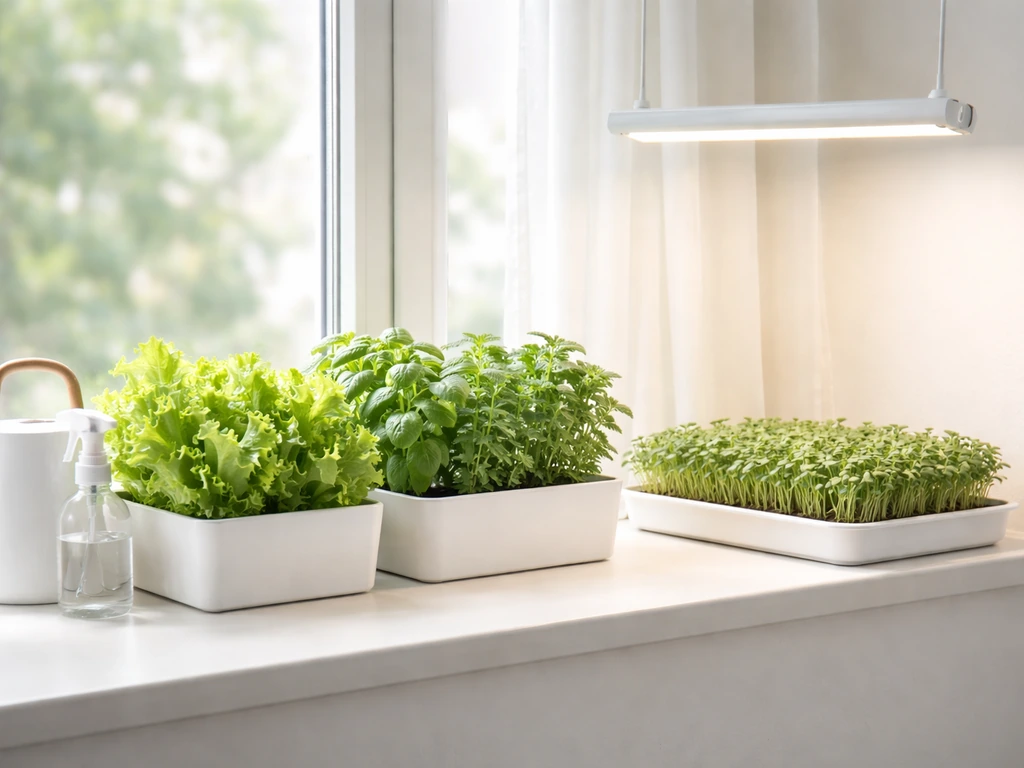
Before you buy a single seed packet, take five minutes to honestly assess your space. The single biggest factor is light. A bright south-facing window in North America gets roughly 4 to 6 hours of direct sun in winter and 6 to 8 in summer. That is enough for herbs and leafy greens, and marginal for fruiting crops. A north or east-facing window rarely cracks the threshold fruiting plants need, which is why adding a simple LED grow light is often the smartest $30 to $60 you can spend if you want tomatoes or peppers on a shelf.
Light intensity for plants is measured in PPFD (micromoles per square meter per second, or μmol·m⁻²·s⁻¹), which tells you the rate of photosynthetically usable photons hitting the leaf. Most herbs and leafy greens thrive at 150 to 250 μmol·m⁻²·s⁻¹, while fruiting crops want 400 to 600 or more. You can roughly estimate PPFD from a lux meter reading by dividing lux by about 54 (a useful rule of thumb for daylight or white LED conditions, though exact values shift with spectrum). A shaded indoor spot that reads 5,000 lux converts to roughly 93 μmol·m⁻²·s⁻¹, which is honestly only enough for microgreens and the most shade-tolerant herbs.
Beyond light, think about container footprint, temperature, and how much time you want to spend. A windowsill fits small 4-to-6-inch pots, great for herbs. A countertop tray works for microgreens. A 5-gallon bucket or fabric pot on a stand covers most compact vegetable varieties. Temperature matters too: most edible plants prefer 60 to 75°F (15 to 24°C). Kitchens and living rooms tend to land right in that range, which is one reason indoor food gardening works so well year-round compared to outdoor growing in cold climates.
Top low-effort indoor food plants: herbs, greens, and microgreens
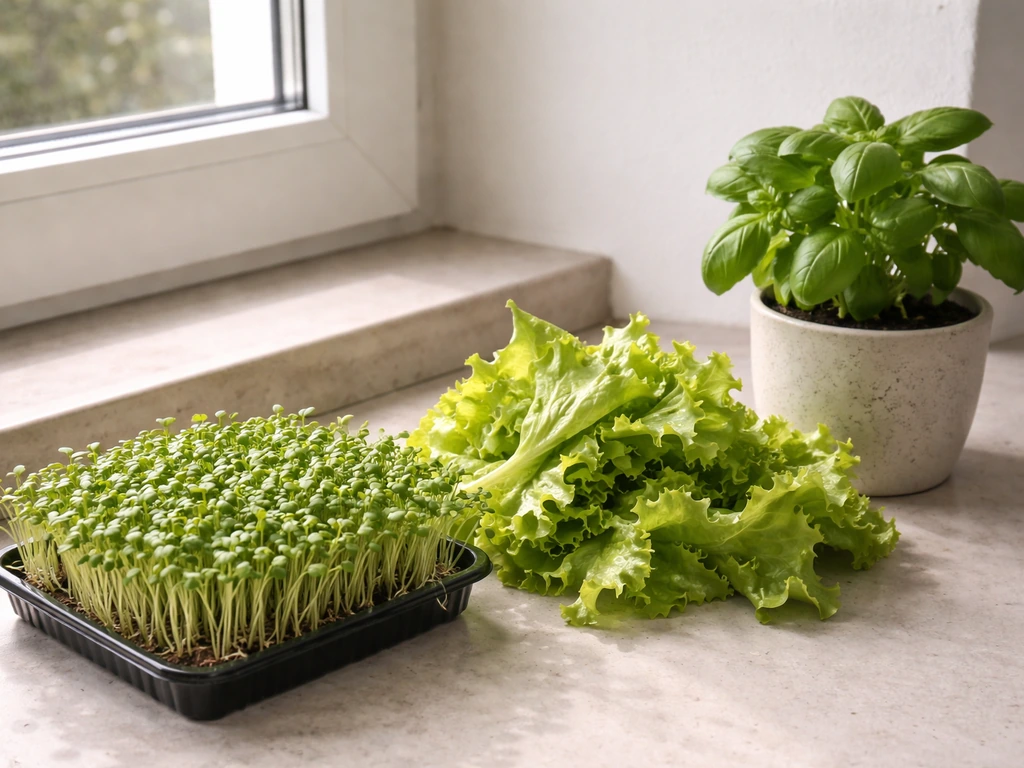
These are your safest starting points. They are fast, productive, and forgiving. Many people growing indoors for the first time on a small-space setup get their best early wins here before moving on to more demanding crops.
Herbs
- Basil: fast (harvest in 3 to 4 weeks from transplant), needs 6+ hours of bright light or a grow light, keep warm above 65°F or it sulks
- Mint: nearly indestructible, grows in lower light than most herbs, pot it separately because it spreads aggressively
- Chives: tolerates lower light, regrows after cutting, almost zero maintenance in a 4-inch pot
- Cilantro: fast (3 to 4 weeks to first harvest), bolts quickly in warmth, so succession-sow every 2 to 3 weeks
- Parsley: slower to establish (6 to 8 weeks), but then reliably productive for months
- Thyme, oregano, rosemary: Mediterranean herbs that prefer bright, dry conditions; rosemary can get large but thyme and oregano stay compact
Leafy greens
Cut-and-come-again lettuce varieties like 'Black Seeded Simpson' or any loose-leaf blend give you harvests in 30 to 40 days and keep producing for months if you snip outer leaves and leave the center. Spinach takes 40 to 45 days and tolerates cooler, dimmer conditions than most edibles. Baby kale and arugula hit their first harvest around 25 to 30 days, and arugula's peppery punch means you use less of it, so a single 6-inch pot goes a long way.
Microgreens
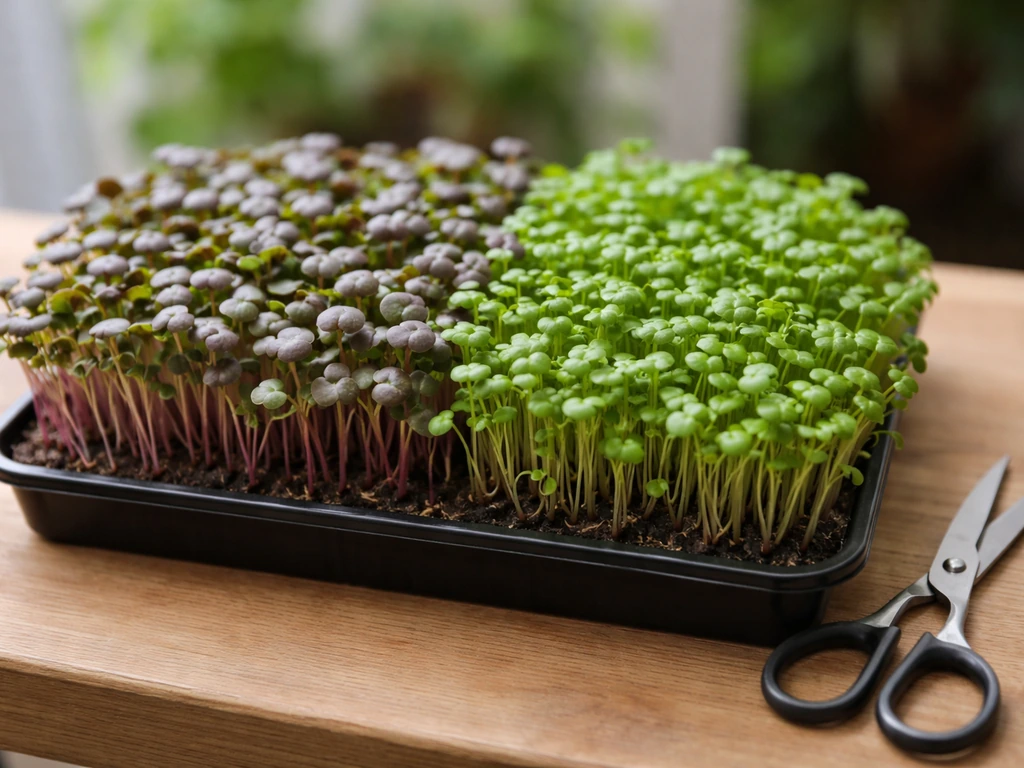
Microgreens are the fastest edible crop you can grow indoors. Radish and mustard microgreens are ready to cut in 7 to 10 days. Sunflower and pea shoots take 10 to 14 days. You grow them in a shallow tray (1 to 2 inches of growing medium), they need only moderate light (a sunny windowsill works fine), and you harvest the whole tray once. No waiting for fruit, no watering schedule to maintain for months. If you want something to eat this week, microgreens are the answer.
Best indoor vegetables and fruits in containers (and which varieties actually work)
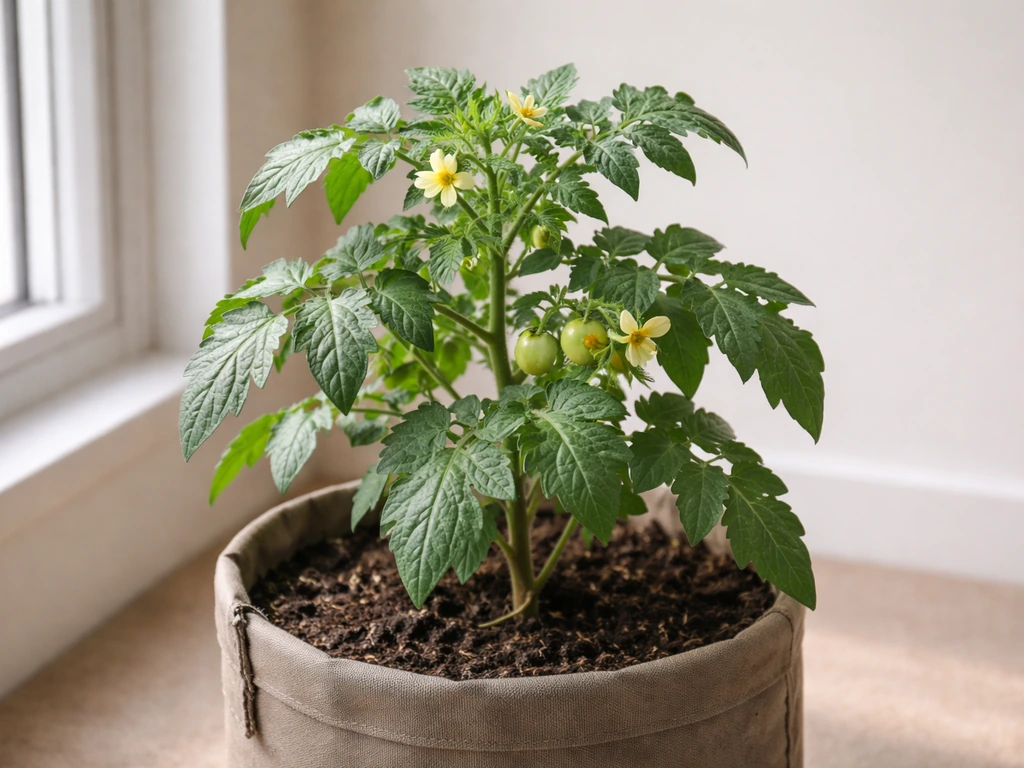
Fruiting crops indoors are absolutely doable, but variety selection matters enormously. A standard beefsteak tomato will grow 5 feet tall and produce maybe a dozen fruit indoors before it exhausts itself. A dwarf or determinate variety bred for containers will produce continuously in the same footprint. If you are picking plants for growing in pots, stick to the varieties below.
| Crop | Best Indoor Varieties | Min. Container Size | Light Needed | Days to First Harvest |
|---|---|---|---|---|
| Cherry tomato | Tiny Tim, Tumbling Tom, Window Box Roma | 3 to 5 gallon | Strong light or grow light (400+ μmol) | 60 to 70 days from transplant |
| Hot pepper | Lemon Drop, Thai Hot, Prairie Fire | 3 to 5 gallon | Strong light or grow light | 70 to 90 days from transplant |
| Sweet pepper | Mini Bell blend, Lipstick | 5 gallon | Strong light or grow light | 75 to 85 days from transplant |
| Bush cucumber | Spacemaster, Bush Pickle | 5 gallon | Very strong light, grow light recommended | 50 to 60 days from transplant |
| Strawberry | Alpine/Everbearing types (Mignonette, Alexandria) | 6-inch to 1 gallon | Moderate to bright light | 90 days year 1, continuous year 2 |
| Green onion (scallion) | Any bunching type, or regrow store-bought | 4-inch pot | Moderate light | 3 to 4 weeks |
| Radish | Cherry Belle, French Breakfast | 4 to 6 inches deep | Moderate light | 25 to 30 days |
Peppers are actually better indoor plants than tomatoes in many situations. They are more tolerant of dry indoor air, stay compact with the right varieties, and hot peppers especially keep producing for a year or more if you keep them warm. Strawberries are worth a mention because everbearing alpine types flower and fruit almost continuously indoors and they stay small enough that a 6-inch pot works. They will not produce pounds of fruit, but they are low-effort and genuinely productive for their size.
One crop to skip unless you have a serious grow-light setup: standard cucumbers. They need intense light, big containers, and vertical space. The bush varieties listed above are more manageable but still demanding. Start with tomatoes or peppers if you want to graduate from herbs to fruiting crops.
Indoor edible plants for minimal light vs bright light
Not every indoor gardener has a bright window or wants to buy a grow light. Here is an honest breakdown of what actually works in different light conditions. Note that 'low light' indoors still means some natural light from a window, not a dark interior room. True low-light edible growing only works well with supplemental lighting.
| Light Condition | Approximate PPFD | What grows well | What to avoid |
|---|---|---|---|
| Dim/north window | 50 to 100 μmol·m⁻²·s⁻¹ | Mint, chives, microgreens (short-term) | Everything else; add a grow light |
| Moderate/east window | 100 to 200 μmol·m⁻²·s⁻¹ | Lettuce, spinach, parsley, chives, cilantro, mint | Tomatoes, peppers, basil (will be leggy) |
| Bright/south or west window | 200 to 400 μmol·m⁻²·s⁻¹ | Basil, most herbs, all greens, strawberries | Heavy-fruiting tomatoes and cucumbers |
| Grow light supplemented | 400 to 600+ μmol·m⁻²·s⁻¹ | All of the above plus tomatoes, peppers, cucumbers | Nothing, this is the sweet spot for all indoor edibles |
If you are thinking about plants that grow tall indoors for visual impact alongside productivity, standard basil and indeterminate tomatoes (with support) can work double duty, but be realistic: without a strong grow light, tall plants just get leggy and stop producing well. Compact varieties almost always outperform tall ones indoors.
For grow light shopping, a full-spectrum LED panel rated for a 2x2 foot footprint typically covers 4 to 6 small pots adequately. Run it 14 to 16 hours per day for herbs and greens, 16 hours for fruiting crops. The daily light integral (DLI), which combines PPFD with the number of hours of light per day, gives you a more complete picture of whether your plants are getting enough total photosynthetic energy. Herbs and greens want a DLI of roughly 12 to 17 mol·m⁻²·day⁻¹; fruiting crops want 20 to 30 or more.
Season, timing, and growing year-round indoors
One of the biggest advantages of growing indoors is that season mostly stops mattering for most crops. You can sow lettuce in January or July and get the same result because you are controlling temperature and light. That said, a few timing points still apply.
If you rely on natural window light (no grow lights), indoor harvests will be slower in November through February in the northern hemisphere simply because day length drops. A plant getting 14 hours of light in June versus 9 hours in December will grow noticeably faster in summer. This is when a simple grow light makes the biggest difference: running it for a few extra hours in winter keeps your herbs and greens producing at a consistent rate year-round.
Stagger your sowings for a continuous harvest. For microgreens, start a new tray every week or two so you always have one ready to cut. For lettuce, sow a small pot every 3 weeks. For cilantro, sow every 2 to 3 weeks because it bolts fast. Herbs like basil, chives, and mint do not need staggering because they regrow after harvesting. For tomatoes and peppers, a single plant started in late winter (February or March) will typically produce through most of the year indoors. Starting a second plant in late summer gives you a fresh productive cycle going into fall.
Some gardeners who also grow hanging plants indoors find that trailing herbs like thyme or trailing varieties of cherry tomatoes (Tumbling Tom is specifically bred for this) work well in hanging baskets near a bright window or grow light, freeing up shelf and counter space for other crops.
Containers, soil, nutrients, and watering: the basics that actually matter
Container choice comes down to size and drainage. For example, West Virginia University Extension’s container gardening guidance emphasizes considering container size for roots and the watering needs that come with container growing blank" rel="noopener noreferrer">Container choice comes down to size and drainage.. blank" rel="noopener noreferrer">Never plant edibles in a pot without drainage holes unless you are very experienced with watering. Root rot is the number one killer of indoor edibles. Herbs grow fine in 4 to 6-inch pots. Greens do well in anything at least 4 inches deep. Tomatoes and peppers need at least 3 gallons, and 5 gallons is better. You can use plastic nursery pots, fabric grow bags, ceramic pots, or repurposed containers, as long as they drain.
For soil, do not use garden soil or heavy potting mixes indoors. Garden soil compacts in containers and holds too much moisture. Use a quality peat or coco-coir-based potting mix with perlite. A mix of roughly 70% potting mix and 30% perlite gives excellent drainage and aeration. For microgreens, you can use a shallow layer (1 to 1.5 inches) of any good potting mix or a dedicated germination mix.
Nutrients matter more indoors than outdoors because containers have finite soil volume. Most quality potting mixes include enough slow-release fertilizer for the first 4 to 6 weeks. After that, feed leafy greens and herbs every 2 to 3 weeks with a balanced liquid fertilizer (something like a 5-5-5 or 10-10-10) diluted to half strength. Fruiting crops like tomatoes and peppers need more potassium once flowering starts, so switch to a bloom-focused formula (lower nitrogen, higher potassium and phosphorus) when you see the first flower buds.
Watering is where most indoor edible growers go wrong, usually by overwatering. The general rule: water when the top inch of soil feels dry for herbs, and when the top 2 inches feel dry for larger vegetable pots. Stick your finger in. If it is moist, wait. Small pots dry out faster than large ones, and a pot near a heat vent or in a warm, bright spot dries out faster than one in a cool dim spot. Bottom watering (setting the pot in a tray of water for 20 to 30 minutes) is excellent for herbs because it encourages deeper root growth without wetting foliage.
Troubleshooting common indoor growing problems
Leggy, stretched growth
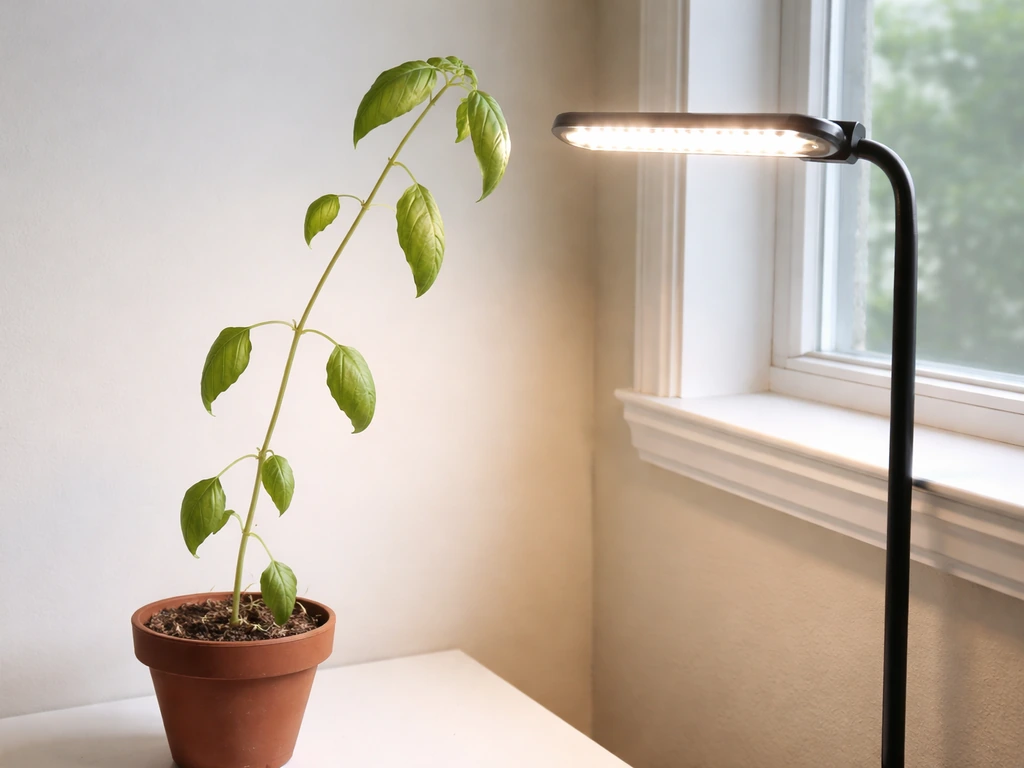
Leggy plants (tall, thin stems that flop over) almost always mean insufficient light. The plant is stretching toward any available light source. Fix: move the plant closer to the window, rotate pots a quarter turn every few days so all sides get light, or add a grow light positioned 6 to 12 inches above the plant canopy. Pinching the growing tips on herbs like basil also promotes bushier, more compact growth.
Slow or failed germination
Most seeds need warmth (65 to 75°F at minimum, 70 to 85°F for peppers and basil) and consistent moisture to germinate. A common mistake is letting the germination tray dry out once between checks. Use a humidity dome or plastic wrap over the tray until seedlings emerge. Pepper seeds are the most temperature-sensitive: below 70°F, germination can take 3 to 4 weeks instead of 7 to 10 days. A seedling heat mat makes a real difference for peppers, basil, and tomatoes.
Fungus gnats and other pests
Fungus gnats are the most common indoor plant pest. Their larvae live in moist soil and damage roots. The fix is almost always the same: let the top inch of soil dry out completely between waterings (gnats need consistently moist surface soil to breed), use yellow sticky traps to catch adults, and apply a diluted hydrogen peroxide solution (1 part 3% H2O2 to 4 parts water) as a soil drench to kill larvae. Spider mites appear in dry, warm conditions; a light misting of leaves and increased humidity usually manages mild infestations. Aphids can be knocked off with a firm spray of water or treated with insecticidal soap spray.
Poor yields or no fruit
If your tomatoes or peppers are flowering but not setting fruit, pollination is usually the issue. Outdoors, bees handle this. Indoors, you need to help. Once a day, gently shake flowering stems or use a small electric toothbrush held against the flower stem for a few seconds to simulate pollinator vibration. This dramatically improves fruit set. Low light is the other common cause of poor yields: if the plant is not getting enough PPFD, it will grow but not fruit productively.
Your next steps starting today
If you are starting from scratch right now in April 2026, here is the simplest plan: start a tray of radish or pea shoot microgreens today for a harvest in 7 to 14 days, sow a small pot of lettuce or spinach for greens in 30 to 40 days, and pick up a basil or mint transplant from a garden center for near-immediate use.
If you want to go further, start tomato or pepper seeds now under a grow light for transplanting into 5-gallon containers in 6 to 8 weeks, targeting productive plants by early summer. Want to browse the full range of what you can keep growing in your indoor space? The best compact indoor plants guide covers a wider range of options worth adding around your edible crops.
And if you are thinking about indoor herb gardens for a different reason, many of the most fragrant plants you can grow indoors (like mint, lavender, and lemon balm) are also edible, so you can double up on sensory and culinary value with the same plants.
FAQ
How often should I harvest indoor edibles so they keep producing?
Use a simple “harvest schedule” based on plant type. Cut-and-come-again greens (lettuce, spinach, arugula) recover best when you remove outer leaves and avoid cutting below the growing center. Basil and most herbs respond to regular pinching, but don’t take more than about one-third of the plant at a time. Microgreens are a one-and-done tray, so plan multiple trays if you want uninterrupted weekly harvests.
My indoor greens are growing slowly, how do I tell if it is light or fertilizer?
If leaves look healthy but growth slows, the most common indoor cause is low light rather than fertilizer. First check that plants are near the light source or that your LED is on the correct schedule, then rotate pots and confirm your light duration. If you have sufficient light, switch to feeding (leafy greens, herbs) every 2 to 3 weeks, using half-strength liquid fertilizer to avoid salt buildup in containers.
Should I water from the top or bottom, and will wet leaves cause problems indoors?
For indoor edibles, the safest approach is to avoid water on leaves when possible. Water at the soil line, especially for lettuce and spinach, and keep airflow moving gently to reduce fungal issues. Bottom watering for herbs works well, but with larger pots make sure excess water drains away so roots do not sit in a wet tray for hours.
What temperature problems most often ruin indoor edible plants?
Hardiness indoors depends on consistency. The 60 to 75°F range is a good target, but basil and peppers are most sensitive to cold drafts near windows and AC vents. If your window gets cool at night, move plants slightly back from the glass or add a small barrier, and consider a seedling heat mat for peppers during early stages.
Can I get better results by switching to larger containers, even if my space is limited?
Yes, but use the right container scale. Small herb pots can dry out quickly, while fruiting plants need a larger soil volume to buffer moisture swings. If you are seeing nutrient deficiencies or wilting between waterings, step up pot size (tomatoes and peppers generally do better in at least 5 gallons) before increasing fertilizer. Also ensure the container has true drainage holes, not just decorative gaps.
I do not have much sun, can I still grow edibles without a grow light?
Indoors, “low light” means it still gets some daylight. If your room is genuinely dark, most edibles will stall or become leggy unless you use supplemental lighting. Before buying seeds, test the location with your expectations in mind, if you cannot provide direct sun hours, plan to rely on an LED grow light set to an appropriate schedule for greens (about 14 to 16 hours) versus fruiting plants (about 16 hours).
What are the most beginner-proof choices if I want the highest chance of success?
Go for “whole-plant reliability.” Herbs like basil, mint (in its own pot), and chives are more forgiving than cilantro or delicate greens. For guaranteed speed, microgreens are the fastest, and loose-leaf lettuce is a strong beginner crop because it tolerates harvests and keeps going for months. For fruiting, start with a container-friendly pepper variety rather than a large tomato cultivar.
When should I start fertilizing indoor edibles, and what is too much?
The biggest mistake is using “plant food” too early or too strongly. Many potting mixes already include slow-release fertilizer for several weeks. After that, feed lightly and consistently, leafy greens and herbs with a balanced liquid at half strength, every 2 to 3 weeks. For tomatoes and peppers, wait until flower buds appear, then shift to a bloom-focused formula to support potassium needs.
If I use coco coir instead of peat-based potting mix, do I need a different watering approach?
Yes, and it changes how you water and feed. Gardeners often switch from potting mix to coco coir or a heavier mix and forget that water retention and drainage differ. Coco coir blends generally dry differently than peat-based mixes, so re-check “top inch” moisture timing rather than watering on a fixed schedule. If you notice persistent sogginess or fungal symptoms, adjust drainage (more perlite, better pot size, correct watering depth).
My basil (or tomatoes) are getting leggy, what should I do first?
Legginess is usually light deficiency or uneven light direction. Fixes in order: move plants closer to the window or light, rotate pots every few days so all sides get similar exposure, and if needed raise your light effectiveness by placing it closer to the canopy (commonly around 6 to 12 inches). Pinch basil or other herbs to encourage branching, but pinching will not replace missing light for fruiting crops.
Why are my indoor tomatoes or peppers flowering but not producing fruit?
If your tomatoes or peppers flower but do not set fruit, start with pollination and then light. Indoors, gently shaking stems or using a small electric toothbrush on flowering clusters can improve fruit set. If flowers drop or fruit never forms, verify your light intensity and daily duration, because insufficient PPFD often prevents productive flowering.
How do I prevent fungus gnats in indoor edible pots without overcorrecting?
Fungus gnats are usually triggered by consistently moist topsoil. Let the top inch of soil dry completely between waterings, use yellow sticky traps to monitor adults, and if needed apply a diluted hydrogen peroxide soil drench as described in your growing routine. Also avoid keeping a constantly wet tray under small pots.
Are there indoor-friendly ways to manage pests early before they get out of control?
Spider mites and aphids can show up when indoor air is dry or when plants spend time near other houseplants. For mild infestations, increasing humidity and checking leaf undersides regularly helps. For recurring issues, quarantine new plants, inspect weekly, and use a targeted treatment like insecticidal soap for aphids rather than broad, repeated sprays.
What is a realistic planting plan for continuous harvest if I have limited time?
If you want to keep things simple, plan a “three-cycle” rotation: one weekly tray for microgreens, one pot scheduled every few weeks for cut-and-come-again greens, and one transplant-based herb (basil or mint) for immediate harvest. This setup gives you predictable weekly outputs without needing constant re-sowing for everything.
Next Article
Best Smelling Plants to Grow Outdoors: A Practical Guide
Curated outdoor plants with strong fragrance by season, light, and container vs ground, plus care tips and troubleshooti