A shady balcony is not a problem to solve, it is a specific set of conditions to match plants to. For true shade (under 3 hours of direct sun per day), your most reliable picks are hostas, ferns, heuchera, begonias, and coleus for ornamentals; lettuce, spinach, and chard for edibles; and mint, chervil, and lemon balm for herbs. For light shade (3 to 6 hours of sun, often morning light), you open up to astilbe, New Guinea impatiens, Brunnera, kale, parsley, chives, and climbing hydrangea. That is the core answer, everything below is how to make those choices work in your specific space. For additional plant-by-plant suggestions and layout ideas, see what can I grow on my patio. For a quick shortlist of the best plants to grow on balcony, see the concise recommendations tailored to shaded and partially shaded spaces.
Best Plants to Grow on Shady Balcony: Top Picks & Care
Top plants at a glance: true shade and light shade
| Plant | Shade depth | Category | Container minimum | Notes |
|---|---|---|---|---|
| Hosta | True shade / light shade | Ornamental | 10–14 in. (25–35 cm) | Huge range of leaf sizes; slugs are the main pest |
| Heuchera (coral bells) | True shade / light shade | Ornamental | 10–12 in. (25–30 cm) | Evergreen in mild zones; great foliage color |
| Ferns (Polystichum, Athyrium) | True shade | Ornamental | 10–14 in. (25–35 cm) | Need consistent moisture; avoid hot dry wind |
| Begonia (wax, tuberous, rex) | True shade / light shade | Ornamental | 8–12 in. (20–30 cm) | RHS trial results rate these top shade performers |
| Coleus | True shade / light shade | Ornamental | 8–12 in. (20–30 cm) | Modern cultivars hold color even in deep shade |
| Astilbe | Light shade | Ornamental | 10–14 in. (25–35 cm) | Needs moist soil; feathery plumes mid-summer |
| New Guinea impatiens | Light shade | Ornamental | 8–10 in. (20–25 cm) | More sun-tolerant than standard impatiens |
| Brunnera | True shade / light shade | Ornamental | 10–12 in. (25–30 cm) | Silver-splashed leaves; spring blue flowers |
| Lettuce | True shade / light shade | Edible | 8–12 in. (20–30 cm) | Bolts slower in shade — actually an advantage |
| Spinach | True shade / light shade | Edible | 8–10 in. (20–25 cm) | Best in cool seasons; shade extends harvest |
| Chard | Light shade | Edible | 10–14 in. (25–35 cm) | Colorful stems; tolerates 3–4 hours direct sun |
| Kale | Light shade | Edible | 10–14 in. (25–35 cm) | Slower growth in shade but fully productive |
| Mint | True shade / light shade | Herb/medicinal | 8–10 in. (20–25 cm) | Keep in its own pot — spreads aggressively |
| Chervil | True shade | Herb/medicinal | 6–8 in. (15–20 cm) | Prefers cool shade; bolts in heat |
| Lemon balm | True shade / light shade | Herb/medicinal | 10–12 in. (25–30 cm) | Calming herb; vigorous grower, needs trimming |
| Chives | Light shade | Herb/medicinal | 6–8 in. (15–20 cm) | Edible flowers too; tolerates 3–4 hours sun |
| Parsley | Light shade | Herb/medicinal | 8–10 in. (20–25 cm) | Slow germination; easier to buy transplants |
| Climbing hydrangea | Light shade | Climber | 20+ in. (50+ cm) | Slow to establish; stunning when mature |
How to actually measure shade on your balcony
Before you buy anything, spend one clear day tracking when and where direct sunlight lands on your balcony. Check at 8 am, 10 am, noon, 2 pm, and 4 pm, and note which sections get hit and for how long. Tally the total hours of direct light per spot. US extension services use a straightforward framework: full sun is 6 or more hours of direct sun per day, partial or light shade is roughly 3 to 6 hours (usually morning sun is gentler and preferred), and full or deep shade is under 3 to 4 hours of direct sun or mostly dappled, filtered light coming through an overhead structure or neighboring building.
On a balcony, terrace, or rooftop, shade rarely behaves like it does in a woodland garden. You are dealing with hard architectural shadows, from the floor above, from a parapet wall, from neighboring buildings. These cast sharp, consistent shade that moves predictably with the season. In June the sun is high and that overhang might block less than it does in October. Do your assessment in the month you plan to plant, and repeat it in fall if you are planning year-round growing. A north-facing balcony in a northern climate is a different challenge from a north-facing balcony in Houston, where the sun angle means you pick up more light than you might expect.
If you want to go a step further, a basic PAR meter (measuring photosynthetic photon flux density in µmol per square meter per second) gives you a more precise read than just counting hours. Shade-adapted plants generally perform well at PPFD values in the 50 to 300 µmol range, while deep-shade species can grow at even lower readings. For most home gardeners, though, counting direct sun hours is precise enough. The main takeaway: do not guess. An hour of honest observation tells you more than any general advice.
Also think about microclimate layers. The front rail of a balcony may catch 4 hours of sun while the back wall sits in near-permanent shade. A rooftop with no overhead cover but surrounded by taller buildings might receive reflected light from glass facades that boosts effective light levels considerably. These pockets matter, a half-hour of sun in an otherwise shaded spot is often enough to push a plant from struggling to thriving.
Plants grouped by shade depth and purpose
Ornamentals for shade containers
Hostas are the benchmark for shade containers for good reason. They come in sizes ranging from 4-inch miniatures to plants that fill a half-barrel, they thrive in low light, and their foliage variation, blue-green, chartreuse, white-edged, yellow-centered, means you can build an entire display using nothing else. Container hostas need good drainage and consistent moisture; they will forgive occasional drought better than constant waterlogging. In zones 3 to 9 they are perennial, so one plant gives you years of return.
Heuchera is my second-most-recommended shade container plant. It holds interest all season with leaves in burgundy, caramel, silver-purple, and lime green, it is evergreen in mild winters (roughly zones 6 and warmer), and it combines beautifully with just about anything. Ferns, particularly the Japanese painted fern (Athyrium niponicum) and the soft shield fern (Polystichum setiferum), add movement and texture but do need consistently moist soil and protection from hot, desiccating wind, something to watch for on exposed rooftops or upper-floor balconies.
Begonias, wax-leaf, tuberous, and rex types, have earned their place through hard performance data as much as beauty. RHS trial results consistently rate them as top shade bedding and container choices. Tuberous begonias are especially impressive in deep shade, producing large blooms in colors that seem almost too vivid for low-light conditions. Coleus (now formally Plectranthus scutellarioides) rounds out the list with outrageous foliage in every color imaginable, and modern cultivars hold that color even in deep shade rather than reverting to green.
Edibles for shady balconies and patios
The rule of thumb from NC State Extension and Texas A&M AgriLife is this: fruiting crops need at least 6 hours of full sun, so tomatoes, peppers, and cucumbers are largely off the table for a shaded balcony. But leafy greens and many roots are another story. Lettuce, spinach, kale, chard, mustard greens, radish, and beet all tolerate partial shade and can actually benefit from it, shade slows bolting in summer heat, which extends your harvest window considerably. A shaded balcony in July is often a better lettuce spot than a full-sun patio.
For a long-term edible addition, consider currants or gooseberries (Ribes spp.) if your space and zone support them. These small-fruit shrubs are among the few woody edibles that genuinely tolerate partial shade, though yields and sugar content will be lower than in full sun. NCAT's Specialty Crops for Cold Climates notes that currants and gooseberries (Ribes spp.) tolerate partial shade though yields and fruit sugar typically decline as light falls, and recommends contacting local extension for cultivar recommendations Specialty Crops for Cold Climates (NCAT) — currants/gooseberries and shade-tolerance notes. They work well in large containers (20+ inches) on balconies or terraces and can double as ornamentals with attractive foliage and pendant fruit clusters.
Herbs and medicinals for light shade
Most Mediterranean herbs (basil, rosemary, thyme, oregano) want 6 or more hours of sun and will disappoint you in shade. The herbs that genuinely thrive in 3 to 4 hours of dappled light are mint, chervil, lemon balm, chives, parsley, and cilantro. University of Maryland Extension specifically calls these out as reliable in light shade. Care of Herbs and Starting Herbs from Seed (University of Maryland Extension) lists chives, mint (keep contained), parsley, chervil, cilantro, and lemon balm as culinary/medicinal herbs that reliably tolerate light or dappled shade in containers. Mint is practically indestructible in shade but needs its own container or it will overrun everything. Chervil is a gem for shaded balconies, it prefers cool, dim conditions and is an underused culinary herb with an anise-parsley flavor. Lemon balm grows vigorously even in deep shade and the leaves make a pleasant tea with documented mild calming properties.
Low-maintenance picks for busy gardeners
- Heuchera: plant it, water it when dry, divide every 3 years — nearly zero fuss
- Hosta: emerges every spring, ignores neglect, needs only slug management and occasional division
- Wax begonias: deadhead-free modern varieties bloom until frost without any intervention
- Mint: grows in almost any conditions; harvest regularly to keep it in check
- Ferns: set-and-forget if moisture is consistent — perfect for self-watering pots
Climbing plants for pergolas, arbors, and garden arches in shade
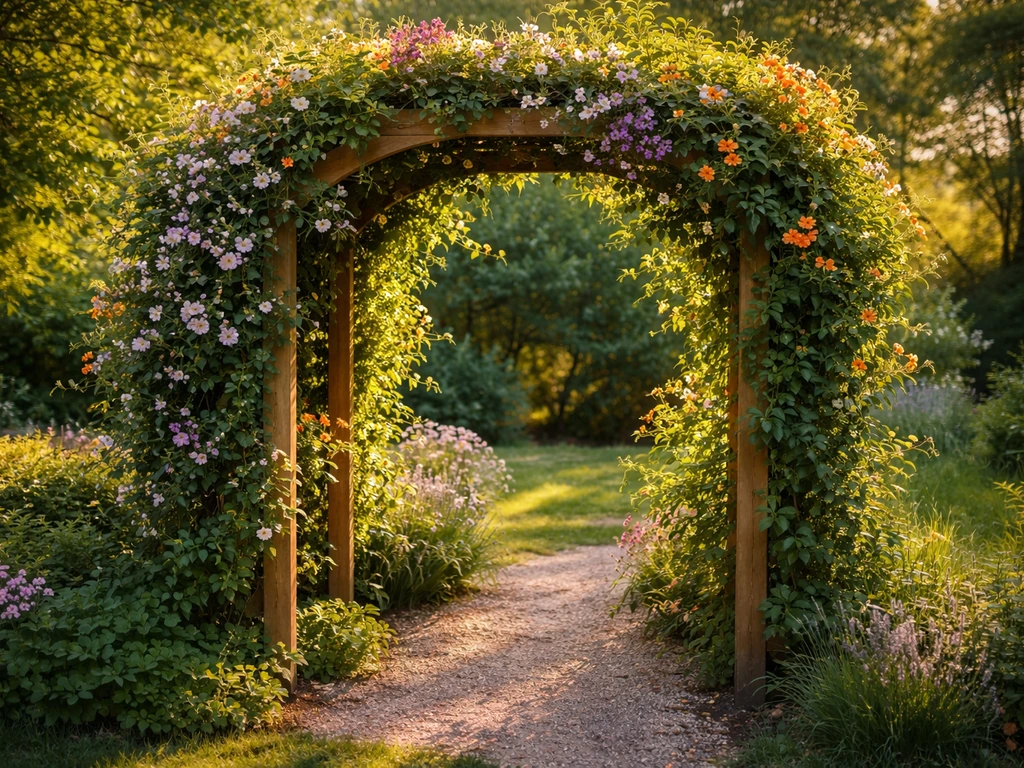
Shade-tolerant climbers are a short list, and the most important thing to know upfront is that most of the best ones are slow. Climbing hydrangea (Hydrangea anomala subsp. petiolaris) is the gold standard for shady pergolas and arbors, it clings to structures with adhesive rootlets, produces gorgeous flat-topped white flower clusters in early summer, and tolerates partial to full shade in zones 4 to 8. The catch is that it typically takes 2 to 3 years to establish and begin climbing vigorously. For a concise list of the best plants to grow up a pergola, see our dedicated guide on best plants to grow up a pergola. For a quick guide to suitable species and planting tips, see our roundup of the best plants to grow on arbor. If you plant it on a garden arch and expect coverage in year one, you will be disappointed.
Schizophragma hydrangeoides (Japanese hydrangea vine) is closely related to climbing hydrangea and behaves similarly, slow to establish, ultimately stunning, genuinely shade-tolerant. Virginia creeper (Parthenocissus quinquefolia) is much faster, covers a pergola in a single season, and handles everything from full sun to deep shade. Its fall color is spectacular. It is not invasive in most of the US but does self-seed, so be aware of what is below and around your structure.
Clematis is often suggested for light-shade pergolas. The guidance here is nuanced: many clematis cultivars want their roots in shade and their tops in at least dappled light, so a structure that shades the base but allows filtered light through a pergola canopy can work well. True deep shade is too much for most varieties. Akebia quinata (chocolate vine) performs in shade and smells remarkable in bloom, but it is classified as invasive in several US states and some European regions, check your local invasive species lists before planting it, and if you do grow it, keep it in a container.
| Climber | Shade tolerance | Growth speed | Hardiness zone | Watch out for |
|---|---|---|---|---|
| Climbing hydrangea | Partial to full shade | Slow (2–3 yr to establish) | Zones 4–8 | Needs time; adhesive roots can mark walls |
| Schizophragma hydrangeoides | Partial to full shade | Slow | Zones 5–9 | Same slow-start issue as climbing hydrangea |
| Virginia creeper | Full sun to full shade | Fast | Zones 3–9 | Vigorous self-seeder; can stain masonry |
| Clematis (select varieties) | Light shade (roots in shade) | Moderate | Varies by cultivar (3–9) | Most need at least dappled light to flower well |
| Akebia quinata | Partial to full shade | Moderate–fast | Zones 4–9 | Invasive in many regions — check locally first |
| Aristolochia (Dutchman's pipe) | Partial shade | Moderate | Zones 4–8 | Slow to establish; large leaves suit pergolas well |
Mounting and trellis guidance for arches, arbors, and pergolas
Before you attach anything to a balcony railing, wall, or overhead structure, check your lease, building regulations, or homeowner association rules. Many apartments and condos prohibit permanent fixings, so look for freestanding trellis systems or tensioned wire rigs that clamp to railings without drilling. For owned properties, masonry anchors and stainless-steel vine eyes are reliable for walls; 3 mm to 4 mm stainless wire strung horizontally at 12-inch intervals gives most climbers enough purchase to grip and train.
Weight is the critical variable on balconies and rooftops. A mature climbing hydrangea in a large container plus wet soil can easily exceed 100 lbs (45 kg). Add a wooden trellis panel and you are loading the balcony floor significantly. Most residential balconies are engineered to handle 40 to 60 lbs per square foot (195 to 290 kg per square meter), but consult a structural engineer or building manager before placing multiple large containers in a concentrated area. On rooftops, distributing weight across a wider area using wheeled platforms or weight-spreading boards is standard practice.
For training climbers, tie new growth loosely to the support in the direction you want it to go. Never use wire directly against stems, soft plant ties, jute twine, or silicone clips are gentler. Twining vines (Akebia, Aristolochia) will wrap themselves if you get them started; clinging vines (climbing hydrangea, Virginia creeper) attach with rootlets or adhesive pads on their own once they find the surface. Clematis grabs with leaf petioles, so it needs a mesh or fine trellis rather than single wires.
Freestanding garden arches in containers work best when each leg is anchored into its own heavy container filled with ballast (dense potting mix or gravel at the base). In wind-exposed locations, arch legs should also be cross-braced or tied back to a wall. A tumbling garden arch in a gust causes real damage to both the plant and the structure below.
Container and site requirements
Pot sizes and soil mixes
The minimum pot size guidance used across extension services and nursery practitioners breaks down simply: small herbs and annuals need 6 to 8-inch pots (15 to 20 cm); most vegetables and medium perennials need 10 to 14 inches (25 to 35 cm) in diameter with at least 8 to 12 inches of depth; large perennials, shrubs, and climbers need 15 to 20-plus inches (40 to 50+ cm) with proportional root volume. Go bigger whenever weight limits allow, larger containers buffer moisture and temperature swings, and they are far more stable in wind.
For soil mixes, shady container plantings generally need a free-draining mix that also retains moisture, a contradiction managed by using quality compost or loam blended with perlite or vermiculite for drainage, plus coir for moisture retention. Ferns and astilbe want more organic matter and consistent moisture, so increase the compost fraction for those. Avoid standard topsoil from a garden, it compacts in containers, kills drainage, and becomes hydrophobic when dry. A purpose-made container or patio mix from a reputable brand is worth the extra cost.
Drainage, self-watering options, and wind exposure
Every pot needs drainage holes, full stop. On a balcony, use pot feet or a small riser to prevent holes from sitting flush against the floor, waterlogged roots will kill shade plants just as reliably as too much sun. For shady conditions, where evaporation is slower, the risk of overwatering is real; check soil moisture before watering rather than following a fixed schedule. Self-watering containers with a bottom reservoir are genuinely useful here because they deliver moisture from below on demand rather than flooding from above. They are especially good for ferns, hostas, and leafy greens.
Rooftops and upper-floor balconies introduce wind as a major stress factor that ground-level gardens do not face. Wind increases transpiration (water loss through leaves), can physically damage brittle stems and large leaves, and makes containers dry out faster than the shade level would suggest. Ferns are particularly vulnerable to wind scorch. Strategies that help include grouping containers together to create a windbreak effect, placing larger pots at the windward edge, and choosing more compact, low-growing varieties for the most exposed spots. A partial windbreak screen (open mesh, not solid) can cut wind speed significantly without creating a turbulence problem.
Seasonal and regional guidance
Hardiness zones and annual vs. perennial choices
Whether a plant survives your winters in a container depends heavily on your USDA hardiness zone (or equivalent RHS zone in the UK). Container plants are more vulnerable to cold than in-ground plants because the roots have less soil insulation. A hosta that is hardy to zone 3 in the ground may need extra protection in a container in zone 5 if that container sits on an exposed rooftop. The general rule is to treat container plants as two zones less hardy than their label suggests when they are left outdoors year-round.
Annuals, begonias, coleus, New Guinea impatiens, give you immediate color and fill gaps fast, but you replant every year. Perennials, hostas, heuchera, ferns, astilbe, lemon balm, chives, come back and get better with time. A practical shady balcony planting uses a backbone of hardy perennials topped up with annuals for seasonal color. In zones 7 and warmer, you can overwinter most of these perennials outdoors in containers with minimal fuss. In zones 4 to 6, moving containers to an unheated garage or shed for winter protects both the roots and the pot itself from freeze-thaw cracking.
Planting calendar for shady sites by zone
| Zone / Region | Start annuals/transplants outdoors | Direct sow leafy greens (spring) | Direct sow leafy greens (fall) | Overwinter perennial containers |
|---|---|---|---|---|
| Zones 3–4 (Upper Midwest, Canada) | Late May–early June | Mid-April under cover; May outdoors | Late July–August | Move containers to garage by October |
| Zones 5–6 (Mid-Atlantic, Pacific NW, UK) | Mid-April–mid-May after last frost | March–April | August–September | Insulate in place or move to shed October–November |
| Zones 7–8 (Southeast US, UK mild coasts) | March–April | February–March | September–October | Usually fine outdoors; protect in hard freezes |
| Zones 9–10 (California, Texas Gulf, S. Florida) | February–March | November–February (cool season) | September–November | No overwintering needed; manage summer heat instead |
| UK (most regions) | April–May after last frost | March–April | August–September | Zones 7–9 equivalent; move tender plants inside Oct–Nov |
A note on warm climates: in zones 9 and 10, shade is often an advantage rather than a limitation. The issue in August in Texas or Southern California is not lack of light, it is heat and drought stress. On a shaded balcony in those regions, you can grow cool-season crops like lettuce and spinach well into summer when an exposed patio would burn them out. Shift your planting calendar to treat the cool season (October through March) as your main growing window for edibles, and use shade-loving ornamentals year-round.
Care basics: watering, feeding, pruning, and overwintering
Shade slows growth, which means shade plants need less fertilizer than their full-sun counterparts. Over-feeding is a common mistake, it produces lush, weak, leggy growth that is more vulnerable to pests and disease. A balanced slow-release granular fertilizer applied at planting and again mid-season is usually sufficient. For leafy edibles, a nitrogen-forward feed (like a liquid seaweed or fish emulsion) every 2 to 3 weeks during the growing season supports productive leaf growth without pushing excessive soft growth.
Watering frequency depends on container size, material, and season more than the shade itself. Small terracotta pots in a partly shaded spot can dry out in a day during a warm summer. Large glazed or plastic containers in true shade may need water only every 3 to 4 days. Always check the top 2 inches of soil before watering, if it is still damp, wait. Underwatering shows as wilting and crisp leaf edges; overwatering shows as yellowing, soft stems, and a sour smell from the soil.
Pruning shade plants is mostly about removing dead material and managing size. Coleus should be pinched regularly to prevent flowering (which signals the plant to put energy into seeds rather than leaves). Hostas, ferns, and heuchera need old foliage removed in early spring. Climbers like Virginia creeper or climbing hydrangea benefit from a light tidy after flowering and a more structural prune every 2 to 3 years to prevent the base from becoming woody and bare.
For overwintering container perennials in cold zones, move pots before hard frost arrives, not after. Once the soil in a container freezes solid, roots are already damaged. Wrap pots that must stay outside with bubble wrap or hessian and cluster them together against a sheltered wall. Tender plants (coleus, tuberous begonias) are best brought inside to a frost-free spot; lift tuberous begonia tubers, dry them, and store in barely-damp compost or peat at 5 to 10°C.
Common pests and diseases in shady container plantings
Shade conditions favor a slightly different pest profile than sunny gardens. Slugs and snails are the number-one problem: they thrive in moist, sheltered conditions and will devastate hostas, begonias, and lettuce overnight. Use copper tape around pot rims, set beer traps, or apply iron phosphate pellets (organic-approved). Check under pot rims and saucers regularly, they hide there during the day.
Vine weevils are the second major threat in containers. The adult beetles notch leaf edges, but it is the white C-shaped larvae eating roots underground that kill plants, often suddenly. Signs include plants that collapse despite good watering. The organic fix is nematodes (Steinernema kraussei or Heterorhabditis bacteriophora) applied to moist soil in late summer when soil temperatures are above 5°C. This is highly effective in containers.
In poor air circulation, common on enclosed balconies and under pergolas, powdery mildew and botrytis (grey mould) become problems, especially on begonias and astilbe. Space plants to allow airflow, avoid wetting foliage when watering, and remove dead or dying leaves promptly. A diluted baking soda spray (1 tsp per litre of water with a drop of dish soap) provides light control of powdery mildew without chemicals. Aphids and spider mites occasionally attack coleus and herbs; a strong blast of water or an insecticidal soap spray clears them quickly.
Design ideas for small shady spaces
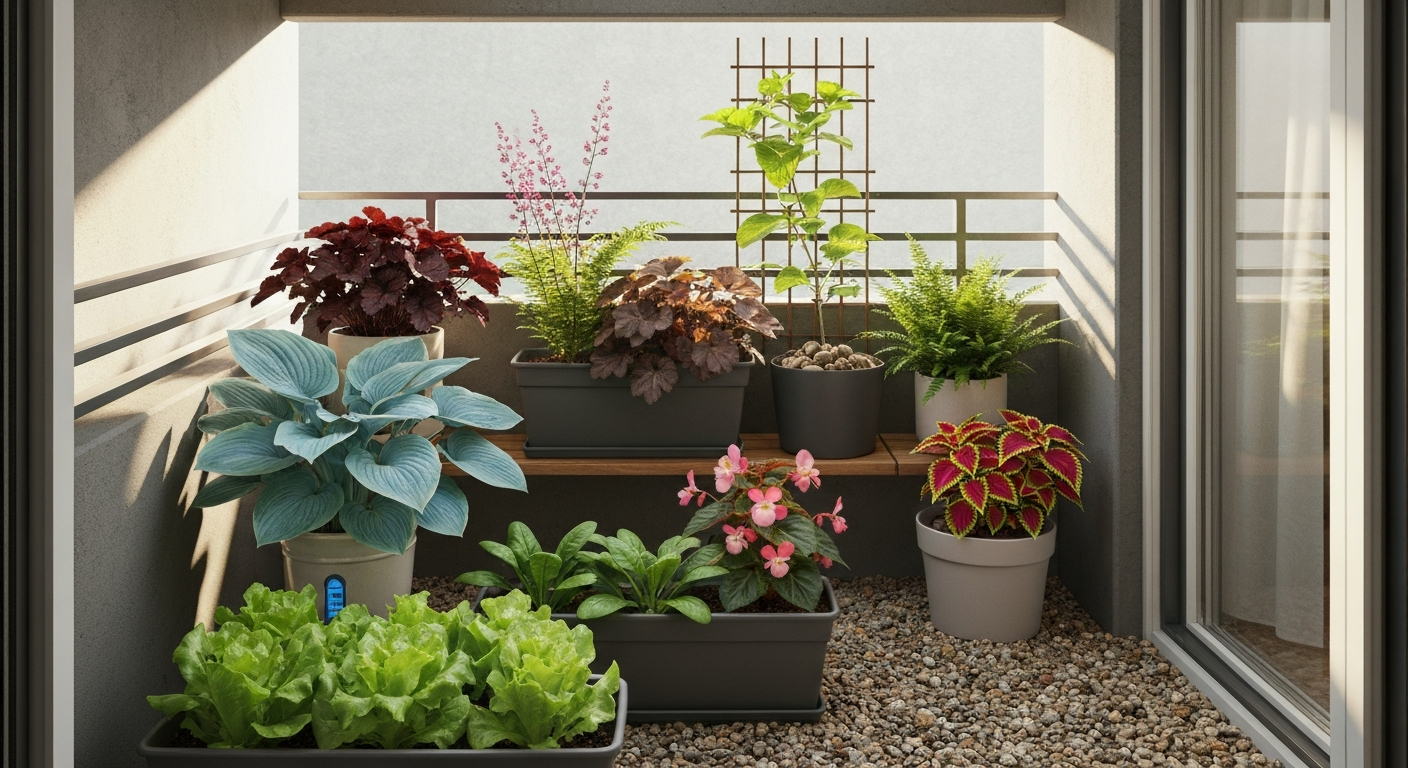
The design challenge on a shady balcony is that you are working mostly with foliage rather than flowers, and the light itself is lower, so spaces can feel gloomy without intentional contrast. The fix is to lean into textural and tonal contrast rather than fighting for flower color. Pair the bold, smooth leaf of a blue-green hosta with the fine fronds of a Japanese painted fern and the ruffled, burgundy foliage of a heuchera. Three different textures, three different colors, and that combination works in as little as a 24-inch-wide railing planter.
Vertical layering transforms a small shady space. At floor level, use wide, low containers with spreading hostas or ferns. At mid-height, place a climbing frame or trellis with a slow-starting climbing hydrangea (be patient) and fill the gaps in years one and two with annual nasturtiums or annual black-eyed Susan vine (Thunbergia alata), which tolerates light shade. At eye level, use wall-mounted or railing-hung planters with trailing heuchera, ivy, or begonias cascading down.
For privacy screens, Virginia creeper grown on a tensioned wire trellis attached to railing posts creates dense cover in one season and spectacular red fall color. Alternatively, a row of taller ornamental grasses in large containers, many tolerate partial shade, softens boundaries while adding movement. On a rooftop or terrace, this layering approach also serves as a windbreak, which benefits everything growing behind it.
Light-colored pots, pale gravel mulch, and mirrors or reflective surfaces on walls all bounce available light around a shaded space, effectively raising the ambient light level for nearby plants. It is not a substitute for actual sun, but it does help, and it makes the space feel more open.
Troubleshooting common shady balcony problems
| Symptom | Likely cause | Quick fix |
|---|---|---|
| Yellowing leaves (whole plant) | Overwatering or waterlogged roots | Check drainage holes; reduce watering frequency; repot if roots are brown and mushy |
| Yellowing leaves (older leaves only) | Nitrogen deficiency | Apply a balanced liquid feed; check if roots are pot-bound |
| Leggy, stretched stems reaching for light | Too little light even for shade plants | Move pot closer to light source; switch to more shade-tolerant variety |
| Leaf scorch (brown crispy edges) | Wind desiccation or reflected heat from nearby glass/metal | Add windbreak; move away from reflective surfaces; increase watering |
| No flowers on begonias or astilbe | Too deep shade or over-feeding with nitrogen | Move to higher-light spot; cut nitrogen; use phosphorus-forward bloom feed |
| Hostas demolished overnight | Slugs or snails | Set beer traps; apply iron phosphate pellets; add copper tape to pot rim |
| Plant wilts despite moist soil | Vine weevil larvae eating roots | Apply nematodes; check for white larvae in root zone; repot in fresh mix |
| White powder on leaves | Powdery mildew (poor airflow) | Improve spacing; remove affected leaves; spray with diluted baking soda |
| Waterlogged pot in wet weather | Drainage holes blocked or saucer too full | Elevate pot; remove saucer or drill additional holes; add drainage layer |
Quick decision checklist before you buy
- Measure actual sun hours in the spot where you plan to place containers — do not guess
- Weigh or estimate the total load if you are on a balcony, terrace, or rooftop and check building limits
- Decide whether you want ornamentals, edibles, herbs, or a mix, then match to shade depth from the table above
- Choose pot size based on plant type: 6–8 in. for small herbs, 10–14 in. for most perennials and veg, 20+ in. for climbers
- Buy a free-draining container mix — never standard topsoil in pots
- If you want climbers on an arch, arbor, or pergola, confirm the structure is anchored and can take the eventual weight
- Check invasive species lists before buying Akebia, Aristolochia, or any vine new to you in your region
- Plan overwintering now, not in October: know which plants need to come inside and where they will go
Where to buy and what to look for
For shade-specific container plants, specialist nurseries consistently outperform big-box garden centers in variety selection, particularly for hostas, heuchera, and shade-tolerant ferns. For related recommendations, see a curated list of the best plants to grow on patio for container performance and site-specific tips (affc1b9d-d52b-4429-9dc0-a68acc6e0a14). Look for Proven Winners-labeled container plants at garden centers if you want varieties tested specifically for container performance. Mail-order bare-root hostas and astilbe are excellent value and ship well in spring. For edibles, buy lettuce and spinach as seed (quick, cheap, easy) and parsley as transplants (parsley seed is notoriously slow to germinate). Climbing hydrangea and Schizophragma are worth buying as the largest plant you can find, the slow-establishment problem is partly offset by starting with a more mature specimen.
If you are expanding beyond a shaded balcony to other outdoor spaces, the principles here transfer directly to patios, terraces, and rooftops, where light levels vary considerably by orientation and surrounding structures. For specific terrace-friendly recommendations and planting tips, see our guide to the best plants to grow on terrace. For climbing plants specifically, the same shade-tolerant species work equally well on garden arches, pergolas, and arbors, though the scale and anchoring requirements differ. A shady pergola is actually one of the best homes for climbing hydrangea, which is often too vigorous for a small balcony arch but perfect for a larger overhead structure.
FAQ
Quick answer: What are the best plants to grow on a shady balcony (true shade and light shade)?
True/deep shade (<3–4 hours direct or heavily dappled): ferns (Athyrium, Polystichum), hostas (mini to standard), Heuchera (coral bells), Begonia (wax/rex/tuberous), Brunnera, Tiarella, and shade‑tolerant Lamiaceae like lemon balm. Light/partial shade (3–6 hours direct or bright filtered): New Guinea impatiens, coleus, astilbe, hydrangea (container varieties), many leafy edibles (lettuce, spinach, chard), parsley, chives, and certain clematis or climbing hydrangea cultivars.
Which plants should I choose grouped by purpose (ornamental, edibles, medicinal/herbs, climbers) and by shade depth?
Ornamental — deep shade: hostas, heuchera, ferns, brunnera, tiarella, pulmonaria. Ornamental — light shade: coleus, New Guinea impatiens, astilbe, begonias, hydrangea. Edibles — light shade: leafy greens (lettuce, spinach, mustard, chard), radish, beet; partial‑fruiting shrubs in light shade: currants/gooseberries (region dependent). Edibles — deep shade: very limited; microgreens and some salad herbs can be grown indoors/under lights. Medicinal/herbs — light/deep shade tolerant: mint (contain root), chives, parsley, lemon balm, chervil, cilantro (best in cooler/part shade). Climbers for shady structures — shade‑tolerant: climbing hydrangea (Hydrangea anomala subsp. petiolaris), Schizophragma, some clematis (select cultivars that tolerate cooler roots), Virginia creeper (screening) and carefully managed akebia (check invasiveness). Avoid sun‑loving vines (wisteria, certain jasmine) on deep shade.
What climbing plants work best on arbors, pergolas and garden arches in shade, and what mounting or trellis guidance should I follow?
Best shade climbers: climbing hydrangea, Schizophragma, shade‑tolerant clematis cultivars, certain Parthenocissus (Virginia creeper) for screening, and trained honeysuckle/actinidia in dappled light (check invasiveness). Mounting/trellis guidance: use heavy‑duty support for woody climbers (metal or pressure‑treated timber), provide anchoring points for root balls in large pots, allow root protection (mulch/insulation) if container grown, attach lightweight trellis or wire for herbaceous vines (clematis). For clinging vines choose structures that won’t be damaged by adhesive aerial roots; for twining vines give a 2–3 cm spacing on slats or wires. If container‑growing a woody vine, use very large pots (15–20+ in/40–50+ cm) and plan to refresh soil every 2–4 years.
What container and site requirements should I follow (pot size, soil mix, drainage, weight, wind, rooftop specifics)?
Pot size: herbs/annuals = 15–20 cm (6–8 in) diameter; most vegetables/medium perennials = 25–35 cm (10–14 in); large perennials/shrubs/climbers = 40–50+ cm (15–20+ in). Soil mix: free‑draining, moisture‑retentive premium potting mix with compost/loam, coir/peat for moisture, and perlite/vermiculite for drainage. Drainage: ensure bottom drainage holes and use saucers where legal for drip collection; add a drainage layer only if mix is very fine. Weight limits: estimate wet weight (soil + water + pot) when planning balcony/roof layout—large filled pots can weigh 40–100+ kg; check building/rail weight limits and consult building management/engineer for rooftops. Wind: position heavier pots near walls, use windbreaks (glass, lattice), low‑profile plants for exposed sites. Rooftops: expect stronger sun reflection, heat stress and faster drying; choose heat/fade tolerant foliage, increase irrigation frequency, and provide insulation or shading for roots.
How should I adapt choices and timing by season and hardiness zone? Annual vs perennial guidance and planting calendar basics?
Know your USDA/region hardiness zone for perennials and expect container plants to experience more temperature swings. Perennials: choose zone‑appropriate varieties and remember containers may freeze solid in winter — either insulate pots, move them to a sheltered spot, or treat tender perennials as annuals. Annuals: sow or plant after last frost; many shade annuals (impatiens, coleus, begonias) run through summer and decline in heat. Planting calendar: spring (after frost) — transplant perennials, sow cool season greens; summer — maintain watering, pinch back legginess; fall — plant cool‑season vegetables and divide perennials where applicable; winter — overwinter containers indoors/sheltered or mulch/insulate for hardy species. In colder zones, move containers to frost‑free storage or sink in-ground where possible. In warm climates, plant shade‑tolerant heat‑tolerant varieties and schedule sowings in cooler months for greens.
What are the basic care tasks: watering, feeding, pruning, overwintering and pest basics for shady balcony containers?
Watering: containers dry faster—check moisture frequently; water thoroughly until run‑through, then let top 1–2 cm dry for most ornamentals; leafy greens prefer consistent moisture. Feeding: use balanced slow‑release granular fertilizer at planting and supplement with monthly liquid feed for heavy feeders; container plants often need more frequent feeding than in ground. Pruning: deadhead spent flowers, remove yellowing shade leaves, shear back leggy coleus/impatiens to promote bushiness. Overwintering: move tender containers indoors or to sheltered microclimate, insulate pots (bubble wrap, mulch), reduce watering in dormancy. Pests/diseases: watch slugs/snails in shady damp spots, powdery mildew or botrytis in poor air circulation—improve airflow and remove infected tissue. Manage aphids/fungus gnats with water sprays, insecticidal soaps, or biological controls as needed.
Best Plants to Grow on an Arbor: Curated Picks by Conditions
Curated arbor climbers by sun, zone, soil and goals, with training, pruning, and beginner tips to cover fast.