For most home gardeners, somewhere between 3 and 12 tropical plants is a practical, manageable range, but the real answer depends almost entirely on your space, your climate, and how much time you can honestly put in each week. A single sunny windowsill can support 3 to 5 small tropicals comfortably. A 4x4 raised bed in a warm climate handles 4 to 9 plants depending on species. A 10x10 in-ground bed or a full greenhouse bench can take 12 to 30 or more. Start at the lower end of whatever range fits your space, get comfortable with the care routine, and scale up from there.
How Many Tropical Plants to Grow in a Garden: Space-Based Guide
Rachel Hartley
7 Aug 2026
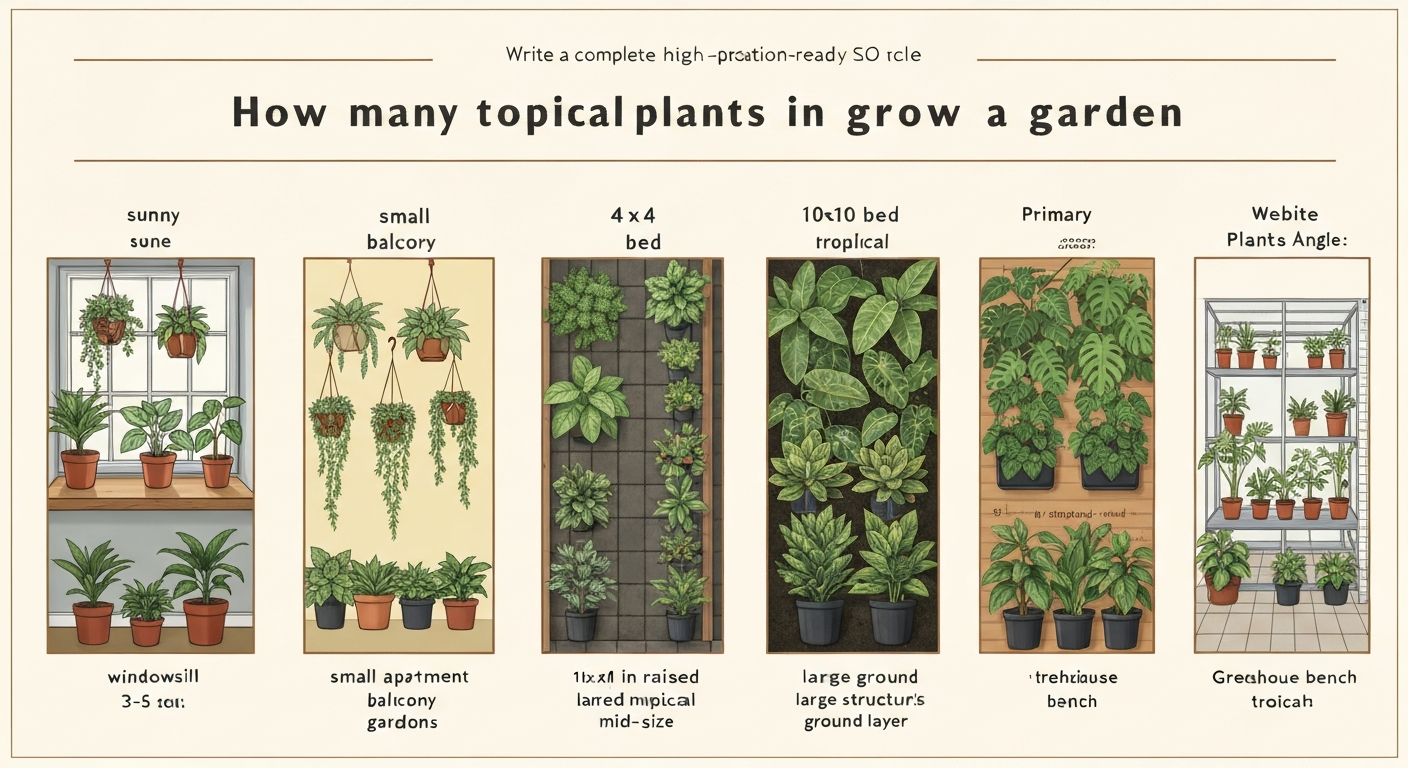
How many tropical plants should you actually grow? Quick ranges by space and goal
Before diving into the details, here are working numbers you can use right now. These are based on typical spacing requirements for commonly grown tropical species and assume you are managing the plants yourself without hired help.
| Growing space | Recommended plant count | Notes |
|---|---|---|
| Windowsill (approx. 3–4 ft long) | 3–5 plants | Small-pot species only; good light essential |
| Small balcony (up to 30 sq ft) | 4–8 plants in containers | Use vertical space; weight limits matter |
| 4×4 raised bed (16 sq ft) | 4–9 plants | Depends on species size; see spacing table below |
| 10×10 in-ground bed (100 sq ft) | 9–25 plants | Mix sizes for better density |
| 100 sq ft dedicated plot | 10–30 plants | Succession planting pushes numbers higher |
| Standard greenhouse bench (8×2.5 ft = 20 sq ft) | 10–20 plants in pots | More if using 4-inch pots, fewer for 1-gallon+ |
Your goal shifts the count too. If you are growing for aesthetics, you can pack in more variety at slightly tighter spacing because you do not need every plant to produce a harvestable yield. Growing for food or medicine means giving each plant room to reach its productive potential, which generally means fewer plants per square foot. A medicinal planting of turmeric or lemongrass, for example, needs room to form full clumps, which are wide and hungry for space compared to an ornamental arrangement of small-potted heliconias.
Know your climate before you commit to a number
The single biggest variable in how many tropical plants you can grow, and whether you can grow them in-ground at all, is where you live and what your microclimate actually does. The USDA Plant Hardiness Zone Map gives you a baseline: if you are in Zone 9b or warmer, many tropicals can stay in the ground year-round. Zone 8 is borderline for most true tropicals (brief freezes will kill them without protection), and Zone 7 and below means containers or overwintering indoors for almost everything tropical.
But your zone is just the starting point. Your microclimate can shift your effective growing conditions by a full zone or more in either direction. A south-facing brick wall in Zone 8b can create a pocket warm enough to carry a tropical through a mild winter. A low-lying frost pocket in Zone 9a can kill tender plants your neighbor 50 feet away never loses. To assess your actual site, you want to know: how many hours of direct sun does the spot get (most tropicals need 6 or more), what is the lowest overnight temperature you have recorded there, how sheltered is it from wind, and is it in a low spot where cold air drains and pools on still nights?
NOAA's 1991-2020 climate normals give you median last-spring and first-autumn frost dates for your nearest station, and these are the dates that tell you your frost-free growing window. In the U.S. Southeast, that window can be 9 to 10 months. In the upper Midwest, you may have only 120 frost-free days, which means tropical plants either need to go in containers that come inside or you treat them as annuals. Canadian gardeners can pull the equivalent figures from Environment and Climate Change Canada's 1991-2020 normals for the same purpose.
- Map your sun: track which areas get full sun (6+ hours) versus partial shade through the day
- Record your lowest overnight temperature on a still, clear night, not just the station average
- Identify warm microclimates: south/west-facing walls, paved surfaces, sheltered courtyards
- Identify cold traps: low spots, open north-facing beds, areas with no overhead protection
- Check your last average frost date and add a week of buffer before moving tropicals outside
Humidity matters almost as much as temperature for many tropical species. Most true tropicals come from Köppen-Geiger 'A' climate zones, which are characterized by high year-round humidity alongside heat. If you live in an arid climate like the American Southwest, even if temperatures are warm enough, you may need to cluster plants together (they create their own humidity bubble), use pebble trays with water, or run a humidifier for indoor tropicals. Arid-climate growers often do better with a smaller, well-managed group of humidity-adjusted tropicals than trying to hit a high plant count and watching them slowly crisp.
Space-based plant counts: footprint-by-footprint breakdown
Windowsill and indoor shelf
A standard windowsill (around 3 to 4 feet long) will fit 3 to 5 small tropical plants in 4 to 6 inch pots comfortably without crowding, which matters because crowded plants block each other's light and invite fungal problems from poor air circulation. A south-facing window in the northern hemisphere is the gold standard. East-facing gives you softer morning light that suits moisture-loving tropicals like calatheas. West-facing works well for most, but can get harsh and dry in summer afternoons. North-facing is genuinely difficult for most tropical species, though a few low-light tolerant aroids can manage.
Small balcony (up to 30 sq ft)
A small balcony gives you 4 to 8 plants depending on pot sizes and your weight tolerance (check your building's load ratings if you are stacking heavy ceramic pots). Use vertical space with a simple trellis or tiered plant stand to fit more without overwhelming floor space. Lightweight plastic or fabric grow bags are your friend here. A manageable balcony setup for someone new to tropicals might be: 2 large statement plants (like a small bird of paradise or a canna in a 15-gallon bag), 3 mid-size tropicals in 5-gallon pots, and 2 to 3 small tropicals in hanging planters.
4×4 raised bed (16 sq ft)
A 4x4 raised bed is a genuinely versatile tropical growing space if you have a warm enough climate or are treating it as a seasonal bed. At medium spacing (around 18 inches on center), you fit 9 plants. At wide spacing for large-canopy tropicals like banana pups or giant taro, you may only want 4. At dense spacing for small clumping species like lemongrass divisions or smaller heliconias, you can push to 12 to 16. The raised bed also warms up faster in spring than in-ground soil, which buys you a couple of extra weeks at the start and end of the season.
10×10 in-ground bed and 100 sq ft plot
A 100 square foot plot is where you start making real design decisions. You have room for a structural backbone plant or two (a banana, a large canna, a tree fern), several mid-size tropicals, and a ground layer of smaller species. A well-planned 10x10 tropical bed in a Zone 9 or 10 climate can realistically hold 15 to 25 plants with a layered planting approach. Closer to Zone 8 where you are managing more risk, I would keep it to 12 to 18 plants so you are not overwhelmed if you need to dig and bring them in quickly before an unexpected frost.
Greenhouse bench (approx. 20 sq ft)
A standard 8x2.5-foot greenhouse bench holds roughly 10 to 20 plants depending on pot sizes. In a heated greenhouse you are unconstrained by climate zones and can grow true tropical species year-round, which is where your count can scale up much faster than any outdoor setup. The limiting factor shifts from climate to your watering routine, pest management, and heating costs. A manageable bench for a hobbyist is 15 to 20 plants in a mix of pot sizes, giving you enough variety without creating a maintenance burden that takes hours each week.
Plant type changes everything: single-harvest, stalky, clumping, and vining
The category of tropical plant you choose has a huge effect on how many you can fit and how your count changes over time. Single-harvest tropicals (plants you grow once and harvest completely, like certain tropical root crops) are replaced after harvest, so your active plant count stays relatively stable but your total plants grown in a season is higher. Stalky or structural tropicals like bananas, cannas, and heliconias take up more horizontal space than their pot size suggests, and they send up offsets over time, so a single 'plant' can become a clump of 5 to 8 stems within a season if you do not manage it.
Clumping tropicals (lemongrass, certain ginger species, ornamental grasses) expand laterally. Budget at least 3 to 4 square feet per clumping plant at maturity even if it starts small. Vining tropicals (certain passionfruit, climbing aroids, monstera) need vertical support and should not be counted by ground footprint alone since their canopy spreads far beyond where they are rooted. One vigorous tropical vine on a 6-foot trellis occupies the equivalent ground space of 3 to 4 clumping plants once mature, but its vertical reach gives you a lot of visual and productive output per square foot of ground.
| Plant type | Approx. space per plant (sq ft) | Count in 4×4 bed | Notes |
|---|---|---|---|
| Single-harvest (small root crops) | 1–2 | 8–16 | Replant after harvest; rotate with other species |
| Stalky/structural (banana, canna) | 9–16 | 1–2 | Spread fast; manage offshoots actively |
| Clumping (lemongrass, ginger) | 4–6 | 3–4 | Allow room for seasonal expansion |
| Vining (passionfruit, climbing aroid) | 4–6 ground + vertical | 2–3 | Train up a trellis; do not overcount by canopy |
| Small ornamental (tropical houseplant) | 1–2 | 8–16 | Most suited to containers inside the bed |
If you are exploring the single-harvest category more broadly, the same space-and-count logic applies across tropical and non-tropical species alike, and many of the spacing rules carry over directly. Similarly, if structural or stalky plants are your focus, bear in mind that the largest tropical 'stalky' species will dominate a small bed quickly and may shade out everything else if you are not careful about placement.
Carnivorous and specialty species: how pitcher plants and their relatives affect your count
Carnivorous plants are a category where the tropical versus temperate distinction genuinely changes your entire growing setup, and getting it wrong is one of the fastest ways to kill plants. The critical split is between tropical Nepenthes (tropical pitcher plants) and North American Sarracenia (temperate pitcher plants). These two groups could not be more different in their requirements, and mixing them up is a common and expensive mistake.
Nepenthes are true tropicals. They want warm temperatures year-round (most highland Nepenthes prefer 60 to 80 degrees Fahrenheit with a modest day-to-night drop; lowland species want it consistently warm), high humidity (60 to 80 percent or higher), and no frost ever. They do not go dormant. If you grow Nepenthes, they belong on a greenhouse bench, a humidity tent, or a well-lit indoor setup with supplemental humidity. A beginner-friendly Nepenthes collection on a greenhouse bench might be 3 to 6 plants to start, since each one needs consistent attention and they are sensitive to water quality (use only rainwater or distilled).
Sarracenia, by contrast, are temperate bog plants. They are not tropical at all. They need a cold dormancy period in winter (outdoor exposure or a cold garage/refrigerator), they grow happily in full sun outdoors in many parts of the eastern U.S. and similar climates, and they tolerate frost well. If you are planning a carnivorous plant section and wondering whether to count Sarracenia as part of your tropical garden, the honest answer is no: they belong in a separate bog planter or outdoor bog bed, and lumping them in with your tropical Nepenthes would kill one or the other.
From a count standpoint, a Nepenthes collection benefits from being kept small and well-managed. Three well-cared-for Nepenthes in a properly humidified space will outperform 12 stressed ones every time. For Sarracenia outdoors in a bog container or bed, you can pack them more densely (6 to 9 per square foot in a traditional peat-sand bog mix), but that is a separate planting from your tropical garden proper.
Trade-name ornamentals like 'Poseidon': what to check before you buy
The 'Poseidon plant' is a good example of why you need to look beyond the name before adding anything to your tropical garden plan. 'Poseidon' is used as a cultivar or trade name across at least several completely unrelated plant genera. The RHS lists Aeonium undulatum 'Poseidon', which is a succulent from the Canary Islands, definitely not a tropical in the warmth-and-humidity sense. blank" rel="noopener noreferrer">RHS Plant Details for Aeonium undulatum 'Poseidon' confirms the cultivar listing. The Chicago Botanic Garden records Colchicum 'Poseidon', an autumn crocus that is a fully temperate bulb. Chicago Botanic Garden lists Colchicum 'Poseidon' in its Plant Finder Chicago Botanic Garden lists Colchicum 'Poseidon' in its Plant Finder.. Nursery catalogues list Clematis Evison 'Poseidon', a temperate flowering vine. None of these are tropical plants.
The practical lesson: whenever you see a plant sold under a trade name or cultivar epithet like 'Poseidon' without a genus name attached, do not assume anything about its temperature requirements. Before adding it to your tropical count, you need to confirm the actual botanical genus and species. Look at the tag for a Latin binomial, check the RHS plant finder or the USDA PLANTS database, or look up the botanical name on Plants of the World Online (Kew). Once you have the genus confirmed, you can assign the correct hardiness category and decide whether it belongs in your tropical setup or somewhere else entirely.
- Always get the genus and species name, not just the cultivar or trade name
- Check RHS hardiness ratings: H1a–H1c indicates plants needing heated glasshouse conditions (true tropicals); H4 and above are hardy outdoors in most of the UK and often Zone 7+ U.S.
- Verify native range using Plants of the World Online to understand the climate the plant evolved in
- Cross-check USDA PLANTS for U.S. recorded occurrences and regional suitability
- Do not count a 'tropical-looking' ornamental as a tropical plant for spacing purposes until you have confirmed it
Ambiguous names like 'hinomai': how to figure out what you actually have
If you have encountered 'hinomai' in the context of a garden game (specifically the video game Grow a Garden, where it appears as an in-game crop), it does not map to a real botanical species. It is a game-specific item name, and trying to find it in scientific floras or plant databases will come up empty. That is not a problem for playing the game, but it means you cannot carry any 'tropical or not' classification from the game into real-world garden planning.
Outside of the game context, 'hinomai' also appears occasionally as a cultivar epithet in ornamental breeding, most notably in some iris cultivar lists. If someone hands you a plant labeled 'hinomai' at a nursery or plant swap, your first move is exactly the same as with any ambiguous cultivar name: ask for or look up the genus. An iris is not a tropical plant. A cultivar of almost any temperate genus given a Japanese-sounding epithet is not automatically tropical either.
The general protocol for any plant with a name that does not resolve clearly in standard references is: search the name on Plants of the World Online and the USDA PLANTS database first. If it does not appear there, search herbarium and botanical garden records. If it only appears in game wikis, forum posts, or nursery trade catalogues without a botanical binomial attached, treat it as unclassified and do not slot it into your tropical garden plan until you can confirm the genus. This matters for your plant count because a temperate plant given the same care regime as a true tropical will either die from overwatering and overheating or simply underperform.
Spacing, density, and succession planting: making your numbers work
Spacing is where most gardeners either over-plant (and then have to thin painfully) or under-plant (and end up with a half-empty bed that gets colonized by weeds). The right answer depends on whether you are going for a dense tropical look, a moderate mixed planting, or a wide-spaced production layout.
| Density style | Spacing (on center) | Area per plant (sq ft) | Count in 4×4 bed | Count in 10×10 bed |
|---|---|---|---|---|
| Dense (ornamental impact) | 12 inches | 1 | 16 | 100 |
| Moderate (mixed tropical border) | 18 inches | 2.25 | 9 | 44 |
| Wide (production/clumping/large) | 24–36 inches | 4–9 | 2–4 | 11–25 |
| Statement plant (banana, tree fern) | 48–72 inches | 16–36 | 1 | 3–6 |
For a layered tropical garden that looks full without becoming a maintenance nightmare, a practical approach is to combine spacing styles: one or two statement plants at wide spacing in the back or center, a ring of moderate-spaced mid-size tropicals around them, and a dense planting of small or ground-cover tropicals at the edges. In a 10x10 bed, this might work out to 2 large plants, 6 to 8 medium plants, and 10 to 12 small plants, for a total of 18 to 22 plants.
Succession planting is a technique more commonly used with vegetables but it works well in tropical gardens where you are growing shorter-lived or single-harvest tropicals seasonally. The idea is to stagger your plantings by 2 to 4 weeks so you always have something coming in as something else is finishing. In a frost-free climate or a heated greenhouse, you can run two or even three successions of fast-growing tropical crops per year in the same bed space, which means your total plants grown per season is a multiple of your bed capacity. In a Zone 8 climate with a 5-month frost-free window for tropicals, one main succession plus a late-season planting of fast-maturing varieties is realistic.
One practical gotcha: tropical plants started indoors in late winter need to be hardened off before going outside, regardless of your spacing plan. Move them outdoors for an hour or two in the first few days, increasing exposure over 7 to 14 days. Skipping hardening off is probably the most common reason a well-thought-out tropical planting collapses in the first week outside. Build the hardening period into your timeline and do not count on hitting your target plant count until the hardening is complete.
Matching your plant count to your time and skill level
A realistic self-assessment of your available time per week is the final filter on your plant count. Tropical plants are generally higher maintenance than hardy temperate perennials because they are more sensitive to temperature swings, often need more consistent watering, and may need fertilizing on a regular schedule during the growing season. A rough rule: budget 15 to 30 minutes per week per 10 plants in a container or raised bed setup during the peak growing season, more if you are hand-watering without a drip system and more still if you are managing a greenhouse.
Beginners are often told to start with 5 to 10 plants total. That is honest advice. The failure mode is not choosing the wrong species (though that happens), it is choosing too many plants and then being unable to give them the consistent attention they need. A collection of 5 healthy, thriving tropicals is more satisfying and more educational than 20 that are all slightly struggling. Once you have a reliable routine down for your first season, doubling your count the following year is a much smoother experience than trying to manage a large collection from the start.
Container versus in-ground planting also affects your workload. Containers dry out faster (sometimes needing daily watering in summer heat), but they give you the flexibility to bring plants in before a frost and to move them to better light. In-ground plants in a warm climate need less frequent watering once established, but you have much less flexibility if a cold snap is coming. In Zone 8 and below, a hybrid approach often works best: keep a few tropicals in large containers that can be moved, and treat any in-ground tropicals as replaceable if they do not survive the winter.
FAQ
How do I decide if I can grow tropical plants in my garden or containers?
Start by identifying your macroclimate (USDA hardiness zone or Köppen–Geiger class) and local frost dates; use USDA Plant Hardiness Zones or local climate normals for baseline. Then map microclimates on-site (sun hours, sheltered walls, urban heat island, cold-air drainage). If you have a frost-free tropical climate (Köppen 'A') you can grow true tropicals in-ground year-round. In temperate zones, rely on sheltered microclimates, containers for overwintering, heated glass/greenhouse, or choose tender (non-hardy) tropicals that can be moved indoors.
Rule-of-thumb: how many tropical plants should I try for based on common garden footprints?
Use these simple targets tuned to maintenance time and space: windowsill (1–6 small houseplants), small balcony (3–12 plants in containers), 4×4 ft raised bed (4–8 medium plants or 12–20 small/successional plants), 10×10 ft bed (10–25 medium plants or 40+ small/successional), 100 ft² plot (~25–60 mixed-size plants), single greenhouse bench (bench 4×8 ft → 12–30 pots depending on pot size). Adjust down if plants are large/stalky or if you have low time/skill.
How should I convert 'space' into specific plant counts?
Measure usable planting footprint and decide plant size class: small (pots ≤6" or plants 6–12" tall), medium (1–3 gallon/12–36"), large (5+ gallon/3+ ft). Spacing rules: small = 1–1.5 ft² each, medium = 4–9 ft² each, large = 12–25 ft² each. Example: a 10×10 bed (100 ft²) can hold ~60 small, ~16–25 medium, or ~4–8 large tropicals, depending on desired canopy density and access paths.
How do plant type and growth habit change recommended counts (single-harvest vs. stalky/structural plants)?
Single-harvest/annual tropicals (e.g., some chili varieties grown for one season): you can intensify density and succession-plant for continuous harvest—plan 2–4 plants per person for many edibles. Stalky or structural species (banana, bird-of-paradise, cannas): allocate more space (large class) and count them as 1 plant each in a mixed bed. For mixed-purpose beds, limit structural/tall plants to 10–30% of total plant count to avoid shading and crowding.
What about carnivorous tropicals like Nepenthes (pitcher plants)?
Differentiate tropical Nepenthes (warm, humid, non-dormant greenhouse/indoor plants) from temperate Sarracenia (require winter dormancy outdoors). Tropical pitcher plants do well in containers or greenhouse benches—treat each adult Nepenthes as a medium container plant (1–3 per bench square meter depending on pot size and climbing support). For bog-carnivores that are small, use higher density: 4–8 per 4×4 bed with shared acidic, moist conditions.
What is 'Poseidon plant' and how does that affect planting decisions?
'Poseidon' is an epithet used across different genera and cultivars (not a single tropical taxon). Before planning, identify the exact plant (genus/cultivar and hardiness). An Aeonium 'Poseidon' is a succulent with lower watering needs and can be container-grown; a Colchicum 'Poseidon' is a temperate bulb with different requirements. Do not assume 'Poseidon' is tropical—check nursery or RHS records for species-specific care and hardiness.
Next Article
What Type of Plant Is Hinomai in Grow a Garden?
Identify Hinomai in Grow a Garden and learn exact light, soil, watering, planting, and fixes for pests