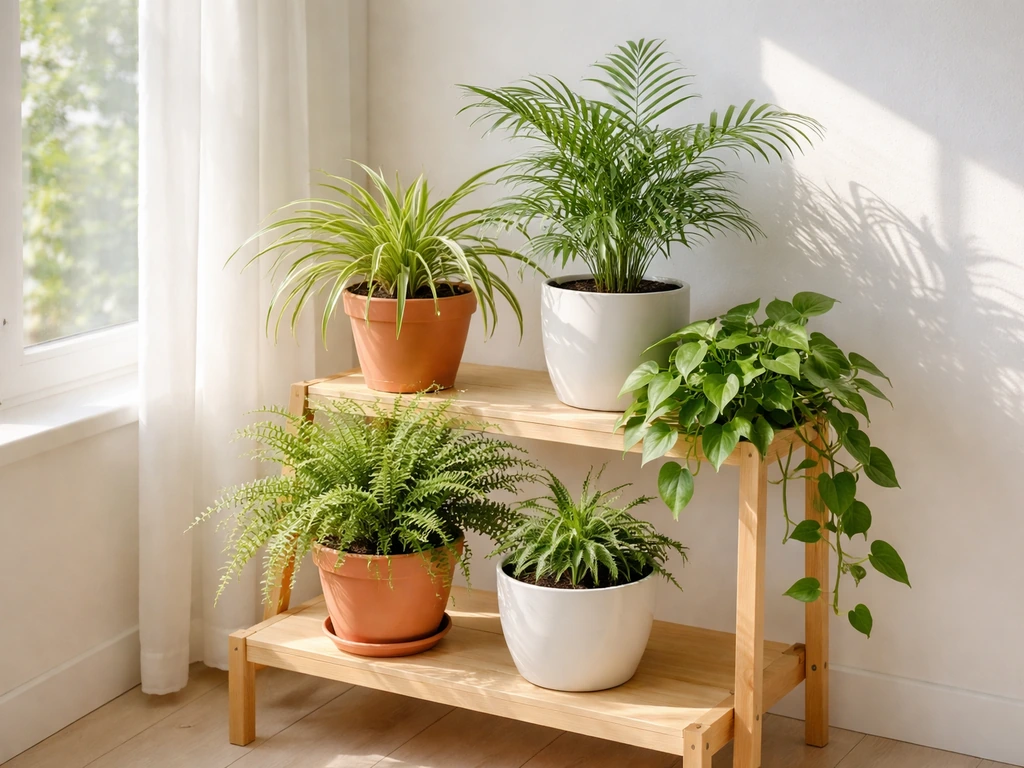
The most reliable common easy-to-grow houseplants for beginners and busy owners are golden pothos, snake plant, spider plant, ZZ plant, aglaonema, and aloe vera. Each of these tolerates low attention, survives a missed watering or two, and thrives in the kind of imperfect indoor light most homes actually have. If you can only pick one, start with pothos or spider plant: both root from cuttings in a glass of water, forgive irregular care, and show you within days whether they are happy.
Common Easy-to-Grow Houseplants: Best Picks for Any Home
Rachel Hartley
14 Jul 2026
Quick answer: the best common easy-to-grow houseplants at a glance
The table below gives you a one-line care summary for each plant so you can make a fast decision before reading further. Light ranges are based on measured indoor footcandle categories: low is roughly 25–100 fc (north windows), medium is 100–500 fc, bright indirect is 500–1,000 fc (east or west windows with no direct afternoon glare), and direct sun is above 1,000 fc at a south-facing window.
| Plant | Light | Water | Mature size | Pet safe? | Primary use |
|---|---|---|---|---|---|
| Golden pothos | Low to bright indirect | When top 1 inch is dry | Trails 6–10 ft+ | No (toxic to cats & dogs) | Aesthetic, air interest |
| Snake plant | Low to bright indirect | Fully dry between waterings | 1–4 ft upright | No (toxic to cats & dogs) | Architectural, low light |
| Spider plant | Bright indirect to medium | When top inch is dry | 1–2 ft, long arching runners | Yes (ASPCA non-toxic) | Aesthetic, easy propagation |
| ZZ plant | Low to medium | Fully dry between waterings | 2–3 ft, slow | No (irritant if ingested) | Low-light accent |
| Aglaonema | Low to medium | When top inch is dry | 1–3 ft | No (toxic to cats & dogs) | Colorful foliage |
| Aloe vera | Bright indirect to direct | Completely dry between waterings | 1–2 ft rosette | No (toxic to cats & dogs) | Medicinal, succulent accent |
| Peace lily | Medium to bright indirect | Keep evenly moist | 1–3 ft | No (toxic to cats & dogs) | Flowering, humid rooms |
| Cast-iron plant | Low | When top inch is dry | 2–3 ft upright | Yes (generally considered non-toxic) | Deep shade accent |
| Pothos 'Marble Queen' | Bright indirect | When top inch is dry | Trails 6 ft+ | No (toxic to cats & dogs) | Variegated hanging display |
| Boston fern | Bright indirect, high humidity | Keep evenly moist | 2–3 ft arching | Yes (ASPCA non-toxic) | Hanging basket, humidity lover |
How to decide what to grow: a simple decision flow
Before buying anything, run through these six questions in order. Each one eliminates bad choices and narrows the list fast. I walk through this same mental checklist every time someone asks me what to get for their apartment or office.
- Light level first. Hold your hand 12 inches above your intended spot at midday. A sharp shadow means bright indirect or better. A faint shadow is medium. No visible shadow is low light. Alternatively, download a free lux meter app and match the reading to the footcandle ranges above. This single step eliminates about half of poor plant choices before you even leave the store.
- Room and space constraints. A trailing pothos on a high shelf is stunning; a 4-foot snake plant in a studio bathroom is probably too ambitious. Measure the space and decide whether you want something upright, trailing, spreading, or compact before you fall for a plant at the nursery.
- Container type. Terracotta dries faster than glazed ceramic or plastic, which matters for succulents and snake plants. Hanging baskets need plants with enough vigor to fill them (pothos, spider plant, Boston fern). Windowsill herb pots need at least 4–6 inches of depth and drainage holes.
- Climate and season. If it is winter in a northern apartment right now (as in, low light from November through February), skip high-light tropicals and reach for ZZ plant, cast-iron plant, or pothos instead. If you are in a humid subtropical climate like Florida or coastal Texas, humidity-loving peace lilies and ferns will do far better than they would in a dry Denver winter apartment.
- Pet presence. If cats or dogs roam freely, remove every toxic plant from the list and work only from the pet-safe column. ASPCA's database is the definitive reference. Do not rely on anecdote.
- Desired outcome. Aesthetic interest and air texture? Go foliage plants. Fresh cooking herbs? Basil and mint on a sunny windowsill. Minor burn relief and skin care? Aloe vera. Each goal has a different care commitment and light requirement, so decide this before committing.
Best plant picks by situation
For beginners who have never grown anything indoors
Start with golden pothos or snake plant. Both will survive neglect that would kill most other plants. Pothos tolerates dim light, roots from a cutting in a week, and tells you it is thirsty by looking slightly limp before any real damage happens. Snake plant can go weeks without water and genuinely prefers to dry out completely between drinks. Neither needs fertilizer in its first year if potted in fresh mix. If you want a third plant to round out your first collection, add a spider plant for its forgiving nature and the bonus of free baby plants every few months.
For apartment dwellers with limited light
North-facing windows and interior rooms are notoriously dim. In a low-light apartment, your safest choices are ZZ plant, cast-iron plant, aglaonema, and pothos. The ZZ plant is remarkable: its waxy, water-storing rhizomes let it survive weeks of drought and light levels that would rot or starve most other plants. ZZ Plant (Zamioculcas zamiifolia), Clemson/HGIC (extension guide) notes that ZZ plants tolerate low light and long dry intervals because of water‑storing rhizomes, grow slowly, and prefer a well‑draining mix with occasional feeding ZZ Plant (Zamioculcas zamiifolia) — Clemson/HGIC (extension guide). Cast-iron plant earns its name in truly dim corners. Aglaonema offers colorful variegated foliage even in 100–200 fc conditions. If you want to add a high-light plant to a dim apartment, place it directly at the brightest window and supplement with a basic grow light on a 12-hour timer during autumn and winter months.
For time-pressed owners who water irregularly
Succulents (including aloe), snake plant, and ZZ plant are your people. All three store water in leaves or rhizomes and genuinely suffer more from overwatering than underwatering. Plant them in a fast-draining mix (standard potting soil cut 50/50 with perlite), pot in terracotta, and water only when the soil is fully dry to the touch all the way through. You can go two to three weeks between waterings in most indoor conditions without any stress.
For small spaces, shelves, and hanging baskets
Pothos, spider plant, and string of pearls are natural trailers. Pothos will cascade down a bookshelf or hang in a macrame holder beautifully, and you can trim it back whenever it gets too long with no harm to the plant. Spider plants specifically shine in hanging baskets because of their arching runners loaded with plantlets. For tight windowsills, compact varieties like mini-pothos, dwarf aglaonema, or a single aloe rosette keep things tidy and manageable.
For windowsill herbs and edible growing
A south- or west-facing windowsill that gets at least 4–6 hours of direct or bright indirect light can support basil, mint, chives, or parsley in 4–6 inch pots with drainage holes. Mint spreads aggressively, so keep it in its own pot. Basil needs consistently warm temps above 60°F and goes bitter and bolts fast if chilled or allowed to dry out repeatedly, so it is higher maintenance than the foliage plants above. If your window light is marginal, chives and parsley are more forgiving. In winter in cold-climate apartments, a small LED grow light 6–12 inches above pots will make the difference between productive herbs and spindly disappointment.
Choosing by goal: aesthetic, edible, and medicinal
Top picks for aesthetic impact
For foliage drama, aglaonema gives you deep reds, pinks, and greens in low to medium light. Pothos 'Marble Queen' has stunning cream-and-green variegation and looks best in a hanging pot or on a high shelf where its trailing stems can be seen. Peace lily earns its place with elegant white spathes that bloom reliably in medium indoor light, and it signals thirst by drooping visibly before any real damage occurs. For a bold architectural statement in a bright room, a snake plant in a tall cylindrical pot is one of the cleanest design choices available in the easy-care category.
Top picks for edible growing
Windowsill herbs are the most accessible edible houseplants, but they need genuine light. Basil, mint, chives, and parsley are the workhorses. For something more unusual, microgreens (sunflower, radish, pea shoots) grown in shallow trays under a grow light are harvestable in 7–14 days, require minimal space, and need no soil expertise. If you want a longer-term edible, a dwarf lemon or kumquat tree in a large south-facing window (or sunroom) can produce fruit indoors in most climates, though it requires more commitment than a pot of herbs.
Top picks for medicinal use
Aloe vera is the standout easy-to-grow medicinal houseplant. The clear gel from broken inner leaves is widely used topically for minor burns and skin irritation, and the plant itself is straightforward to grow in a bright window with minimal water. One important caveat: the yellow-green latex just under the outer leaf skin (aloin) is a laxative and should not be ingested. Keep aloe away from pets, as ASPCA lists it as toxic to cats and dogs. For a gentle aromatic and traditionally calming herb, lavender can grow in a bright sunny windowsill pot in a well-draining gritty mix, though it struggles in humid, dim apartments. Mint is a mild medicinal herb for teas and digestion support that is much easier indoors than lavender and tolerates moderate light.
Curated plant groups: what houseplants grow well together and why
Grouping houseplants is not just about looks. When you place compatible plants near each other, they share humidity from transpiration (a measurable benefit in dry apartments), and the grouping makes watering rounds faster because plants with the same schedule sit together. The principles for matching plants are simple: match light requirements first, then water needs, then root habits (shallow vs. deep, aggressive spreaders vs. tidy clumpers).
- Match light needs: group low-light plants (ZZ, cast-iron, aglaonema) away from bright-light plants (aloe, cacti, herbs) so you can move the groups closer to or farther from windows without compromising any individual plant.
- Match watering schedules: putting drought-tolerant succulents next to moisture-loving peace lilies leads to one plant being chronically overwatered or the other chronically underwatered. Keep dry-preference plants (snake plant, ZZ, aloe) together and moisture-loving plants (peace lily, Boston fern, spider plant) in a separate group.
- Consider root habits: shallow-rooted pothos and spider plants work well in wide, shallow containers or grouped on a tray. Deep-rooted plants like aglaonema and snake plant do better in their own pots within a grouped display rather than sharing a single container.
- Use groupings to raise humidity: clustering 3–5 tropical foliage plants together on a tray of pebbles and water raises local humidity around the group without a humidifier, which benefits ferns, peace lilies, and aglaonema in dry winter apartments.
- Separate aggressive spreaders: mint and tradescantia will overtake smaller plants in a shared pot. Give them their own containers within the group display.
Specific three-plant companion combos
Low-light combo: north window or interior shelf
Pair a ZZ plant (tall, upright, drought-tolerant), a low-growing aglaonema (colorful, handles 50–150 fc without complaint), and a trailing pothos (adds a trailing dimension). All three tolerate the same infrequent watering schedule and similar dim light. Place them on a tiered shelf with the ZZ at the back for height, aglaonema in the middle for color, and a hanging pothos at the front or side cascading down. Water all three only when the top inch of mix is fully dry. None of these need fertilizer in winter. Note that none of these three are pet-safe, so if you have curious cats, see the pet-safe combos below.
Bright indirect combo: east or west windowsill display
Combine a spider plant (arching, bright indirect lover, pet-safe), a peace lily (elegant bloomer, prefers consistent moisture), and a pothos 'Marble Queen' (bright variegation improves in better light). How to grow spider plants, RHS notes spider plants prefer bright, indirect light and an evenly moist-to-dry surface cycle, and the ASPCA species page lists Chlorophytum comosum as non‑toxic to cats and dogs How to grow spider plants — RHS; and ASPCA species page. Place the spider plant in a hanging pot or on an elevated bracket above the group to show off its runners. Keep the peace lily in a slightly larger pot and water it before it droops. The pothos can trail from a shelf bracket or wall-mounted planter beside the window. Spider plant and peace lily both benefit from the humidity this group creates together. One caveat: peace lily is toxic to pets, so this combo is for pet-free rooms or rooms pets cannot access.
Small-space balcony or sunny windowsill combo
For a bright balcony or a south-facing window ledge that gets some direct morning sun, try aloe vera (low, rosette-shaped), a pot of chives (upright, edible, easy), and a compact succulent like echeveria or haworthia (rosette, slow, very low maintenance). All three prefer to dry between waterings, tolerate direct morning sun, and fit in 4–6 inch individual pots lined up on a ledge. This is a functional combo: you get a practical medicinal plant, a usable edible herb, and a decorative succulent that almost takes care of itself. In a cold winter climate, bring all three indoors by the time nighttime temps drop below 45°F.
Easy-to-grow houseplants that are safe for cats and common pets
Pet safety is non-negotiable. The ASPCA toxic plant database is the most widely referenced authority for this, and I always cross-check it before recommending any plant to someone with free-roaming cats or dogs. Below are easy-care houseplants confirmed non-toxic to cats and dogs by ASPCA, with brief care notes and any real-world caveats. For a ready list of easy to grow houseplants that are safe for cats, see our dedicated pet-safe plant guide for specific non-toxic recommendations and care notes.
| Plant | Light | Water | Care note | Caveat |
|---|---|---|---|---|
| Spider plant (Chlorophytum comosum) | Bright indirect to medium | When top inch is dry | Propagates via plantlets; extremely forgiving | Cats are attracted to it and may chew leaves — no toxicity, but chewing can cause mild stomach upset due to mildly hallucinogenic compounds |
| Boston fern (Nephrolepis exaltata) | Bright indirect | Keep evenly moist | Needs higher humidity; mist or use a pebble tray | Drops fronds quickly if air is too dry |
| Cast-iron plant (Aspidistra elatior) | Low to medium | When top inch is dry | Extremely tough; tolerates deep shade | Very slow growing — patience required |
| Areca palm (Dypsis lutescens) | Bright indirect | When top inch is dry | Good air-interest plant; prefers moderate humidity | Needs a large pot as it grows; can reach 6–7 ft indoors |
| Calathea / Maranta (prayer plants) | Medium to bright indirect | Keep evenly moist, never soggy | Moves leaves with light cycle; prefers filtered water | Sensitive to fluoride in tap water — use filtered or rainwater |
| Peperomia spp. | Medium to bright indirect | When top inch is dry | Compact, many varieties, slow growing | Overwatering is the main failure mode |
| Haworthia spp. | Bright indirect to low (for a succulent) | Fully dry between waterings | One of the few succulents that tolerates lower light | Non-toxic but still keep curious pets from chewing |
| Christmas cactus (Schlumbergera) | Bright indirect | When top inch is dry; more water during bloom | Blooms in winter; good for seasonal interest | Not a desert cactus — does not want bone-dry conditions for extended periods |
A few popular easy-care plants that are commonly assumed to be safe are actually toxic: golden pothos, snake plant, ZZ plant, peace lily, aloe vera, and aglaonema are all listed as toxic to cats and dogs by ASPCA. If you have pets that chew or knock plants over, build your collection entirely from the list above and keep toxic plants in rooms with closed doors.
Practical care essentials
Soil mixes that actually work
The single most common mistake I see beginners make is using straight garden soil in containers. It compacts, drains poorly, and invites root rot and fungus gnats. A good all-purpose indoor mix is two parts sphagnum peat moss or coconut coir, one part perlite, and one part coarse bark or compost. For succulents and cacti (including aloe and snake plant), use a 50/50 blend of standard potting mix and perlite or coarse sand to ensure fast drainage. For moisture-loving tropicals like peace lily and ferns, the standard two-part coir plus one-part perlite mix is fine without extra bark.
Watering schedules by plant type
Calendar watering kills more houseplants than neglect does. Use the touch test instead. For most foliage houseplants (pothos, aglaonema, spider plant, peace lily), water when the top 1 inch of potting mix is dry to the touch. For drought-tolerant plants (snake plant, ZZ plant, aloe, succulents), wait until the mix is fully dry all the way through before watering again. In winter in a heated apartment, most plants need water about half as often as in summer. In humid subtropical climates in summer, check more frequently because heat and airflow can dry pots faster than you expect.
Feeding and fertilizing
Feed houseplants only during their active growing season, which for most indoor plants is spring through early summer. A balanced liquid fertilizer (such as 10-10-10 or 20-20-20) diluted to half the label strength, applied every two to four weeks, is enough for most foliage plants. Slow-release granules applied at repotting time are a good low-effort alternative. Stop or drastically reduce feeding in autumn and winter unless you are running supplemental grow lights and plants are visibly still putting out new growth. Over-fertilizing in low-light winter conditions causes salt buildup in the mix and can burn roots.
Light tweaks for common indoor situations
If your apartment has only north-facing windows, stick to the low-light species listed above and supplement with a basic LED grow light on a 12-hour timer during the darkest months. East and west windows typically deliver 500–1,000 fc of bright indirect light, which suits most tropical foliage plants. South windows are the brightest and deliver direct sun, which is ideal for aloe, succulents, and herbs but can scorch thin-leaved tropicals like pothos or aglaonema unless diffused by a sheer curtain. Rotate pots a quarter turn every time you water to prevent plants from leaning dramatically toward the light source.
Humidity tips and seasonal adjustments
Most tropical houseplants prefer 40–60% relative humidity, but the average heated apartment in winter in Chicago, Denver, or Minneapolis can drop to 20–30%. The cheapest fix is grouping plants together on a wide tray filled with pebbles and water (keep the pot bottoms above the water line to prevent root rot). A room humidifier near your plant collection is the most effective solution if you have several humidity-sensitive plants like ferns, calathea, or peace lily. In summer in a naturally humid climate, most of these plants will thrive without any humidity assistance at all. In winter, check your baseboard heaters and radiators: placing plants directly above or beside them will dry out roots and crisp leaf edges fast.
Repotting: when and how
Repot when roots are growing out of drainage holes, when the plant is clearly distorting the pot shape, or when growth has stalled despite adequate light and water. Size up by just one pot size (1–2 inches in diameter), not dramatically larger, because excess soil around roots holds too much moisture and invites rot. Spring is the best time to repot for most species. Never use garden soil in containers. Fresh potting mix provides enough nutrients that you can skip fertilizing for the first two to three months after repotting.
Common pests and how to handle them
Fungus gnats are the most common complaint from beginners, and they almost always trace back to consistently wet surface soil. Let the top inch or two dry out between waterings, and the gnat population collapses within a few weeks. For persistent infestations, yellow sticky traps catch adults and a soil drench with Bacillus thuringiensis israelensis (Bti, sold as Mosquito Bits) kills larvae without harming plants. Mealybugs appear as white cottony clusters at leaf joints; remove them with a cotton swab dipped in 70% isopropyl alcohol, then follow up with insecticidal soap spray. Spider mites thrive in hot, dry air; improve humidity and wash leaves under a lukewarm shower to knock them back before reaching for sprays.
Propagation basics
Pothos is the easiest indoor plant to propagate: cut a stem below a node (the small brown bump where a leaf attaches), remove the bottom leaf, and place the cutting in a glass of water. Roots appear within one to two weeks. Spider plant propagation is even simpler: pin a plantlet from one of the dangling runners into a small pot of moist mix while still attached to the parent, wait two weeks for it to root, then cut the runner. Snake plant is best divided at the rhizome base when repotting. ZZ plant can be divided or propagated from individual leaf cuttings, but leaf cuttings are very slow (months to a year to produce a new plant). The best propagation window for all of these is late spring to early summer when plants are in active growth.
Troubleshooting and a quick seasonal checklist
Most houseplant problems come down to three root causes: too much water, too little light, or the wrong environment for the species. Here is a fast reference by symptom and season.
| Symptom | Most likely cause | Fix |
|---|---|---|
| Yellow leaves (lower/older first) | Overwatering or poor drainage | Check roots for rot, repot in fresh draining mix, reduce watering frequency |
| Pale, washed-out leaf color | Too much direct sun | Move back from window or add a sheer curtain |
| Leggy, stretched growth | Insufficient light | Move closer to window or add grow light |
| Crispy brown leaf edges | Low humidity or heat source nearby | Group plants on pebble tray, move away from radiator |
| Dropping leaves rapidly | Cold draft or temperature shock | Move away from exterior doors and AC vents; keep above 55°F |
| Soil stays wet for 2+ weeks | Compacted or wrong mix, or pot has no drainage | Repot into well-draining mix with a pot with drainage holes |
| Tiny flies around soil (fungus gnats) | Constantly moist surface soil | Let top 2 inches dry out; use Bti drench for larvae |
Seasonal and regional reminders
- Cold-climate winters (Minneapolis, Chicago, Denver in Jan–Feb): cut watering frequency in half, stop fertilizing, move plants closest to south windows, and add a grow light for any plant that is stretching toward the light.
- Low-light apartments year-round: commit to ZZ plant, cast-iron plant, aglaonema, and pothos as your core collection. Do not try to grow succulents or herbs without a grow light.
- Hot, humid subtropical summers (Florida, Gulf Coast, coastal Texas): humidity is not an issue, but heat can stress plants near south or west windows. Diffuse afternoon sun, increase watering frequency, and watch for spider mites in air-conditioned rooms where air is drier.
- Dry high-altitude climates (Denver, Albuquerque year-round): succulents and aloe thrive, but tropical foliage plants need a humidifier or regular pebble tray setup to avoid crispy edges.
- Spring everywhere: the best time to repot, take cuttings, start fertilizing again, and bring any outdoor-wintered plants back inside to acclimate before nights stay reliably above 50°F.
Where to go from here
Once you have a small collection running smoothly, you will naturally want to expand into more specific territory: finding the best overall houseplants for your experience level, exploring which plants grow well together in shared pots or display groups, building a fully pet-safe plant collection, or getting into companion planting combinations for a small indoor or balcony garden. For practical examples of compatible pairings and display groups, see what house plants can grow together. For ready-made three-plant pairings, see what 3 plants grow well together. For a curated list, see a practical guide to the best houseplants to grow. For a quick list of houseplants that are easy to grow, see our beginner roundup on houseplants that are easy to grow. The plants covered in this guide are your foundation. Every one of them can be propagated for free once established, so a collection of ten thriving plants can become twenty within a single growing season. Start with two or three that fit your actual light and care conditions, get comfortable, then branch out. That is the approach that actually works.
FAQ
Quick answer: Which common, easy-to-grow houseplants are best for beginners and apartment dwellers?
Top reliable, low‑maintenance choices: golden pothos (Epipremnum aureum) — trailing, low–bright indirect light, water when top ~1" dry, vigorous, toxic to pets; snake plant (Dracaena/Sansevieria) — very drought tolerant, low–bright, well‑draining mix, toxic to pets; spider plant (Chlorophytum comosum) — bright indirect best, evenly moist to slightly dry, pet‑safe; ZZ plant (Zamioculcas zamiifolia) — tolerates low light and infrequent watering, slow grower, toxic to pets; aglaonema (Chinese evergreen) — low light tolerant, moderate watering, variegated choices, some cultivars pet‑toxic; pothos, philodendron (toxic), peace lily (Spathiphyllum — medium light, moist soil, toxic), aloe (succulent, medicinal topically, toxic to pets). These are widely recommended by botanical gardens and extension services for beginners.
How do I decide what to grow based on my situation (light level, room, container type, climate/season, pets, intended use)?
Decision flow (simple): 1) Measure light (lux/fc) or estimate: low ≈ 270–1,080 lux (25–100 fc); medium ≈ 1,080–5,380 lux (100–500 fc); bright indirect ≈ 5,380–10,764 lux (500–1,000 fc); bright direct >10,764 lux. 2) Match plants to light: low = ZZ, snake plant, cast‑iron; medium = aglaonema, pothos, philodendron; bright indirect = spider plant, pothos, peace lily; direct sun = succulents, aloe, cacti. 3) Room & humidity: bathrooms/kitchens (higher humidity) suit ferns, peace lily, spider plant; bedrooms/living rooms suit snake plant, pothos, ZZ. 4) Container type: hanging = pothos, spider plant; windowsill = small succulents, herbs; large floor pots = fiddle leaf fig (not beginner) or big snake plant. 5) Climate/season: in cold winters move tender plants away from drafty windows and lower watering in winter; in humid tropics emphasize airflow and watch fungus gnats. 6) Pets? If pets roam, choose pet‑safe species (see pet‑safe list). 7) Intended use: aesthetic = variegated aglaonema/pothos; edible = windowsill herbs, dwarf citrus; medicinal (topical) = aloe (keep away from pets).
Which three‑plant companion combinations are easy to grow together and why?
Three tested combos: 1) Low‑light, low‑care trio (bedroom/entry): ZZ plant + snake plant + cast‑iron plant — aligned drought tolerance, low light, minimal feeding. 2) Bright indirect, trailing/hanging trio (living room/hanging rail): golden pothos + spider plant + philodendron Brasil — similar light needs and complementary trailing/tufted forms. 3) Humid bathroom trio (filtered light): peace lily + Boston fern (Nephrolepis) + pothos — like higher humidity and steady moisture. Plant together when water/light needs match; pair drainage and pot size accordingly.
What houseplants can grow together in one container or close grouping?
Grow‑together rules: group plants with similar water, light, and root‑space needs. Examples: succulents/cacti together (fast drainage, infrequent water); tropical foliage mix (pothos + aglaonema + calathea) in bright indirect with consistent moisture; herb windowsill (basil + chives + parsley) in full to bright indirect light and regular watering. Avoid mixing succulents with moisture‑loving species in same pot.
Which easy‑to‑grow houseplants are safe for cats and other pets?
Pet‑safe, easy options: spider plant (Chlorophytum comosum), Boston fern (Nephrolepis exaltata), areca palm (Dypsis lutescens) in small form, money tree (Pachira aquatica) typically non‑toxic, certain Calathea/Maranta (prayer plants) varieties. Always verify cultivar and monitor pets—ASPCA lists are the standard reference. Keep toxic plants (pothos, philodendron, snake plant, aloe, peace lily) out of reach.
What are the practical, tested care essentials (soil, watering, feeding, light tweaks, humidity, repotting) tailored by season and region?
Essentials: Soil — use soilless mix (peat or coir + perlite) for good drainage; succulents need cactus mix. Watering — foliage plants: water when top ~1" dry; succulents: allow full drying between waterings. Feeding — fertilize spring–summer only with balanced liquid at 1/2–1x label every 2–4 weeks or a slow‑release at potting. Light tweaks — rotate plants monthly, move thin‑leaved species away from direct summer sun, add grow light in dark winters. Humidity — increase with pebble trays, grouping, or small humidifier for 40–60% humidity plants; in humid tropics provide airflow to prevent fungal issues. Repotting — repot every 12–24 months or when roots show through drainage holes or growth stalls; choose one pot size up and fresh mix. Seasonal adjustments — reduce watering and stop feeding in winter in cold/temperate regions unless supplemental light used; in hot/dry seasons increase monitoring for drying and pests.
Next Article
Best Houseplants to Grow: Match Light, Water, and Safety
Find the best houseplants to grow by light, watering, safety for pets, and season, with a 2 to 4 week care plan.