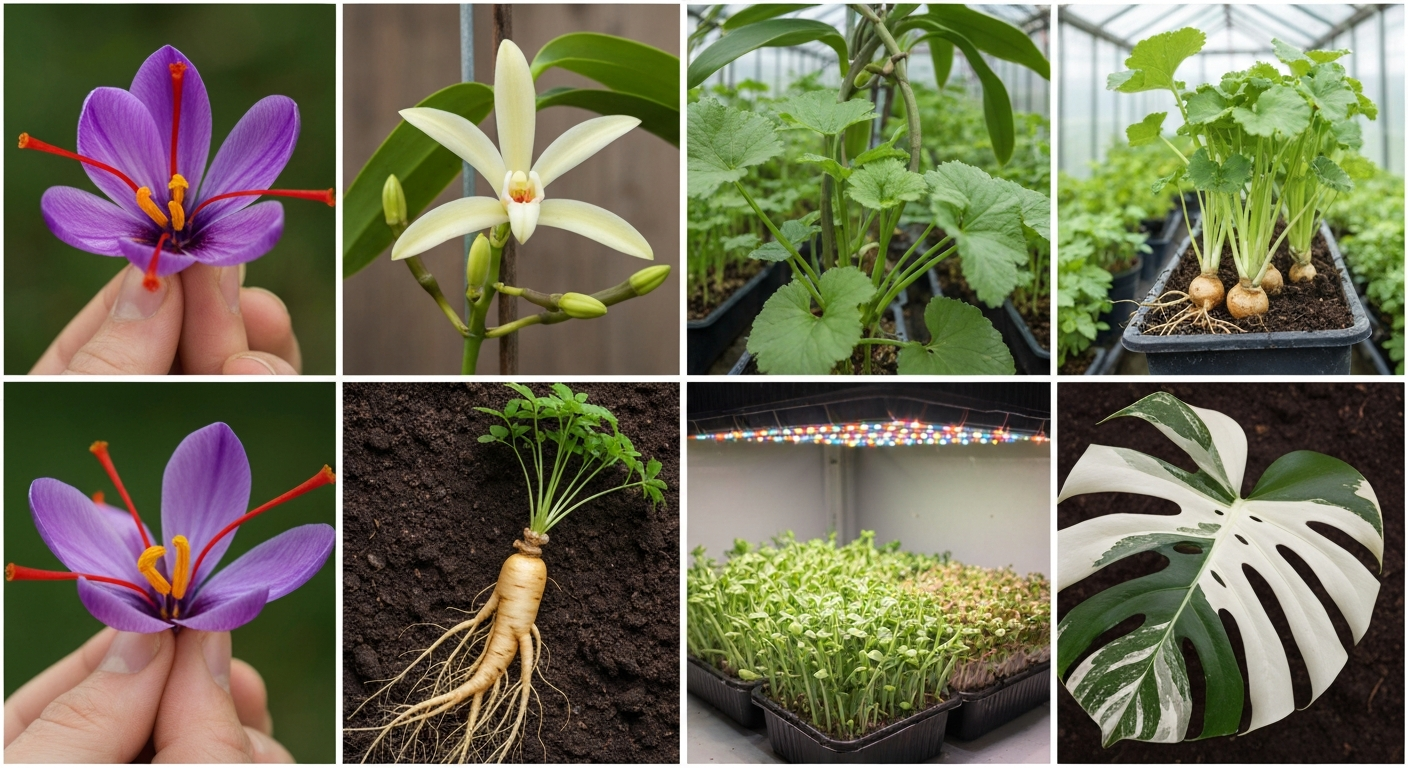
The most valuable plants you can realistically grow at home include saffron (worth up to $5,000 per kilogram at wholesale), vanilla, wasabi, American ginseng, microgreens, variegated rare houseplants, and specialty orchids. Some of these pay back in months; others take a decade. Which one belongs in your garden, greenhouse, or spare bedroom depends on your climate, your budget, and how patient you are. This guide walks you through every serious contender, with real numbers and honest trade-offs, so you can pick one that actually fits your situation.
Most Expensive Plants You Can Grow: High-Value Choices
Rachel Hartley
20 Jul 2026
Who this guide is for and how to use it
If you have a spare shelf under a grow light, a heated greenhouse, a shaded woodland corner, or even just a south-facing windowsill, there is a high-value plant worth trying. This guide is written for home gardeners, apartment growers, small-scale producers, and plant collectors who want to grow something with genuine market or collector value. It is not a get-rich-quick pitch. Growing expensive plants requires real investment in time, infrastructure, and often patience measured in years. What this guide gives you is the information to decide before you spend money on corms, seedlings, or equipment.
Use the decision criteria section to narrow your list, then jump directly to the crop profiles that match your situation. Each profile covers the climate and USDA zones where the crop works, the right season and timing, whether it suits containers or needs in-ground or greenhouse space, the skill and labor level required, time to first harvest, rough startup and ongoing costs, typical retail and wholesale price ranges, and the risks that could cost you your investment. At the end, there are practical next steps and region-specific pathways.
What "expensive" actually means for growers
There are three ways a plant can be "expensive" and they are not the same thing. The first is market price per unit: saffron commands up to $5,000 per kilogram at wholesale because so little can be produced per plant. The second is collector or rarity value: a single variegated Monstera Thai Constellation cutting can sell for hundreds of dollars, not because it is nutritionally valuable, but because it is rare and desirable among collectors. The third, and arguably the most useful metric for growers, is value per square foot. A crop that earns $30 per tray of microgreens in 10 days beats a $500 orchid that takes three years to rebloom, at least in terms of space efficiency.
The right way to evaluate any expensive plant is with an enterprise budget: take the annual yield per square foot, multiply it by the price you can realistically sell for, then subtract amortized establishment costs, annual inputs, labor, and utilities. What is left is your net return per square foot, and dividing your total establishment cost by that figure gives you your payback period. University extension programs use this exact approach, and you should too before buying 500 saffron corms or building a vanilla trellis. Wholesale prices are typically 30 to 60 percent of retail, so model both scenarios and use the conservative number for planning.
How to choose: five questions before you start
Before picking a crop, answer these five questions honestly. They will eliminate most mismatches before you spend a cent.
- Space: Do you have a balcony, a raised bed, a woodland patch, a greenhouse, or a spare indoor shelf? Space type matters as much as square footage. Wasabi needs flowing water infrastructure. Vanilla needs vertical trellis space inside a warm greenhouse. Microgreens need trays under lights. Saffron corms grow happily in a deep container on a patio.
- Time horizon: Can you wait 4 to 7 years for ginseng to pay back, or do you need revenue in 3 weeks (microgreens) or one growing season (saffron flowers)? Be honest about this. Long-term crops tie up capital and real estate.
- Budget: Some crops require significant upfront investment. A truffle orchard means buying inoculated trees, preparing soil, and waiting up to 10 years. Microgreens can start for under $100. Know your ceiling before you research.
- Desired outcome: Are you growing to sell, to use at home, to collect, or all three? Market channels differ. Direct-to-chef or farmers market sales get you closer to retail price. Wholesale buyers offer volume but lower margins. Collector plants often sell best online.
- Legal constraints: Some crops come with serious regulatory baggage. American ginseng interstate trade requires permits. Wild goldenseal harvest is restricted in many states. Some Nepenthes species are CITES-listed. Know the rules in your state before you plant.
Cost and profitability: what to realistically expect
Startup costs for high-value crops range from almost nothing (microgreens) to tens of thousands of dollars (truffle orchard, vanilla greenhouse). Recurring costs include inputs, labor, utilities, pest management, and packaging if you are selling. Labor is the sneaky one. Saffron's labor cost is essentially all in the harvest window: you are hand-picking stigmas from each flower, and at roughly 150 to 200 flowers per gram of dried saffron, that adds up fast at any meaningful scale.
Time to payback varies enormously. Microgreens can turn a profit in the first month if you have a buyer lined up. Saffron corm yields build over two to three seasons as daughter corms multiply, so revenue grows gradually. Ginseng and goldenseal require years of patient maintenance before any harvest. Variegated rare houseplants can pay back in a single propagation cycle if you propagate cuttings from a mother plant that you bought at peak value. Always build in a buffer: assume prices will be lower than the peak examples you see online and yields will be lower than optimistic extension projections in your first year.
High-value food and spice plants
Food and spice crops are the most straightforward category because you have concrete market comparables: grocery stores, farmers markets, restaurant buyers, and online spice retailers. The challenge is that the highest-value spices are expensive precisely because they are hard to produce. That said, even a small-scale harvest of saffron or vanilla has tangible value, and some growers do turn these crops into side income with the right setup.
Saffron (Crocus sativus)
Saffron is the most expensive spice in the world by weight, and it is genuinely achievable for home growers in a wide range of climates, including cold ones. URI Extension has run successful trials in New England, and growers across the continental U. URI Extension's How to Grow Saffron in Rhode Island, URI Extension (propagation & labor notes) reports successful saffron trials in New England and provides propagation and harvest-labor guidance How to Grow Saffron in Rhode Island — URI Extension (propagation & labor notes). S. have had success from zone 6 upward. Saffron grows from corms, not seeds. You plant them in late summer or early fall, and the flowers emerge in autumn, typically October or November depending on your region. Each flower produces three red stigmas, and those are what you harvest and dry. At 150 to 200 flowers per gram of dried saffron, a plot of 1,000 corms might yield 5 to 8 grams in a good year, worth $25 to $120 at retail prices of $5 to $15 per gram.
The key requirements are well-drained soil, a neutral pH, and a dry summer dormancy. Corms rot in waterlogged soil, so raised beds or containers with excellent drainage are important, especially in wet climates. Full sun during the growing season matters too. The plant does not propagate from seed; it multiplies via daughter corms that form each year, so your planting stock grows over time. Startup cost for 100 corms is roughly $20 to $50 depending on supplier. The ongoing costs are minimal: no special irrigation during dormancy, no greenhouse needed in most temperate zones. The real cost is harvest labor: picking stigmas is painstaking work and cannot be mechanized at small scale.
| Factor | Detail |
|---|---|
| USDA Zones | Zones 6–9 (proven in New England; mulch in colder zones) |
| Season/Timing | Plant corms late summer to early fall; flowers October–November |
| Container suitability | Yes, excellent in deep containers or raised beds |
| Skill/Labor | Low skill, high harvest labor (hand-picking stigmas) |
| Time to first harvest | First autumn after planting; commercial yield builds over 2–3 years |
| Startup cost (100 corms) | $20–$50 for corms; containers/soil if needed |
| Typical retail price | $5–$15/gram retail; $1,300–$5,000/kg wholesale by grade |
| Risk factors | Corm rot in wet soil, vole/rodent damage, labor bottleneck at harvest |
Vanilla (Vanilla planifolia)
Vanilla is the second-most expensive spice by weight and one of the more technically demanding crops on this list. It is a tropical climbing orchid, native to Mexico, and it will not survive outside without a warm greenhouse if you are anywhere north of USDA zone 11. Inside a greenhouse or a warm, humid conservatory it is absolutely growable, but plan for a long road: it typically takes 2 to 4 years from planting to first usable pods, and that is assuming you get pollination right.
In its native range, vanilla is pollinated by specific bees and hummingbirds. In cultivation outside that range, every flower must be hand-pollinated, and the window is short: each flower opens for only one day. You transfer pollen from anther to stigma using a toothpick or small brush. Pods take 9 months to mature after successful pollination, and then they require a multi-week curing process involving heat-wilting, sweating, and slow drying that is itself an art form. Retail prices for quality cured vanilla beans range from $12 to $40 for small consumer packs, while commodity wholesale prices fluctuate dramatically with supply cycles driven largely by Madagascar's harvest.
| Factor | Detail |
|---|---|
| USDA Zones | Zone 11+ outdoors; greenhouse/indoor required elsewhere |
| Season/Timing | Year-round in tropical/greenhouse conditions; flowers spring–summer |
| Container suitability | Yes, in large containers with vertical trellis support |
| Skill/Labor | High skill (greenhouse, hand-pollination, curing); medium–high labor |
| Time to first harvest | 2–4 years to first pods; curing adds 3–6 months |
| Startup cost | Cutting or plant ($15–$50) plus greenhouse and trellis infrastructure |
| Typical retail price | $12–$40 per small consumer pack; wholesale highly variable by year |
| Risk factors | Failed pollination, temperature drops, root rot, commodity price volatility |
Wasabi (Wasabia japonica)
Real wasabi is one of the most difficult crops on this list to grow well, which is exactly why authentic fresh rhizome retails for $75 to $150 per pound in U.S. specialty channels. The vast majority of what is served as wasabi in restaurants is actually horseradish paste with green dye, simply because true wasabi is so hard to source at scale. If you can crack the growing requirements, you have very limited competition.
Wasabi wants cool stable temperatures (ideally 46 to 68°F), heavy shade, high humidity, and ideally cool running water flowing over the roots in a streambed or purpose-built water-table system. It does not tolerate heat, dry air, or waterlogged standing water. In practice, you either need a naturally cool, shaded stream environment or an investment in a tank/trough system with a water pump, shade cloth, and a cool basement or climate-controlled space. Growth is slow: 18 to 24 months to harvestable rhizomes. The stems and leaves are also marketable to restaurants, which helps offset the long wait. For cold-climate growers with basement space and some plumbing creativity, this is a genuinely interesting option.
| Factor | Detail |
|---|---|
| USDA Zones | Zones 7–9 outdoors in shaded streams; climate-controlled indoors anywhere |
| Season/Timing | Year-round indoor/controlled environment; plant in spring outdoors |
| Container suitability | Requires flowing-water trough system or streambed; not standard container |
| Skill/Labor | Advanced; infrastructure-intensive |
| Time to first harvest | 18–24+ months for rhizomes; leaves/stems harvestable sooner |
| Startup cost | Moderate–high for water system; plants $10–$20 each |
| Typical retail price | $75–$150/lb fresh rhizome in specialty U.S. retail |
| Risk factors | Heat stress, root rot, high infrastructure failure risk, slow payback |
Truffle orchards (inoculated trees)
Truffles are the extreme long game of high-value food production. Black Périgord truffles (Tuber melanosporum) and white truffles retail for hundreds to thousands of dollars per pound, but you are typically waiting 7 to 15 years from planting a truffle-inoculated tree (hazelnut or oak) to your first meaningful harvest. The trees themselves must be planted in the right soil (well-drained, alkaline, with low organic matter), the right climate (Mediterranean-like or specific temperate zones), and managed carefully to maintain the mycorrhizal relationship between the fungus and tree roots.
This is not a beginner project and not suitable for small gardens. You need at least a few acres to make production economically meaningful, and establishment costs per acre for inoculated trees, soil preparation, and irrigation run into the thousands of dollars. That said, U.S. truffle orchards do exist and some are producing commercially in Oregon, North Carolina, and Tennessee. The risk factors are significant: soil conditions must be ideal and maintained, the mycorrhizal network can fail, and early harvests are small and unpredictable. Approach this as a decade-long investment, not a crop.
Microgreens
Microgreens are the fastest payback crop on this entire list, and they are the best starting point for apartment growers, urban producers, or anyone who wants high value per square foot without years of waiting. Penn State Extension and other university programs document microgreens as a reliable high-value enterprise with real business-planning templates available. The economics work because cycles are 7 to 21 days depending on species, you can run multiple harvests per month, and specialty varieties like sunflower shoots, pea tendrils, amaranth, and shiso command premium prices from restaurants and farmers market customers.
Startup costs are low: trays, a seed-starting mix or hydroponic pads, seeds, and a grow light if you lack natural light. A single 10x20-inch tray can gross $10 to $30 per cycle depending on variety and your sales channel, and direct-to-chef or farmers market sales capture the higher end. The labor is real: seeding, watering, harvesting, washing, and packaging are repetitive and time-consuming at scale. But for a beginner who wants to start earning quickly while learning the rhythm of growing and selling, microgreens are hard to beat. No other crop on this list gets you from seed to sale in under three weeks.
High-value cut flowers: peonies, ranunculus, and specialty bulbs
The specialty cut flower market rewards growers who can supply varieties that florists cannot source reliably from wholesale distributors. Peonies are the classic example: retail stems sell for $3 to $8 each at peak season, the plants are perennial, and local-grown peonies in May can command premium prices from florists who want them fresh and stem-long. The catch is that peony plants take 3 years to produce a meaningful harvest and do best in zones 3 to 8 with a real winter chill requirement.
Ranunculus, specialty anemones, and tulip varieties are quicker: plant corms or tubers in fall (or early spring in cold climates), harvest stems in spring, sell direct to florists or at farmers markets. The value-per-square-foot is good because you can pack them densely in well-prepared beds. The challenge is timing the market: cut flowers have a very short sales window and require same-day or next-day delivery to buyers. Cold storage extends this but adds cost. If you are already selling at a farmers market or have local florist contacts, high-value cut flowers are one of the more accessible high-return enterprises.
High-value medicinal plants
Medicinal crops occupy a complicated middle ground: prices per pound are often very high, demand from herbal supplement manufacturers and bulk botanical buyers is real, but growing timelines are long, regulatory issues are significant, and the market channels are less accessible to casual growers than, say, farmers market vegetables. The most viable route for small producers is growing certified organically and selling to established herb buyers, health food co-ops, or online through platforms that serve herbalists and natural medicine practitioners. Know your state's regulations before you plant anything, especially for wild-harvested or federally monitored species.
American ginseng (Panax quinquefolius)
American ginseng roots are genuinely valuable: wild-simulated roots (grown in forest conditions mimicking wild habitat) command premium prices over cultivated field-grown roots because buyers associate forest-grown roots with higher ginsenoside content and authenticity. Market reports note that wild American ginseng roots command significantly higher prices than cultivated roots, while cultivation typically requires 4–7+ years to reach marketable size and is subject to permitting and interstate trade regulations. Commercial roots grown in cultivated beds often require 4 to 7 years to reach marketable size, while wild-simulated roots in forest gardens can take even longer but fetch higher prices.
The regulatory picture is important and non-negotiable. American ginseng is listed on CITES Appendix II, meaning interstate and international trade requires permits and documentation. Many states require growers to register their ginseng gardens. Wild harvest is regulated by state fish and wildlife agencies and is often restricted to specific seasons, sizes, and quantities. If you are growing from seed or rootlets, you need a shaded woodland environment (mimicking its native forest floor habitat in eastern North America), well-drained, slightly acidic loamy soil, and patience. The payback is real but distant. For growers with suitable woodland acreage in zones 4 to 7, wild-simulated ginseng is one of the better long-term medicinal investments.
| Factor | Detail |
|---|---|
| USDA Zones | Zones 4–7 (eastern U.S. native range preferred) |
| Season/Timing | Plant seeds in fall; multi-year growth; harvest late fall |
| Container suitability | Not ideal; needs forest floor conditions |
| Skill/Labor | Intermediate; forest garden management, regulatory compliance |
| Time to first harvest | 4–7+ years for commercial root size |
| Startup cost | Seeds or rootlets; forest site prep; regulatory registration |
| Typical price | Wild-simulated: premium over cultivated; varies by grade and buyer |
| Risk factors | Fungal disease, slugs, poaching, regulatory non-compliance, long capital lock-up |
Goldenseal (Hydrastis canadensis)
Goldenseal is a native woodland perennial with historically high prices for dried root, driven by demand from herbal supplement manufacturers. Like ginseng, it grows in the forest understory of eastern North America, preferring rich, moist, well-drained soil with deep shade and zones 4 to 8. Propagation is from rootlets or rhizome divisions; seed propagation is slow and germination can be irregular.
The catch: goldenseal is subject to conservation protections in a number of states, and wild harvest is tightly restricted or prohibited in many jurisdictions. Growers using nursery-propagated stock are on firmer legal ground, but you still need to check state-specific rules. Production timelines are multi-year, similar to ginseng. Market channels include bulk botanical buyers, herbal product manufacturers, and specialty herb suppliers. If you have suitable shaded woodland habitat and a long time horizon, goldenseal can be interplanted with ginseng as a complementary forest-garden crop.
High-value ornamental and collectible plants
The ornamental and collectible plant market has exploded in the last several years, driven by social media, the houseplant boom, and a growing community of serious collectors willing to pay significant sums for rare cultivars, variegated specimens, and unusual species. Unlike food or medicinal crops, these plants are often propagated vegetatively from cuttings and sold directly to other collectors online. The value can be extraordinary, but it is also volatile: a variegated Monstera that sold for $500 as a cutting in 2021 may sell for $50 today as the novelty fades and more propagators flood the market.
Variegated and rare houseplants: Monstera, Philodendron, and Alocasia
Variegated Monstera deliciosa (Thai Constellation and Albo Variegata), rare Philodendron species, and unusual Alocasia cultivars are the most traded collectible plants in the current market. Their value comes from visual rarity: variegation (the white or yellow patterning on leaves) is unstable in some forms and cannot be grown from seed reliably, which limits supply. A well-variegated cutting with a node can sell for $100 to several hundred dollars depending on the cultivar and current market demand.
Growing these plants is not difficult in itself: most are tropical aroids that do well in a warm indoor environment with bright indirect light, well-draining aroid mix, and high humidity. Propagation is by node cuttings placed in water, perlite, or sphagnum moss until roots form. The ethical and legal dimension matters: some species and cultivars are sourced from the wild or smuggled from natural habitats, which is both illegal under CITES provisions for protected species and genuinely damaging to wild populations. Stick to nursery-propagated stock with clear provenance. The market for these plants is primarily online: Facebook plant groups, Etsy, eBay, and specialist collector forums are the primary channels.
Rare orchids and epiphytes: Paphiopedilum, Vanda, and collector species
Specialist orchids from genera like Paphiopedilum (slipper orchids), Vanda, Dracula, and certain Cattleya hybrids occupy a dedicated collector market where individual divisions or species plants can sell for hundreds to thousands of dollars. These are not grocery-store Phalaenopsis: they require specific humidity, temperature differentials, airflow, and sometimes highly specific bark or mounted growing media. Many need a greenhouse or a purpose-built growing cabinet with lighting and humidity control.
Propagation is slow: most orchids in this category can only be divided once they have multiple growths, which may take years. Meristem propagation (lab tissue culture) exists but requires specialized equipment. The market is primarily other collectors: orchid societies, specialist online auctions, and orchid shows are the primary venues. CITES regulations are significant: many wild-collected orchids are protected, and selling them without documentation is illegal. Work with reputable nurseries and keep provenance records.
Bonsai and specialty woody ornamentals
A well-developed bonsai can be worth thousands of dollars, but it takes decades to get there. The value in bonsai is almost entirely in accumulated time and skill: a 50-year-old Japanese maple bonsai with exceptional nebari (root flare) and refined branch structure represents decades of work that cannot be shortcut. For a grower starting from nursery stock or collected yamadori material today, bonsai is a true long-term investment.
The more practical near-term opportunity in woody ornamentals is growing unusual or collector-grade material: Japanese maples in rare leaf forms, specimen conifers, or unusual flowering trees that retail for $200 to $500 or more in garden centers. Propagation from cuttings or grafting can produce saleable plants in 2 to 4 years with reasonable skill. The market is local garden centers, landscapers, and direct-to-collector sales.
Carnivorous plants: Nepenthes, Sarracenia, and specialist species
Carnivorous plants, particularly highland Nepenthes (tropical pitcher plants), Sarracenia (North American pitcher plants), and unusual sundews and Heliamphora, have a passionate collector market. Rare Nepenthes species or clones with exceptional pitchers can sell for $50 to several hundred dollars per plant. Sarracenia rhizomes and divisions of unusual color-form plants sell briskly in online groups and at specialty vendors.
Highland Nepenthes are among the more technically demanding plants to keep: they need cool nights (50 to 60°F), high humidity, and good airflow, which typically means a dedicated cool growing cabinet or a cool greenhouse. Lowland species are easier indoors with heat and humidity. Sarracenia are much easier: they are North American natives that handle cold winters and hot summers in outdoor bog gardens in zones 4 to 9, needing only pure water (rainwater or distilled) and full sun. Both categories ship well as dormant or semi-dormant material, and online sales to collectors worldwide are the primary channel. Some Nepenthes are CITES-listed; source only from reputable tissue-culture or nursery-propagated stock.
How these crops compare: a quick side-by-side
| Crop | Time to first return | Space needed | Skill level | Typical value per unit | Best suited for |
|---|---|---|---|---|---|
| Microgreens | 1–3 weeks | Trays/indoor shelves | Beginner | $10–$30/tray | Apartment growers, fast starters |
| Saffron | First autumn | Containers or beds | Beginner–intermediate | $5–$15/gram retail | Temperate zone home growers |
| Cut flowers (peonies/ranunculus) | 1–3 years | Garden beds | Intermediate | $3–$8/stem | Market gardeners with florist contacts |
| Rare houseplants (variegated aroids) | Months (cuttings) | Indoor containers | Intermediate | $50–$500+/cutting | Indoor growers, online sellers |
| Carnivorous plants (Sarracenia) | 1–2 years for divisions | Bog garden or containers | Beginner–intermediate | $20–$200+/division | Collectors, outdoor/indoor growers |
| Vanilla | 2–4 years | Greenhouse, vertical space | Advanced | High but volatile | Tropical/greenhouse growers |
| Wasabi | 18–24 months | Cool water-flow system | Advanced | $75–$150/lb | Cold-climate infrastructure growers |
| American ginseng | 4–7 years | Woodland acreage | Intermediate (+ legal) | Premium for wild-simulated | Eastern U.S. woodland landowners |
| Goldenseal | 3–5 years | Shaded woodland beds | Intermediate (+ legal) | High bulk herb prices | Forest garden growers, herbalists |
| Rare orchids | 3–5+ years per division | Greenhouse or cabinet | Advanced | $100–$1,000+/plant | Specialist collectors, orchid growers |
| Bonsai | Decades for premium | Container/outdoor space | Advanced–expert | $500–$10,000+/tree | Long-term investors, artists |
| Truffle orchard | 7–15 years | Several acres | Advanced + land investment | $400–$1,500+/lb | Landowners with correct soil/climate |
Fast returns vs. long-term value: choosing the right time horizon
One of the most useful things you can do is honestly map your patience against the crop's timeline. If you want returns this season, microgreens and saffron (in autumn) are your realistic options. Microgreens in particular are the fastest-turning high-value crop in horticulture: no other plant on this list gets you from seed to saleable product in under three weeks. Plants that are fast to grow in general are worth understanding as a category, because speed compounds into profitability when you are running multiple cycles per month. If you need suggestions for fast-growing species ideal for classroom or home science projects, see a short list of the best plants to grow for science experiments.
If you have a medium time horizon of one to three years and want something genuinely interesting, variegated houseplants and specialty cut flowers fit well. If you are comfortable committing five or more years and have the right land, forest medicinals or a small truffle planting can make sense as part of a larger land-management or farm diversification strategy. Coolest and most experimental plants often fall into the collectible and ornamental category: rare carnivorous plants, unusual orchids, and collectible aroids reward curiosity and patience in equal measure.
Region-aware growing pathways
Apartment and container growers
If your growing space is a shelf, a windowsill, or a balcony, your highest-value options are microgreens (under grow lights, any season), saffron corms in deep containers (planted in late summer, flowering in autumn), and variegated houseplants or carnivorous plants sold online to collectors. These three categories require no ground access, minimal infrastructure, and scale up or down easily. A grow-light shelf system in a spare room running microgreens and propagating rare houseplant cuttings is a genuinely viable small-scale enterprise.
Greenhouse and hydroponic growers
A heated greenhouse unlocks vanilla, highland Nepenthes, rare orchids, wasabi (in a water-trough system), and year-round microgreen and cut-flower production. The key is matching your infrastructure investment to the crop value. A small heated polytunnel that enables year-round microgreens and spring-forced specialty bulbs pays back faster than building tropical infrastructure for vanilla. Add the more demanding crops once you have the infrastructure running and paying its own costs.
Cold-climate growers (zones 4–6)
Cold climates are not a disadvantage for every crop. Saffron performs well in New England with mulching. American ginseng and goldenseal are native to cold temperate forests. Peonies and hardy spring bulbs thrive with winter chill. Sarracenia are genuinely cold-hardy. The challenge is vanilla, wasabi, and tropical ornamentals, which all need artificial warmth. If you are growing outdoors in zone 5, focus on the crops that actually prefer your climate rather than fighting it with expensive heating.
Tropical and warm-climate growers (zones 9–11)
Warm climates open the door to vanilla growing outdoors or in open structures, lowland Nepenthes, and year-round tropical ornamental production. The trade-off is that cold-requirement crops like peonies, saffron (which needs summer dormancy and some chill), and ginseng are harder or impossible to grow well. Focus on the tropical high-value niches: vanilla, tropical aroids for propagation, specialty tropical herbs, and lowland carnivorous plants.
Risk factors and legal issues to know before you plant
Every high-value crop comes with specific risk factors that can wipe out a season or an entire planting. For saffron, the main threats are waterlogged soil (corm rot) and rodent damage in winter. For vanilla, temperature drops below 55°F can kill the vine overnight. For wasabi, any spike in temperature above 75°F causes rapid decline. For microgreens, mold and damping-off are the primary failure modes, usually caused by overcrowding, poor air circulation, or overwatering.
The legal picture is equally important for medicinal and collectible crops. American ginseng requires CITES documentation for interstate trade and state registration in many states. Goldenseal wild harvest is restricted or prohibited in multiple states; use only nursery-propagated stock. CITES Appendix I and II listings cover many rare orchids and some Nepenthes species; always verify provenance and keep documentation. Some invasive plants that look attractive as fast-growing hedgers or ornamentals are outright banned in certain states. For any crop where you are uncertain, check with your state department of agriculture and your local extension office before investing.
- Saffron: corm rot (drainage is critical), rodent damage, labor bottleneck at harvest
- Vanilla: temperature sensitivity, hand-pollination failure, post-harvest curing skill required
- Wasabi: heat stress, water system failure, very long time-to-harvest
- Ginseng: fungal disease, poaching risk, CITES and state permit requirements
- Goldenseal: state wild-harvest restrictions, multi-year capital commitment
- Rare orchids/Nepenthes: CITES violations if sourced illegally, specialist care requirements
- Variegated aroids: market price volatility, ethical/legal sourcing concerns
- Truffle orchards: soil condition failure, mycorrhizal network collapse, extreme long lead time
- Microgreens: mold/damping-off, perishability, short shelf life requiring reliable buyers
Practical next steps: how to start small and scale smart
The best approach regardless of which crop you choose is to start with the smallest viable unit, learn the growing cycle, and add scale only after your first successful harvest or sale. For microgreens, that means one or two trays before investing in a rack system. For saffron, it means 50 to 100 corms in a single container to learn the dormancy and harvest cycle before ordering hundreds. For variegated houseplants, it means buying one quality mother plant and practicing node propagation before investing in a mother-plant collection.
Finding buyers before you scale is the single most important business decision in specialty crop growing. Direct-to-chef relationships, farmers market vendor spots, and online plant selling accounts take time to build, and you want to have those channels established and generating feedback before you are sitting on a hundred trays of microgreens or a hundred saffron grams with nowhere to sell them. Reach out to local restaurants and florists before you plant; ask what they currently buy and what they cannot reliably source locally. That conversation will tell you more about your best crop choice than any price list.
- Choose one crop that matches your climate zone, space type, and time horizon using the comparison table above.
- Start with the minimum viable planting: 50–100 corms, 2–4 microgreen trays, one mother plant, or a small forest-garden test plot.
- Source planting material from reputable suppliers with clear provenance, especially for regulated or collectible species.
- Build your enterprise budget before you spend money: estimate yield, price, costs, and labor honestly using the formula (annual yield × price per unit) minus (amortized establishment + annual inputs + labor).
- Contact potential buyers (local restaurants, florists, farmers markets, online plant groups) before your first harvest to test demand and price expectations.
- Track your costs and yields from day one. First-year data from your own growing conditions is worth more than any general estimate.
- Check state and federal regulations for any medicinal, wild-harvested, or CITES-listed species before planting or selling.
- Plan your next season's scale-up only after a successful first cycle: this is how small producers stay solvent while learning.
FAQ
What do you mean by “expensive” plants you can grow?
“Expensive” is operationalized three ways: (1) market value per unit (retail and wholesale price per gram, pod, pound, etc.); (2) rarity/collector value (cultivar provenance, variegation, wild vs cultivated premium); and (3) value‑per‑square‑foot (yield per area × price per unit minus allocated production costs). Practical planning should use an enterprise budget that amortizes establishment cost, includes labor, inputs, utilities and computes net return per sq ft and payback period.
Which high‑value plants can a home gardener or small producer realistically grow? (short curated list grouped by outcome)
Food/spice: saffron (Crocus sativus), vanilla (Vanilla planifolia where tropical or greenhouse possible), real wasabi (Wasabia japonica), specialty culinary mushrooms (shiitake, oyster, cultivated morels). Medicinal/herbal: ginseng (Panax spp.), goldenseal (Hydrastis canadensis). Ornamental/collectible: variegated houseplants and rare collectors (variegated Monstera, variegated peperomia, rare succulents). High value per sq ft also includes microgreens and cut‑and‑come‑again culinary herbs (fast turnover, indoor/ greenhouse).
For each top plant, what are the practical cultivation facts I need to decide whether to grow it?
Saffron — Climate/zones: temperate zones with dry summer dormancy; proven in many USDA zones with fall planting; plant in fall, flowers in autumn. Method: field, containers, raised beds; needs very well‑drained soil. Skill/labor: low botanical complexity, extremely labor‑intensive harvest (hand‑pluck stigmas). Time to yield: corms multiply over several years; small harvest first year, commercial steady state in 2–4 years. Costs: corms are upfront cost; major recurring cost is labor; low input otherwise. Typical price: retail $5–$15/g; wholesale published ranges vary widely (hundreds to thousands $/kg depending on grade). Risks: theft, spoilage if not dried correctly, high labor cost. Vanilla — Climate/zones: tropical; in temperate regions requires greenhouse/hothouse. Timing: vine flowers seasonally; hand‑pollination required outside native ranges. Method: greenhouse, pots, trellis. Skill/labor: high skill for pollination and complex curing; 2–4+ years to first harvest. Costs: high greenhouse/heat/humidity startup and long labor for curing. Price: retail varies widely by origin and grade. Risks: long payback, market price volatility. Wasabi — Climate/zones: cool temperate (prefers shaded, cool, humid conditions). Timing: long growth cycle (18–36+ months). Method: flowing water streambeds, tanks, shaded beds, greenhouse. Skill/labor: advanced system setup and maintenance. Costs: high infrastructure (water systems) and time. Price: specialty retail commonly $75–$150/lb fresh rhizome. Risks: disease in warm/hot conditions, long capital tie‑up. Microgreens — Climate/zones: indoor/any climate with grow lights. Timing: 7–21 day cycles, many turnovers monthly. Method: trays under lights, greenhouse. Skill/labor: low technical skill, repetitive harvesting/packing labor. Costs: low startup (lights, racks) and recurring seed, substrate. Value: high revenue per sq ft because of turnover; use enterprise budget for exact numbers. Risks: perishability, contamination if sanitation lapses. Specialty mushrooms (shiitake/oyster) — Climate/zones: indoor or suitable outdoor (logs). Timing: weeks to months depending on method. Method: logs, substrate blocks, indoor flow racks. Skill/labor: moderate (sterile techniques for indoor spawn). Costs: spawn, substrate, fruiting space. Price: restaurant/wholesale premiums vs commodity mushrooms; cultivated morels higher but variable. Risks: contamination, inconsistent yields. Ginseng/Goldenseal — Climate/zones: woodland/temperate shade; USDA zones variable by species. Timing: multi‑year (4–7+ years) to marketable roots. Method: shaded beds, woodland culture. Skill/labor: moderate horticulture, long patience. Costs: years of maintenance, possible permit/compliance needs. Price: wild roots command premiums; cultivated root prices lower. Risks: regulatory constraints, long capital tie‑up, market fluctuation. Variegated/collector houseplants — Climate/zones: indoor climate control. Timing: months to produce saleable cuttings/plants. Method: propagation by cuttings, tissue culture (advanced). Skill/labor: beginner to advanced depending on propagation method. Costs: low–moderate startup; potential high retail prices for unique specimens. Risks: market trends, counterfeits, propagation disease.
How do I choose the best expensive plant to grow for my situation?
Use decision criteria: space (square feet, vertical/indoor), time horizon (days for microgreens vs years for ginseng), desired outcome (quick cash vs collectible asset), budget for startup (greenhouse, water systems, tissue culture), local climate and legal constraints (wild plant permits), and skill willingness (sterile technique, curing). Match: tiny space & fast return = microgreens or tray mushrooms; balcony/containers & high price per area = saffron in containers; tropical greenhouse & patience = vanilla; cool shaded stream/greenhouse & high startup = wasabi; long‑term woodland = ginseng/goldenseal; collectors market = variegated plants or tissue‑cultured rare succulents.
How do value‑per‑square‑foot and enterprise‑budget views change crop choice?
Value‑per‑sq‑ft favors high price per unit with high turnover (microgreens) or extreme unit price in small area (saffron). Enterprise budgets force inclusion of amortized establishment (corms, greenhouse), labor, utilities and give net return per sq ft and payback period. Crops with high retail price but huge labor or capital (vanilla, wasabi) can show poor net return unless you secure premium channels. Always test small batches and model best/worst price and labor cost scenarios.
What are the typical startup and recurring costs to expect (ranges and drivers)?
Startup drivers: planting stock (saffron corms, vanilla vines), infrastructure (greenhouse, shade/flow systems for wasabi, racks and lights for microgreens, sterile lab for mushrooms), and tools/packaging. Recurring drivers: labor (harvest/processing/curing), seed/inputs, substrate, utilities, pest control, and marketing. Example ranges (very approximate): microgreens startup $500–$5,000; greenhouse vanilla/wasabi $5,000–$50,000+ depending size; saffron corms costs vary by corm number but can be $100s–$1,000s for scaled operations. Compute amortized capital per year in your enterprise budget.
Next Article
Which Hedging Plants Grow Fast: Quick Privacy Guide
Fast hedging plants shortlist plus spacing, timing, watering and pruning tips for quick privacy screening.